On St. Irenaeus of Lyons
"The First Great Theologian of the Church"
VATICAN CITY, MARCH 28, 2007 (Zenit.org).- Here is a translation of the address Benedict XVI gave at the general audience today in St. Peter's Square. The reflection focused on St. Irenaeus of Lyons.
* * *
Dear Brothers and Sisters!
In the catechesis on the great figures of the Church during the first centuries, today we reach the figure of an eminent personality, Irenaeus of Lyons. His biographical information comes from his own testimony, sent down to us by Eusebius in the fifth book of the "Storia Ecclesiastica."
Irenaeus was most probably born in Smyrna (today Izmir, in Turkey) between the years 135 and 140. There, while still a youth, he attended the school of Bishop Polycarp, for his part, a disciple of the apostle John. We do not know when he moved from Asia Minor to Gaul, but the move must have coincided with the first developments of the Christian community in Lyons: There, in 177, we find Irenaeus mentioned among the college of presbyters.
That year he was sent to Rome, bearer of a letter from the community of Lyons to Pope Eleutherius. The Roman mission took Irenaeus away from the persecution by Marcus Aurelius, in which at least 48 martyrs died, among them the bishop of Lyons himself, the 90-year-old Pothinus, who died of mistreatment in jail. Thus, on his return, Irenaeus was elected bishop of the city. The new pastor dedicated himself entirely to his episcopal ministry, which ended around 202-203, perhaps by martyrdom.
Irenaeus is above all a man of faith and a pastor. Like the Good Shepherd, he has prudence, a richness of doctrine, and missionary zeal. As a writer, he aims for a twofold objective: to defend true doctrine from the attacks of the heretics, and to clearly expound the truth of the faith. His two works still in existence correspond exactly to the fulfillment of these two objectives: the five books "Against Heresies," and the "Demonstration of Apostolic Preaching" (which could be called the oldest "catechism of Christian doctrine"). Without a doubt, Irenaeus is the champion in the fight against heresies.
The Church of the second century was threatened by so-called gnosticism, a doctrine which claimed that the faith taught by the Church was nothing more than symbolism for the simpleminded, those unable to grasp more difficult things. Instead, the initiated, the intellectuals -- they called themselves gnostics -- could understand what was behind the symbolism, and thus would form an elite, intellectual Christianity.
Obviously, this intellectual Christianity became more and more fragmented with different currents of thought, often strange and extravagant, yet attractive to many. A common element within these various currents was dualism, that is, a denial of faith in the only God, Father of all, creator and savior of humanity and of the world. To explain the evil in the world, they asserted the existence of a negative principle, next to the good God. This negative principle had created matter, material things.
Firmly rooted in the biblical doctrine of Creation, Irenaeus refuted dualism and the gnostic pessimism that devalued corporal realities. He decisively affirmed the original holiness of matter, of the body, of the flesh, as well as of the spirit. But his work goes far beyond the refutation of heresies: In fact, one can say that he presents himself as the first great theologian of the Church, who established systematic theology. He himself speaks about the system of theology, that is, the internal coherence of the faith.
The question of the "rule of faith" and its transmission lies at the heart of his doctrine. For Irenaeus, the "rule of faith" coincides in practice with the Apostles' Creed, and gives us the key to interpret the Gospel, to interpret the creed in light of the Gospel. The apostolic symbol, a sort of synthesis of the Gospel, helps us understand what the Gospel means, how we must read the Gospel itself.
In fact, the Gospel preached by St. Irenaeus is the one he received from Polycarp, bishop of Smyrna, and the Gospel of Polycarp goes back to the apostle John, Polycarp having been John's disciple. Thus, the true teaching is not that invented by the intellectuals, rising above the simple faith of the Church. The true Gospel is preached by the bishops who have received it thanks to an uninterrupted chain from the apostles.
These men have taught nothing but the simple faith, which is also the true depth of the revelation of God. Thus, says Irenaeus, there is no secret doctrine behind the common creed of the Church. There is no superior Christianity for intellectuals. The faith publicly professed by the Church is the faith common to all. Only this faith is apostolic, coming from the apostles, that is, from Jesus and from God.
To adhere to this faith publicly taught by the apostles to their successors, Christians must observe what the bishops say. They must specifically consider the teaching of the Church of Rome, pre-eminent and ancient. This Church, because of its age, has the greatest apostolicity; in fact its origins come from the columns of the apostolic college, Peter and Paul. All the Churches must be in harmony with the Church of Rome, recognizing in it the measure of the true apostolic tradition and the only faith common to the Church.
With these arguments, very briefly summarized here, Irenaeus refutes the very foundation of the aims of the gnostics, of these intellectuals: First of all, they do not possess a truth that would be superior to the common faith, given that what they say is not of apostolic origin, but invented by them. Second, truth and salvation are not a privilege monopolized by a few, but something that everyone can reach through the preaching of the apostles' successors, and, above all, that of the Bishop of Rome.
By taking issue with the "secret" character of the gnostic tradition and by contesting its multiple intrinsic contradictions, Irenaeus concerns himself with illustrating the genuine concept of Apostolic Tradition, that we could summarize in three points.
a) The Apostolic Tradition is "public," not private or secret. For Irenaeus, there is no doubt that the content of the faith transmitted by the Church is that received from the apostles and from Jesus, the Son of God. There is no teaching aside from this. Therefore, for one who wishes to know the true doctrine, it is enough to know "the Tradition that comes from the Apostles and the faith announced to men": tradition and faith that "have reached us through the succession of bishops" ("Adv. Haer." 3,3,3-4). Thus, the succession of bishops, personal principle, Apostolic Tradition, and doctrinal principle all coincide.
b) The Apostolic Tradition is "one." While gnosticism is divided into many sects, the Church's Tradition is one in its fundamental contents, which -- as we have seen -- Irenaeus calls "regula fidei" or "veritatis." And given that it is one, it creates unity among peoples, different cultures and different communities. It has a common content like that of truth, despite different languages and cultures.
There is a beautiful expression that Irenaeus uses in the book "Against Heresies": "The Church, having received this preaching and this faith, although scattered throughout the whole world, yet, as if occupying but one house, carefully preserves it. She also believes these points (of doctrine) just as if she had but one soul, and one and the same heart, and she proclaims them, and teaches them, and hands them down, with perfect harmony, as if she possessed only one mouth. For, although the languages of the world are dissimilar, yet the import of the tradition is one and the same. For the Churches which have been planted in Germany do not believe or hand down anything different, nor do those in Spain, nor those in Gaul, nor those in the East, nor those in Egypt, nor those in Libya, nor those which have been established in the central regions of the world."
We can already see at this time -- we are in the year 200 -- the universality of the Church, its catholicity and the unifying force of truth, which unites these so-very-different realities, from Germany, to Spain, to Italy, to Egypt, to Libya, in the common truth revealed to us by Christ.
c) Finally, the Apostolic Tradition is, as he says in Greek, the language in which he wrote his book, "pneumatic," that is, spiritual, led by the Holy Spirit. In Greek, spirit is "pneuma." It is not a transmission entrusted to the abilities of more or less educated men, but the Spirit of God who guarantees faithfulness in the transmission of the faith.
This is the "life" of the Church, that which makes the Church always young, that is, fruitful with many charisms. Church and Spirit are inseparable for Irenaeus. This faith, we read in the third book of "Against Heresies," "which, having been received from the Church, we do preserve, and which always, by the Spirit of God, renewing its youth, as if it were some precious deposit in an excellent vessel, causes the vessel itself containing it to renew its youth also. … For where the Church is, there is the Spirit of God; and where the Spirit of God is, there is the Church, and every kind of grace" (3,24,1).
As we can see, Irenaeus does not stop at defining the concept of Tradition. His tradition, uninterrupted Tradition, is not traditionalism, because this Tradition is always internally vivified by the Holy Spirit, which makes it alive again, allows it to be interpreted and understood in the vitality of the Church.
According to his teaching, the Church's faith must be preached in such a way that it appears as it must appear, that is "public," "one," "pneumatic," "spiritual." From each of these characteristics, one can glean a fruitful discernment of the authentic transmission of the faith in the Church of today.
More generally, in the doctrine of Irenaeus, human dignity, body and soul, is firmly rooted in Divine Creation, in the image of Christ and in the permanent work of sanctification of the Spirit. This doctrine is like the "main road" to clarify to all people of good will, the object and the limits of dialogue on values, and to give an ever new impulse to the missionary activities of the Church, to the strength of truth which is the source of all the true values in the world.
[Translation by ZENIT]
[After the audience, Benedict XVI greeted visitors in various languages. In English, he said:]
Dear Brothers and Sisters,
Continuing our catechesis on the Church Fathers, we turn now to Saint Irenaeus of Lyons, a great theologian and bishop at the end of the second century. In his writings, Irenaeus clearly sets forth the contents of the apostolic faith and appeals to the Church's living tradition in order to defend that faith from false teachings. He thus emphasizes the regula fidei: the "rule of faith" contained in the Apostles' Creed and in the Gospel proclaimed by the Church's Bishops. The Gospel Irenaeus preached was the Gospel preached by his teacher Polycarp, who in turn received it from the Apostle John in an unbroken line of succession going back to Christ himself. Irenaeus also writes of the unique authority of the Church of Rome as founded on the Apostles. This zealous pastor illustrates for us three important characteristics of the Apostolic Tradition: it is "public", because it is available to all through the teaching of the Bishops; it is "one", because its content remains the same despite the variety of languages and cultures; and it is "pneumatic", because, through it, the Holy Spirit continues to enliven and renew the Church even today.
I am pleased to welcome the many English-speaking pilgrims present. In a special way, I offer cordial greetings to the priests from the Institute for Continuing Theological Education and to the students of the NATO Defense College. Upon all of you I invoke God's blessings of peace and joy.
© Copyright 2007 -- Libreria Editrice Vaticana
Wednesday, March 28, 2007
On St. Irenaeus of Lyons

Wednesday, March 21, 2007
On St. Justin Martyr
He Considered Christianity the "True Philosophy"
VATICAN CITY, MARCH 21, 2007 (Zenit.org).- Here is a translation of the address Benedict XVI gave at the general audience today in St. Peter's Square. The reflection focused on St. Justin Martyr.
* * *
Dear Brothers and Sisters,
With these catecheses we are reflecting on the great figures of the early Church. Today, we will talk about St. Justin, philosopher and martyr, the most important among the apologist fathers of the second century.
The term "apologist" refers to those ancient Christian writers who wanted to defend the new religion from the weighty accusations of the pagans and the Jews, and to spread Christian doctrine in terms understandable for the times.
Thus, the apologists have a twofold objective: the properly apologetic one, that is, to defend newborn Christianity (in fact, the Greek word "apologhía" means defend); and the "missionary" objective, which seeks to explain the faith using language and ideas which were understandable to their contemporaries.
Justin was born around the year 100, near the ancient city of Sichem, in Samaria, in the Holy Land. For a long time he searched for truth, passing through the various schools of traditional Greek philosophy.
Finally -- as he himself tells in the first chapters of his "Dialogue with Trypho" -- a mysterious person, an old man he met on the beach, initially unsettles Justin by showing him that it is impossible for the human person to satisfy the desire for the divine with human strengths alone.
Then, this man pointed to the ancient prophets as the ones who could show Justin the path to God and "true philosophy." Before leaving, the old man exhorts him to pray so that the doors of light would be opened to him.
The story symbolizes a crucial moment in Justin's life: At the end of a long philosophical journey in search of truth, he comes to find Christianity. He then founded a school in Rome, where, for free, he initiated his students into the new religion, which he considered the true philosophy.
In this religion, in fact, he had found the truth and, therefore, the way to live uprightly. Because of this he was denounced and decapitated around the year 165, under the reign of Marcus Aurelius, the emperor-philosopher to whom Justin had dedicated an "Apologia."
His two "Apologies" and the "Dialogue with Trypho" are the only works of his still in existence. In them, Justin aims above all to show the divine projects of creation and of salvation brought about by Christ, the "Logos," that is, the eternal Word, eternal Reason, creative Reason.
Every person, as a rational creature, participates in the "Logos," carrying within himself a "seed," and can perceive glimmers of truth. In this way, the same "Logos," who had revealed himself as a prophetic image to the Jews in the Old Covenant, had also partially revealed himself, as with "seeds of truth," in Greek philosophy.
Thus, Justin concludes, given that Christianity is a historical and personal manifestation of the "Logos" in its entirety, "all that is beautiful which has been expressed by anyone, belongs to us Christians" (II Apologia 13,4). In this way, Justin, even while contesting Greek philosophy for its contradictions, decidedly directs any philosophical truth toward the "Logos," justifying from a rational viewpoint the unusual "pretension" of truth and the universality of the Christian religion.
If the Old Testament tends toward Christ in the same way that a figure tends toward the reality which it represents, Greek philosophy also tends toward Christ and the Gospel, just as a part tends toward union with the whole.
And he says that these two realities, the Old Testament and Greek philosophy, are like two roads leading to Christ, to the "Logos." This is why Greek philosophy cannot be opposed to evangelical truth, and Christians may confidently draw from it, as if it was their own possession. This is why my venerable predecessor, Pope John Paul II, defined Justin as a "pioneer of a positive engagement with philosophical thinking -- albeit with cautious discernment. Although he continued to hold Greek philosophy in high esteem after his conversion, Justin claimed with power and clarity that he had found in Christianity 'the only sure and profitable philosophy,' ("Dialogue with Trypho" 8,1)" ("Fides et Ratio," No. 38).
On the whole, the person and the work of Justin mark the ancient Church's decisive option for philosophy, because of reason, instead of pagan religions. In fact, the first Christians refused any compromise with the pagan religion. They considered it idolatry, even at the cost of being accused as "impious" and "atheists." In particular and especially in his first "Apology," Justin harshly criticized the pagan religion and its myths, which he considered diabolical "disorientations" on the path to truth.
Instead, philosophy represented the privileged meeting place for paganism, Judaism and Christianity, precisely at the level of critiquing the pagan religion and its false myths.
Another apologist, Justin's contemporary, Bishop Melito of Sardis, defined the new religion as "our philosophy …" ("Hist. Eccl." 4,26,7).
In fact, the pagan religion did not walk along the path of the "Logos," but insisted on following its myths even if recognized by Greek philosophy as inconsistent with the truth. Therefore, the fall of the pagan religion was inevitable: It was the logical consequence of detaching religion from the truth of things, reducing it to a fake collection of ceremonies, traditions and customs.
Justin, and with him other apologists, took the position of the Christian faith as the God of the philosophers instead of the false gods of the pagan religion. It was a choice for the truth of being versus the myth of traditions. Some decades after Justin, Tertullian defined the same option of the Christians with a perennially valid phrase: "Dominus noster Christus veritatem se, non consuetudinem, cognominavit -- Christ said he was the truth, not the tradition" ("De virgin. vel." 1,1).
Note that the term "consuetudo," used here by Tertullian with reference to the pagan religion, may be translated in modern languages with expressions like "cultural fashions" or "fads."
In an era such as ours, marked by relativism in the debate on values and on religion -- as well as in interreligious dialogue -- this is a lesson that should not be forgotten. With this objective, and here I'll conclude, I again present to you the words of the mysterious old man that Justin found by the sea: "You, above all, pray that the doors of light will be opened for you. For, no one can see nor understand if God and his Christ do not give him understanding" ("Dial." 7,3).
[Translation by ZENIT]
[After the audience, Benedict XVI greeted visitors in various languages. In English, he said:]
Dear Brothers and Sisters,
Continuing our catechesis on the Fathers of the Early Church, we consider today St. Justin, Philosopher and Martyr. St. Justin was born in Samaria, Palestine, around the year 100 (one hundred). During his youth he ardently sought the truth. After a meeting with an old man, who directed him to prayer and the study of the prophets, the St. converted to Christianity. He eventually established a school in Rome where he taught the new religion; he was denounced as a Christian and decapitated in the year 165 (one sixty five). Of his written works only his two Apologies and his Dialogue with Trypho remain. These emphasize God's project of Creation and Salvation which find fulfillment in Jesus Christ, who is the Logos or Word of God. Before the birth of Christ the Logos allowed men and women to come to know part of the truth about God and man. The full truth, however, has been given to Christians with the Incarnation of the Word of God. Our dialogue with philosophy and other religions, inspired by St. Justin, must remain firmly rooted in Truth, while always avoiding that which is merely fashionable.
I offer a warm welcome to all the English-speaking visitors present at today's audience. I extend particular greetings to the students from the American Taipei School, to the members of the Shinto religious delegation from Japan and to the pilgrims from St. Vincent Archabbey in Latrobe. May this Lenten season purify your hearts and fill you with joy, and may God bless you all!
© Copyright 2007 -- Libreria Editrice Vaticana
Thursday, March 15, 2007
On St. Ignatius of Antioch
"Truly a Doctor of Unity"
VATICAN CITY, MARCH 14, 2007 (ZENIT.org).- Here is a translation of the address Benedict XVI gave at the general audience today on St. Ignatius of Antioch.
* * *
Dear Brothers and Sisters,
Like last Wednesday, today we are talking about the protagonists in the young Church. Last week, we spoke about Pope Clement I, third successor to St. Peter. Today, we will talk about St. Ignatius, who was "the third bishop of Antioch in Syria, from the year 70 to 107," the year of his martyrdom.
At that time, Rome, Alexandria and Antioch were the three great cities of the Roman Empire. The Council of Nicaea mentions the three "primacies": that of Rome, and Alexandria and Antioch participate, in a certain sense, in a "primacy."
St. Ignatius was the bishop of Antioch, which is now located in Turkey. Here, in Antioch, as we know from the Acts of the Apostles, a blossoming Christian community was emerging: Its first bishop was the apostle Peter as is stated in tradition, and "there for the first time the disciples were called Christians" (Act 11:26).
Eusebius of Caesarea, a fourth-century historian, dedicates an entire chapter of his Storia Ecclesiastica to the life and works of Ignatius (3,36).
"From Syria," he writes, "Ignatius was sent to Rome to be thrown to the animals, because of his testimony to Christ. Traveling through Asia, under the severe care of the guards" (which he calls "ten leopards" in his Letter to the Romans, 5:1), "in each city where he stopped, with preaching and admonitions, he reinforced the Churches; above all, he would exhort heatedly to watch out for heresy, which were beginning to come about and recommended not straying from the apostolic tradition."
The first stop on Ignatius' trip toward martyrdom was the city of Smyrna, whose bishop was St. Polycarp, a disciple of St. John. Here, Ignatius wrote four letters, respectively to the Church of Ephesus, Magnesia, Tralles and Rome.
Eusebius continues: "Having left Smyrna, Ignatius came to Troas, and from there sent new letters": two to the Churches of Philadelphia and Smyrna, and one to Bishop Polycarp.
Eusebius completes the list of letters, which have come to us from the first-century Church like a precious treasure. Reading these texts, one can feel the freshness of the faith of the generation that had still known the apostles. We can also feel in these letters the ardent love of a saint. Finally from Troas, the martyr reached Rome, where, in the Flavian Amphitheater, he was thrown to the lions.
No other Church Father expressed as intensely as Ignatius the wish for union with Christ and life in him. This is why we have read the Gospel of the vine, which according to the Gospel of St. John is Jesus.
Two spiritual currents can be found in St. Ignatius: St. Paul's tending toward union with Christ and St. John's concentrating on life in him. In turn, these two currents merge into "imitation of Christ" many times proclaimed by Ignatius as my or our God.
Therefore Ignatius begs the Roman Christians to not postpone his martyrdom, because he was "impatient to join Jesus Christ." And explains: "It is beautiful for me to die going toward ('eis') Jesus Christ, rather than reigning to the ends of the earth. I look for him, who died for me, I want him, who was resurrected for us. … Let me imitate the Passion of my God!" (Romans 5-6).
In these expressions of burning love we can see the specific Christological realism typical of the Church of Antioch, evermore attentive to the incarnation of the Son of God and his true and concrete humanity. Ignatius writes to the Smyrnaeans, "He is truly of the line of David … truly born of a virgin … truly was he nailed for us" (1,1).
Ignatius' irresistible tension toward union with Christ founds a real "mystique of unity." He defines himself as "a man who has been given the duty of unity" (Philadelphians 8,1).
For Ignatius, union is "above all a prerogative of God who being three," is one in absolute union. He often repeats that God is union and only in God can this be found in the pure and original state. The union to be reached in this world by Christians is but an imitation, the closest possible to the divine archetype. In this way, Ignatius elaborates a vision of the Church, closely recalling certain expression of the Letter to the Corinthians by Clement of Rome.
For example, he writes to the Christians of Ephesus: "Wherefore it is fitting that you should run in accordance with the will of your bishop, a thing you also do. For your justly renowned presbytery, worthy of God, is fitted as exactly to the bishop as the strings are to the harp. Therefore in your concord and harmonious love, Jesus Christ is sung. And do ye, man by man, become a choir, that being harmonious in love, and taking up the song of God in unison you may with one voice sing" (4,1-2).
And after having advised the Smyrnaeans to not "undertake anything regarding the Church without the bishop" (8,1), he confides to Polycarp: "I offer my life for those obeying the bishop, the presbyters and the deacons. May I, with them, have a part with God. Work together one with the other, fight together, run together, suffer together, sleep and wake together as administrators of God, his assessors and servants. Please him under whom you fight and from whom you receive grace. May none of you be found deserting. May your baptism remain a shield, faith as a helmet, charity as a lance, patience as armor" (6,1-2).
In general, in Ignatius' letters, we can see a sort of constant and fruitful dialectic between the two aspects characteristic of Christian life: on one hand the hierarchical structure of the ecclesial community, and on the other hand, the fundamental union that links all the faithful in Christ. Therefore the roles cannot be opposed. On the contrary, the insistence on communion of the faithful among themselves and with their pastors is continually formulated through eloquent images and analogies: the harp, the chords, the tone, the concert, the symphony. The specific responsibility of the bishops, the presbyters and the deacons in the building of the community is evident. To them above all, the invitation to love and union is valid.
Ignatius writes to the Magnesians, taking up Jesus' prayer during the Last Supper: "Be as one. One supplication, one mind one hope in love. … Come all to Jesus Christ as the only temple of God, as the one altar; he is one, and proceeding from the one Father, he remained in union with him, and returned to him in union" (7,1-2).
Ignatius was the first one in Christian literature to give the Church the adjective "Catholic," that is, "universal." He states: "Where Jesus Christ is, so is the Catholic Church" (Smyrnaeans 8,2).
It is in the service of union to the Catholic Church that the Christian community of Rome exercises a sort of primacy in love: "In Rome, it presides worthy of God, venerable worthy of being called blessed. … Presiding over charity, who bears the law of Christ and the name of Father" (Romans, prologue).
As we can see, Ignatius is "truly a doctor of unity": unity of God and unity of Christ (despite the various heresies that had begun to spread and divided humanity and divinity in Christ), unity of the Church, unity of the faithful "in faith and charity, of which there is nothing more excellent" (Smyrnaeans 6,1).
In conclusion, the realism of Ignatius invites the faithful of yesterday and today, invites us all, to a progressive synthesis between configuration to Christ (union with him, life in him) and dedication to his Church (union with the bishop, generous service to the community and the world).
In other words, one must achieve a synthesis between communion of the Church within itself and the mission of proclamation of the Gospel to others, until one dimension speaks through the other, and believers are evermore "in possession of that indivisible spirit that is Jesus Christ himself" (Magnesians 15).
Imploring this "grace of union" of the Lord, and with the conviction of presiding charity throughout the Church (cf. Romans, prologue), I wish you the same desire that ends the Letter by Ignatius to the Trallians: "Love one another with an undivided heart. My spirit is offered in sacrifice for you not only now, but also when you have reached God. … In Christ may you be found without sin" (13). And we pray that the Lord may help us in achieving this unity and to be found without sin, because love purifies the spirit.
[Translation by ZENIT]
[After the audience, the Pope greeted visitors in various languages. In English he said:]
I welcome all the English speaking visitors present today, including the Cardinals and Bishops of the Vox Clara committee, gathered in Rome to advise the Congregation for Divine Worship on the new English translation of the Roman Missal. I thank them and their assistants for their important work. Upon all of you I invoke God's abundant blessings of joy and peace.
© Copyright 2007 -- Libreria Editrice Vaticana
Tuesday, March 13, 2007
Pope's Letter to the Camaldolese Order
Pope's Letter to the Camaldolese Order
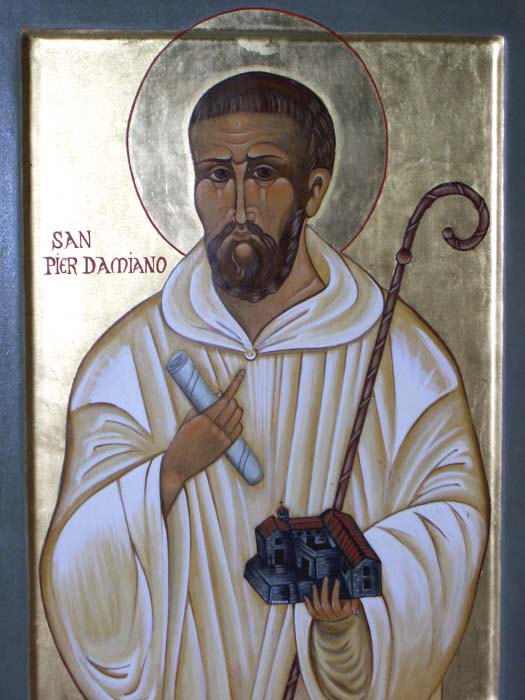
On the Life of St. Peter Damian
VATICAN CITY, MARCH 13, 2007 (Zenit.org).- Here is the Vatican translation of the Feb. 20 letter Benedict XVI sent to the Camaldolese Order.
* * *
LETTER OF HIS HOLINESS BENEDICT XVI
TO THE CAMALDOLESE ORDER
FOR THE FEAST OF SAINT PETER DAMIAN
To Rev. Fr Guido Innocenzo Gargano, Superior of the Monastery of San Gregorio al Celio
Today's Feast of St Peter Damian offers me the pleasant opportunity to address a cordial greeting to all the members of the worthy Camaldolese Order, as well as to those who admire and are inspired by the figure and work of this great Gospel witness. He was one of the protagonists of Medieval Church history and undoubtedly the most prolific writer of the 11th century.
The 1,000th anniversary of his birth is an especially appropriate occasion to examine closely the aspects characterizing his multifacetted personality as scholar, hermit and man of the Church, but especially as a person in love with Christ.
In his life, St Peter Damian was proof of a successful synthesis of hermitic and pastoral activity. As a hermit, he embodied that Gospel radicalism and unreserved love for Christ, so well expressed in the Rule of St Benedict: "Prefer nothing, absolutely nothing, to the love of Christ".
As a man of the Church, he worked with farsighted wisdom and when necessary also made hard and courageous decisions. The whole of his human and spiritual life was played out in the tension between his life as a hermit and his ecclesiastical duty.
St Peter Damian was above all a hermit, indeed, the last theoretician of the hermitic life in the Latin Church exactly at the time of the East-West schism. In his interesting work entitled The Life of Blessed Romuald, he left us one of the most significant fruits of the monastic experience of the undivided Church. For him, the hermitic life was a strong call to rally all Christians to the primacy of Christ and his lordship.
It is an invitation to discover Christ's love for the Church, starting from his relationship with the Father; a love that the hermit must in turn nourish with, for and in Christ, in regard to the entire People of God. St Peter Damian felt the presence of the universal Church in the hermitic life so strongly that he wrote in his ecclesiological treatise entitled Dominus Vobiscum that the Church is at the same time one in all and all in each one of her members.
This great holy hermit was also an eminent man of the Church who made himself available to move from the hermitage to go wherever his presence might be required in order to mediate between contending parties, were they Churchmen, monks or simple faithful.
Although he was radically focused on the unum necessarium, he did not shirk the practical demands that love for the Church imposed upon him. He was impelled by his desire that the Ecclesial Community always show itself as a holy and immaculate Bride ready for her heavenly Bridegroom, and expressed with a lively ars oratoria his sincere and disinterested zeal for the Church's holiness.
Yet, after each ecclesial mission he would return to the peace of the hermitage at Fonte Avellana and, free from all ambition, he even reached the point of definitively renouncing the dignity of Cardinal so as not to distance himself from his hermitic solitude, the cell of his hidden existence in Christ.
Lastly, St Peter Damien was the soul of the "Riforma gregoriana", which marked the passage from the first to the second millennium and whose heart and driving force was St Gregory VII. It was, in fact, a matter of the application of institutional decisions of a theological,disciplinary and spiritual character which permitted a greater libertas Ecclesiae in the second millennium. They restored the breath of great theology with reference to the Fathers of the Church and in particular, to St Augustine, St Jerome and St Gregory the Great. With his pen and his words he addressed all: he asked his brother hermits for the courage of a radical self-giving to the Lord which would as closely as possible resemble martyrdom; he demanded of the Pope, Bishops and ecclesiastics a high level of evangelical detachment from honours and privileges in carrying out their ecclesial functions; he reminded priests of the highest ideal of their mission that they were to exercise by cultivating purity of morals and true personal poverty.
In an age marked by forms of particularism and uncertainties because it was bereft of a unifying principle, Peter Damien, aware of his own limitations -- he liked to define himself as peccator monachus -- passed on to his contemporaries the knowledge that only through a constant harmonious tension between the two fundamental poles of life -- solitude and communion -- can an effective Christian witness develop. Does not this teaching also apply to our times? I gladly express the hope that the celebration of the Millennium of his birth may not only contribute to rediscovering the timeliness and depth of his thought and action, but may also be an appropriate opportunity for a personal and communitarian spiritual renewal, starting constantly from Jesus Christ, "the same yesterday and today and for ever" (Heb 13:8).
I assure a remembrance in prayer for you and for all the Camaldolese Monk Hermits to whom I send a special Apostolic Blessing, gladly extending it to all those who share their spirituality.
From the Vatican, 20 February 2007
BENEDICTUS PP. XVI
Catholic Encyclopedia:
Camaldolese
St. Peter Damian (SEP, Doctors of the Catholic Church)
Monastic community of Camaldoli
New Camaldoli Hermitage (Big Sur, CA)
Camaldolese Oblates
Wednesday, March 07, 2007
On St. Clement of Rome
"The Church Has a Sacramental, Not Political Structure"
VATICAN CITY, MARCH 7, 2007 (ZENIT.org).- Here is a translation of Benedict XVI's address at today's general audience. The Pope is beginning a new cycle of catecheses on the Apostolic Fathers, starting with St. Clement of Rome.
* * *
Dear Brothers and Sisters,
During the past few months we have meditated upon the figures of each individual apostle and the first witnesses of the Christian faith, those mentioned in the New Testament writings. Now, we will turn our attention to the Apostolic Fathers, that is, to the first and second generation of the Church after the apostles. This way we can see how the Church's path started in history.
St. Clement, Bishop of Rome during the last years of the first century, is the third successor of Peter, after Linus and Anacletus. The most important testimonial of his life is that written by St. Irenaeus, bishop of Lyon until 202. He asserts that Clement "had seen the apostles … had met with them," and "still had their preaching in his ears, and their tradition before his eyes" (Adv. Haer. 3,3,3). Later testimonials, between the fourth and sixth centuries, give Clement the title of martyr.
This Bishop of Rome's authority and prestige were such that various writings were attributed to him, but the only certain one is the Letter to the Corinthians.
Eusebius of Caesarea, the great "archivist" of Christian origins, presents it with these words: "One letter by Clement has been sent down to us recognized as authentic, great and admirable. It was written by him on behalf of the Church of Rome to the Church of Corinth. … We know that for a long time, and still today, this letter is read publicly during the reunions of the faithful" (Hist. Eccl. 3,16).
An almost canonical characteristic was attributed to this letter. At the beginning of the text, written in Greek, Clement is sorry if "the multiple and calamitous events" (1,1), made for a tardy intervention. These "events" can be identified with the persecution of Domitian; therefore, the date this letter was written goes back to a time directly after the death of the emperor and toward the end of the persecution, that is to say just after 96.
Clement's intervention -- we are still in the first century -- was called upon because of the serious problems the Church of Corinth was undergoing; the priests of the community, in fact, had been deposed by some young upstarts. The painful event is remembered, once again by St. Irenaeus who writes, "Under Clement, having given rise to a rather serious contrast between the Corinthian brothers, the Church of Rome sent the Corinthians a very important letter to reconcile them in peace to renew their faith and to announce the tradition, a tradition they had so newly received from the apostles" (Adv. Haer. 3,3,3).
Therefore, we could say that this letter is a first exercise of a Primate of Rome after the death of St. Peter. Clement's letter touches upon topics dear to St. Paul who had written two great letters to the Corinthians, in particular the theological dialectic, always pertinent, between the indicative of salvation and the imperative of moral commitment.
First, there is the proclamation of saving grace. The Lord foresees us and gives us forgiveness, gives us his love, the grace of being Christians, his brothers and sisters. This is an announcement that fills our life with joy and gives certitude to our actions. The Lord always foresees our acts with his goodness and the goodness of the Lord is always greater than all of our sins.
We must, however, commit ourselves in a coherent way to this gift that we have received and answer the proclamation of salvation with a generous and courageous path toward conversion. Looking at the Pauline model, the novelty is that Clement follows the doctrinal part and the practical part with a "great prayer," which practically concludes the letter.
The immediate occasion of the letter opened to the Bishop of Rome the possibility for vast intervention on the identity of the Church and its mission. If there were abuses in Corinth, Clement notes, the reason should be looked for in the weakening of charity and the necessary Christian virtues. This is why he calls all the faithful to humility and brotherly love, two virtues, truly the basis for being part of the Church. "We are the portion of the Holy One," he says, "let us do all those things which pertain to holiness" (30,1).
In particular, the Bishop of Rome recalls that the Lord himself, "where and by whom he desires these things to be done, he himself has fixed by his own supreme will, in order that all things, being piously done according to his good pleasure, may be acceptable unto him. … For his own peculiar services are assigned to the high priest, and their own proper place is prescribed to the priests and their own special ministrations devolve on the Levites. The layman is bound by the laws that pertain to the laymen" (40,1-5: note that here, in this letter from the end of the first century, for the first time in Christian literature the Greek term "laikós" appears which means "member of the laos," that is "the people of God").
This way, referring to the liturgy of ancient Israel, Clement reveals his ideal of the Church. This is gathered by his "one spirit of grace poured down upon us," which shows through the different members of the Body of Christ, in which all, joined without division are "members one of the other" (46,6-7).
The clear distinction between the "laymen" and the hierarchy does not mean, in any way, a contraposition but only the organic connection of a body, of an organism with different functions. In fact, the Church is not a place for confusion and anarchy, where someone can do whatever he wants at any time; each one in this organism with an articulated structure practices his ministry according to the vocation received.
As pertains to the heads of the communities, Clement specifies clearly the doctrine of apostolic succession. The laws that regulate this derive from God himself in an ultimate analysis. The Father sent Jesus Christ, who in turn sent the apostles. These then sent out the first heads of the communities, and established that they would be followed by worthy men. Therefore, all proceeds in "an orderly way, according to the will of the word of God" (42).
With these words, with these phrases, St. Clement underlines that the Church has a sacramental structure, not a political structure. God's actions that come to us in the liturgy precede our decisions and our ideas. The Church is above all a gift of God and not a creature of ours and therefore this sacramental structure not only guarantees the common order but also the precedence of the gift of God that we all need.
Finally, the "great prayer" confers a cosmic breath to the preceding discussion. Clement praises and thanks God for his great providence of love, who created the world and continued to save it and bless it. Particular relevance is given to the invocation for the governing body. After the New Testament texts, this represents the oldest prayer for political institutions. Thus, on the morrow of the persecution, Christians, well aware that the persecutions would continue, did not cease to pray for those very authorities that had condemned them unjustly.
The motive is above all Christological: One must pray for persecutors, as Jesus did on the cross. But this prayer also contains a teaching that guides, in the course of the centuries, the attitude of Christians in the face of politics and the state.
In praying for the authorities, Clement recognizes the legitimacy of the political institutions in the order established by God. At the same time, he manifests his concern that the authorities be docile to God and "exercise the power that God has given them in peace and gentleness with compassion" (61,2).
Caesar is not all. Another sovereignty emerges, whose origin and essence are not of this world, but "from above": It is that of Truth, which merits the right to be heard also in confrontations with the state."
Thus Clement's letter faces numerous themes of continuous actuality. This is more significant inasmuch as it represents, since the first century, solicitude of the Church of Rome, which presides in charity over all other churches.
With the same spirit we make our invocations as the "great prayer," where the Bishop of Rome becomes the voice for the entire world, "Yea, Lord, make your face to shine upon us for good in peace, that we may be shielded by your mighty hand ... we praise you through the high priest and guardian of our souls, Jesus Christ, through whom be glory and majesty to you both now and from generation to generation and for evermore. Amen" (60-61).
[Translation by ZENIT]
[At the end of the audience, the Pope greeted pilgrims in several languages. In English, he said:]
Dear Brothers and Sisters,
In our catechesis on the early Church, we now turn to the Apostolic Fathers. Saint Clement, Bishop of Rome and third successor of Peter, lived in the last years of the first century. He had met the apostles personally. Clement wrote an important letter to the Church in Corinth at a time when the Christian community was deeply divided. He encourages them to renew their faith in the message received from the apostles and to be reconciled with one another. In this way, he shows the essential connection between the content of the Gospel and the way we live. This connection is essential to Clement's ideal for the Church, in which the hierarchical structure is intrinsically ordered to the service of charity. Laity and hierarchy are not opposed, but organically connected in the mystery of the one body. According to Clement, not only the Church, but also the entire cosmos reflects God's providential love and mercy. Clement concludes his letter by praising God for this marvelous order. Let us join him as we beg the Lord to "make his face shine upon us in goodness and peace. Amen."
I offer a warm welcome to all the English-speaking visitors and pilgrims present at today's audience, especially the groups from Scotland, Denmark, Japan, Canada and the United States of America. May your pilgrimage renew your love for the Lord and his Church, and may God bless you all!
Subscribe to:
Posts (Atom)