On Chrysostom's Social Doctrine
"All Are Brothers and Sisters With Equal Rights"
VATICAN CITY, SEPT. 26, 2007 (Zenit.org).- Here is a translation of the address Benedict XVI delivered today at the general audience in St. Peter's Square. The reflection was a continuation of last week's commentary on St. John Chrysostom.
* * *
Dear brothers and sisters,
We continue our reflection today on St. John Chrysostom. After his time spent in Antioch, he was appointed in 397 the bishop of Constantinople, capital of the Eastern Roman Empire. From the beginning, John proposed a reform of his Church: The austerity of the bishop's palace would be an example to everyone -- clergy, widows, monks, people of the court and the rich. Unfortunately, many of those people, implicated by his judgments, distanced themselves from him.
Attentive to the poor, John was also called "the almsgiver." With careful administration, in fact, he was able to establish charitable institutions that were well appreciated. His initiatives in various fields caused some to view him as a dangerous rival. However, like a good pastor, he treated everyone in a kind and fatherly manner. In particular, he showed kindness toward women and dedicated special attention to marriages and the family. He invited the faithful to participate in liturgical life, which he made splendid and attractive with his creative genius.
Despite his goodness, his life was not serene. As pastor of the capital of the empire, he found himself often involved in political intrigues, because of his ongoing relationship with the authorities and civil institutions. On the ecclesiastical plane, moreover, given that he deposed six bishops in the year 401 in Asia who were unworthily elected, he was accused of having exceeded the limits of his own jurisdiction, and thus became a target of easy attacks.
Another cause of attacks against him was the presence in Constantinople of some refugee Egyptian monks, excommunicated by Patriarch Theophilus of Alexandria. Lively disagreement was started when Chrysostom criticized Empress Eudoxia and her courtiers, who responded by discrediting and insulting him. Thus, he was deposed at the synod organized by Patriarch Theophilus in 403, and condemned to a brief period of exile.
After his return, he caused more hostility by protesting the festivals in honor of the empress -- which the bishop considered lavish pagan festivals -- and banishing the priests who performed the baptisms in the Easter Vigil in 404. So began the persecution of Chrysostom and his followers, the so-called Johannites.
John explained the facts in a letter to the Bishop of Rome, Innocent I. But it was too late. In 406 he had to again go into exile, this time to Cucusa, in Armenia. The Pope was convinced of his innocence, but he did not have the power to help him. A council, called by Rome to pacify the two parts of the empire and between their two Churches, could not take place.
A difficult trip from Cucusa to Pythius, a destination that was never reached, was meant to impede the faithful from visiting him and to break the resistance of the worn-out prelate: The condemnation to exile was truly a condemnation to death!
The numerous letters from exile are moving. John speaks of his pastoral concerns with undertones of sorrow for the persecutions suffered by his followers. His march toward death came to an end in Comana in Pontus. There, the dying John was brought into the chapel of the martyr Basiliscus, where he gave forth his spirit to God and was buried, martyr next to martyr (Palladio, "Life" 119). It was Sept. 14, 407, feast of the Exaltation of the Holy Cross.
The reconciliation took place in 438 with Theodosius II. The relics of the saintly bishop, placed in the Church of the Apostles in Constantinople, were brought in 1204 to Rome, to the early Constantinian basilica, and now lie in the Chapel of the Choir of Canons of St. Peter's Basilica.
On Aug. 24, 2004, a large portion of the relics were given by Pope John Paul II to Patriarch Bartholomew I of Constantinople. The liturgical memorial of the saint is celebrated on Sept. 13. Blessed John XXIII proclaimed him patron saint of the Second Vatican Council.
It is said of John Chrysostom that, when he sat on the throne of the New Rome, that is, Constantinople, God revealed him as a second Paul, a doctor of the universe. But in reality, in Chrysostom, there is a substantial unity of thought and action, both in Antioch and in Constantinople. Only his role and situations change.
Meditating on the eight works carried out by God during six days, John Chrysostom, in his commentary on Genesis, desires to lead the faithful from creation to the Creator. "It is a great good," he says, "to know that which is creature and that which is Creator." He shows us the beauty of creation and the transparency of God in his creation, which thus becomes a sort of "staircase" to ascend to God, to know him.
But to this first step, he adds a second: This creator God is also the God of condescension ("synkatabasis"). We are weak in our "ascent"; our eyes are weak. And therefore God becomes the God of condescension, who sends a letter to fallen and foreign man, sacred Scripture. In this way, creation and Scripture compliment each other.
In light of Scripture, the letter that God gave us, we can decipher creation. God is called the "tender father" ("philostorgios") (ibid.), physician of souls (Homily 40:3 "On Genesis"), mother (ibid.) and affectionate friend ("On Providence" 8:11-12).
Added to the first step -- creation as a "staircase" leading to God -- and the second step -- the condescension of God through a letter that he has given us, sacred Scripture -- is a third step. God not only gives a letter: He himself descends, is incarnated, he truly becomes: "God with us," our brother unto death on a cross.
And to these three steps -- God is visible in creation, God gives us his letter, God comes down and becomes one of us -- is added a fourth and last step. Within the life and action of the Christian, the vital and dynamic principle is the Holy Spirit ("Pneuma"), which transforms the world's realities. God comes into our own existence through the Holy Spirit and transforms us from within our heart.
Against this backdrop, precisely in Constantinople, John, in his commentary on the Acts of the Apostles, proposes the model of the early Church (Acts 4:32-37) as a model for society, developing a social "utopia" (an "ideal city").
He proposed, in fact, to give a soul and Christian face to the city. In other words, Chrysostom understood that it is not enough to give alms, helping the poor now and then. Rather, it is necessary to establish a new structure, a new model of society, a model based on the New Testament perspective. It is this new society that is revealed in the nascent Church.
Therefore, John Chrysostom truly becomes one of the great Fathers of the Church's social doctrine: The old idea of the Greek "polis" is replaced with a new idea of a city inspired by the Christian faith. Chrysostom affirmed with Paul (cf. 1 Corinthians 8:11) the primacy of the individual Christian, of the person as a person, including the slave and the poor man. His project corrected the traditional Greek view of the "polis," of the city, in which large portions of the population were excluded from the rights of citizenship. In the Christian city, all are brothers and sisters with equal rights.
The primacy of the person is also a consequence of the fact that the city is constructed on the foundation of the person. In the Greek "polis," on the other hand, the country was more important than the individual, who was totally subordinated to the city as a whole. In this way, with Chrysostom, the vision of a society built by the Christian conscience begins. And he tells us that our "polis" is another, "our homeland is in heaven" (Philippians 3:20) and this homeland of ours, even on this earth, renders us all equals, brothers and sisters, and obligates us to solidarity.
At the end of his life, from his exile on the borders of Armenia, "the most remote place in the world," John, going back to his first sermon in 386, once again took up the theme so dear to him -- the plan of God for humanity. It is an "unutterable and incomprehensible" plan, but which is surely guided by him with love (cf. "On Providence" 2:6).
This is our certainty. Even if we cannot decode the details of personal and collective history, we know that God's plan is always inspired by love. Therefore, despite his sufferings, John Chrysostom reaffirmed the discovery that God loves every one of us with an infinite love, and therefore he desires the salvation of all.
For his part, the bishop-saint cooperated generously with this salvation, without holding anything back, throughout his entire life. In fact, he considered God's glory the ultimate goal of his existence, which -- as he was dying -- he left as his last testament: "Glory to God for everything!" (Palladio, "Life" 11).
[Translation by ZENIT]
[After the audience, the Holy Father addressed the audience in various languages. In English, he said:]
Dear Brothers and Sisters,
Today we continue our reflections on Saint John Chrysostom. In 397, when he became Bishop of Constantinople, he set an example to the people of the city by his simplicity of life and his constant concern for the poor. He did not hesitate to speak out against corrupt or pagan practices, even in the Imperial Court, and for this he was sent into exile. In his teaching, he showed how our wonder at the beauty of creation should lead us to give glory to the Creator. Yet God is also a tender father, a healer of souls and an affectionate friend. The Creator of the Universe loved us so much that he did not spare his only Son. The Holy Spirit also features prominently in Saint John's writings – the life-force that transforms the world and gives wings to those Christians who are docile to the Spirit's promptings. This authoritative teaching earned Saint John Chrysostom the title of a second Saint Paul, Teacher of the Universe. The exiled bishop continued until his death to proclaim the infinite love of God, who wants all to be saved. With his last breath he spoke of the ultimate end of human life – the glory of God. Let us learn from Saint John's example to love Christ in the poor and to bear faithful witness to the truth of the Gospel.
* * *
I extend a warm welcome to all the English-speaking visitors and pilgrims present at today's Audience, including groups from Britain and Ireland, New Zealand, Thailand, and North America. I greet in particular the new students from the Venerable English College and the priests from Ireland who are taking part in a renewal course here in Rome. May the time that you spend in this city deepen your love for Christ and his Church, and may God's blessings of peace and joy be with you always!
© Copyright 2007 -- Libreria Editrice Vaticana
Saturday, September 29, 2007
On Chrysostom's Social Doctrine

Thursday, September 20, 2007
On St. John Chrysostom's Antioch Years
On St. John Chrysostom's Antioch Years
"His Is an Exquisitely Pastoral Theology"
VATICAN CITY, SEPT. 19, 2007 (Zenit.org).- Here is a translation of the address Benedict XVI delivered today at the general audience in St. Peter's Square. The reflection focused on St. John Chrysostom.
* * *
Dear brothers and sisters,
This year marks the 16th centenary of the death of St. John Chrysostom (407-2007). John of Antioch was called Chrysostom, "golden-mouthed,” for his eloquence. It could be said he is still alive today through his written works. An anonymous copyist wrote that his works "go across the globe like lighting." His writings enable us -- as they did for the faithful of his time, who were repeatedly deprived of him because of his exiles -- to live with his books, despite his absence. This was the advice he himself gave in one of his letters written from exile (cf. "To Olympia, Letter” 8:45).
Born around the year 349 in Antioch in Syria (modern-day Antakya, in south Turkey), he carried out his priestly ministry for about 11 years. In 397, he was appointed bishop of Constantinople. He exercised the episcopal ministry in the capital of the empire, before his two exiles which happened within a few years of each other, between 403 and 407. Today we limit ourselves to considering Chrysostom's years in Antioch.
Orphaned by his father at a young age, he lived with his mother, Anthusa, who instilled in him an exquisite human sensitivity and a profound Christian faith. He completed his elementary and higher studies, crowned by courses in philosophy and rhetoric. Libanius, a pagan, was his teacher. At his school, John became the greatest orator of late Ancient Greece. Baptized in 368 and formed in the ecclesiastical life by Bishop Meletius, he was ordained as a lector by him in 371. This marked Chrysostom's official entrance into the ecclesiastical "cursus." He attended, from 367-372, the "Asceterium," a kind of seminary in Antioch, together with a group of young men, some of whom later became bishops, under the guidance of the famous exegete Diodorus of Tarsus, who taught John historical-literal exegesis, characteristic of the Antiochian tradition.
He retreated for four years among the hermitages on nearby Mount Silpius. And then he continued his retreat for another two years, living alone in a grotto under the guidance of an "elder." During that time he dedicated himself entirely to meditating on "the laws of Christ," the Gospels and especially Paul's letters. Falling ill, he found it impossible to take care of himself, and therefore he returned to the Christian community of Antioch (cf. Palladium, "Life” 5).
The Lord -- a biographer explains -- intervened at the right time to enable John to follow his true vocation. In effect, he himself would write that if he had to choose between the crosses of governing the Church or the tranquility of the monastic life, he would have preferred pastoral service a thousand times over (cf. "On the Priesthood," 6:7): Chrysostom felt called to this.
And here we see the decisive turning point of his vocation story: full-time pastor of souls! Intimacy with the Word of God, cultivated during the years in the hermitage, matured in him the irresistible urgency to preach the Gospel, to give to others what he received during years of meditation. The ideal missionary was thus launched, a soul afire, into pastoral care.
Between 378 and 379 he returned to the city. Ordained a deacon in 381 and a priest in 386, he became a celebrated preacher in the churches of his city. He gave homilies against the Arians, followed by those commemorating the martyrs of Antioch and others on principal liturgical feasts: constituting a great teaching of faith in Christ, in light of his saints.
The year 387 was John's "heroic year," the so-called statue revolt. The people knocked down the imperial statues, as a sign of protest against tax increases. During those days of Lent and anguish because of the emperor's punishments, he gave his 22 vibrant "Homilies on Statues," directed toward penance and conversion. What followed was a period of serene pastoral care (387-397).
Chrysostom is counted among the most prolific Fathers, having written 17 treatises, 700 authentic homilies, commentaries on Matthew and Paul (Letters to the Romans, to the Corinthians, to the Ephesians and to the Hebrews), and 241 letters. He was not a speculative theologian. However he transmitted the traditional and certain doctrine of the Church in an age of theological controversies caused above all by Arianism, that is, by the negation of Christ's divinity. He is therefore a trustworthy witness of the dogmatic development of the Church in the fourth-fifth century.
His is an exquisitely pastoral theology, in which there is constant concern for the coherence between the thought expressed by the word and lived existence. It is this, in particular, the common thread of the splendid catecheses, with which he prepared the catechumens to receive baptism. Just before he died, he wrote that man's value is found in the "exact knowledge of true doctrine and in rectitude of life” ("Letter From Exile”). The two things, knowledge of the truth and rectitude of life, go together: Knowledge must become life. Every one of his discourses aimed at developing in the faithful the exercise of intelligence, of true reason, in order to understand and put into practice moral needs and precepts of the faith.
John Chrysostom tried to assist, through his writings, the integral development of the person, in the physical, intellectual and religious dimension. The various phases of growth are comparable to as many seas in an immense ocean.
"The first of these seas is infancy” (Homily 81:5 "On the Gospel of Matthew”). Therefore "in this first stage inclinations to vice and virtue begin to show." That is why God's law must be impressed on the soul from the beginning "as on a table of wax” (Homily 3:1 "On the Gospel of John”). In fact this is the most important age. We must be aware how important it is that in this first phase of life the major orientations that give the right perspective to existence truly enter into man. Chrysostom therefore recommends: "From a very young age, arm children with spiritual weapons, and teach them to make the sign of the cross on their foreheads” (Homily 12:7 "On the First Letter to the Corinthians”).
Then follows adolescence and boyhood: "The sea of adolescence follows that of childhood, where violent winds blow … because concupiscence grows within us” (Homily 81:5 "On the Gospel of Matthew”).
Lastly there is engagement and marriage: "After boyhood comes the age of maturity, in which the duties of family life abound: It is the time to look for a wife” (ibid). He recalls the goals of marriage, enriching them -- with an appeal to the virtue of temperance -- with a rich tapestry of personalized relationships. Spouses who are well prepared block, in this way, the road to divorce: Everything is carried out joyfully and one can educate their children to virtue. When the first child is born, this is "like a bridge; the three become one flesh, so that the child links the two parts (Homily 12:5 "On the Letter to the Colossians”), and the three make up "one family, a little Church” (Homily 20:6 "On the Letter to the Ephesians”).
Chrysostom's preaching took place regularly during the liturgy, the "place” in which the community is built up by the word and the Eucharist. Here the assembly, gathered together, expresses the only Church (Homily 8:7 "On the Letter to the Romans”), the same word is addressed to everyone in every place (Homily 24:2 "On the First Letter to the Corinthians”), and the Eucharistic Communion becomes an efficacious sign of unity (Homily 32:7 "On the Gospel of St. Matthew”).
His pastoral project was inserted into the life of the Church, in which the lay faithful, through baptism, assume the priestly, kingly and prophetic office. To the lay faithful he said: "Baptism also makes you king, priest and prophet” (Homily 3:5 "On the Second Letter to the Corinthians”). From this comes the Church's fundamental task of mission, because each one in some way is responsible for the salvation of others: "This is the principle of our social life … to think not just of ourselves!” (Homily 9:2 "On Genesis”). Everything takes place between these two poles: the big Church and the "little Church," the family, in a reciprocal relationship.
As you can see, dear brothers and sisters, this lesson of Chrysostom on the authentically Christian presence of the lay faithful in the family and in society, is important today more than ever. Let us pray that the Lord render us docile to the lessons of this great teacher of the faith.
[Translation by ZENIT]
[At the end of the audience, the Pope greeted pilgrims in several languages. In English, he said:]
Dear Brothers and Sisters,
Our catechesis today focuses on a great orator of the early Church, Saint John Chrysostom: the "golden-mouthed". After his schooling in Antioch, Saint John went into the desert to meditate on the "law of Christ". Illness forced him to return to the city, where he heard the Lord calling him to full-time pastoral service. Years of prayer had prepared him to preach the Word of God with tremendous power and persuasion. Chrysostom constantly strove to connect Christian doctrine to daily living, emphasizing life-long human development in a person's physical, intellectual and religious dimensions. Fundamental to this is the first phase when parents must firmly impress God's law upon their children's souls. Young people will thus be strengthened to confront the "storms" of adolescence when they must learn to temper concupiscence and eventually to assume the duties of marriage. Indeed, Saint John taught that the family is a "little Church" within the wider ecclesial community. Consequently, each of us has a responsibility for the salvation of those around us. Through the intercession of this saintly Bishop, may we generously embrace this and all our responsibilities in the Church and in society.
I extend a cordial welcome to the English-speaking pilgrims present at today's audience, including groups from Viet Nam, India and Nigeria. I also greet the Catholic and Greek Orthodox pilgrims from the United States. May God bless all of you!
© Copyright 2007 -- Libreria Editrice Vaticana
Tuesday, September 11, 2007
Papal Address at Vespers
Papal Address at Vespers
A Reflection on the Evangelical Counsels
VIENNA, Austria, SEPT. 10, 2007 (Zenit.org).- Here is a Vatican translation of Benedict XVI's Saturday address at the celebration of vespers at the Shrine of Mariazell.
* * *
VESPERS WITH PRIESTS, RELIGIOUS, DEACONS AND SEMINARIANS
ADDRESS OF HIS HOLINESS BENEDICT XVI
Shrine of Mariazell
Saturday, 8 September 2007
Venerable and dear Brothers in the Priestly Ministry,
Dear Men and Women of Consecrated Life,
Dear Friends,
We have come together in the venerable Basilica of our Magna Mater Austriae in Mariazell. For many generations people have come to pray here to obtain the help of the Mother of God. We too are doing the same today. We want to join Mary in praising God's immense goodness and in expressing our gratitude to the Lord for all the blessings we have received, especially the great gift of the faith. We also wish to commend to Mary our heartfelt concerns: to beg her protection for the Church, to invoke her intercession for the gift of worthy vocations for Dioceses and religious communities, to implore her assistance for families and her merciful prayers for all those longing for freedom from sin and for the grace of conversion, and, finally, to entrust to Mary's maternal care our sick and our elderly. May the great Mother of Austria and of Europe bring all of us to a profound renewal of faith and life!
Dear friends, as priests, and as men and women religious, you are servants of the mission of Jesus Christ. Just as two thousand years ago Jesus called people to follow him, today too young men and women are setting out at his call, attracted by him and moved by a desire to devote their lives to serving the Church and helping others. They have the courage to follow Christ, and they want to be his witnesses. Being a follower of Christ is full of risks, since we are constantly threatened by sin, lack of freedom and defection. Consequently, we all need his grace, just as Mary received it in its fullness. We learn to look always, like Mary, to Christ, and to make him our criterion and measure. Thus we can participate in the universal saving mission of the Church, of which he is the head. The Lord calls priests, religious and lay people to go into the world, in all its complexity, and to cooperate in the building up of God's Kingdom. They do this in a great variety of ways: in preaching, in building communities, in the different pastoral ministries, in the practical exercise of charity, in research and scientific study carried out in an apostolic spirit, in dialogue with the surrounding culture, in promoting the justice willed by God and, in no less measure, in the recollected contemplation of the triune God and the common praise of God in their communities.
The Lord invites you to join the Church "on her pilgrim way through history". He is inviting you to become pilgrims with him and to share in his life which today too includes both the way of the Cross and the way of the Risen One through the Galilee of our existence. But he remains always one and the same Lord who, through the one Baptism, calls us to the one faith. Taking part in his journey thus means both things: the dimension of the Cross -- with failure, suffering, misunderstanding and even contempt and persecution -- , but also the experience of profound joy in his service and of the great consolation born of an encounter with him. Like the Church, individual parishes, communities and all baptized Christians find in their experience of the crucified and risen Christ the source of their mission.
At the heart of the mission of Jesus Christ and of every Christian is the proclamation of the Kingdom of God. Proclaiming the Kingdom in the name of Christ means for the Church, for priests, men and women religious, and for all the baptized, a commitment to be present in the world as his witnesses. The Kingdom of God is really God himself, who makes himself present in our midst and reigns through us. The Kingdom of God is built up when God lives in us and we bring God into the world. You do so when you testify to a "meaning" rooted in God's creative love and opposed to every kind of meaninglessness and despair. You stand alongside all those who are earnestly striving to discover this meaning, alongside all those who want to make something positive of their lives. By your prayer and intercession, you are the advocates of all who seek God, who are journeying towards God. You bear witness to a hope which, against every form of hopelessness, silent or spoken, points to the fidelity and the loving concern of God. Hence you are on the side of those who are crushed by misfortune and cannot break free of their burdens. You bear witness to that Love which gives itself for humanity and thus conquered death. You are on the side of all who have never known love, and who are no longer able to believe in life. And so you stand against all forms of injustice, hidden or apparent, and against a growing contempt for man. In this way, dear brothers and sisters, your whole life needs to be, like that of John the Baptist, a great, living witness to Jesus Christ, the Son of God incarnate. Jesus called John "a burning and shining lamp" (Jn 5:35). You too must be such lamps! Let your light shine in our society, in political and economic life, in culture and research. Even if it is only a flicker amid so many deceptive lights, it nonetheless draws its power and splendour from the great Morning Star, the Risen Christ, whose light shines brilliantly -- wants to shine brilliantly through us -- and will never fade.
Following Christ -- we want to follow him -- following Christ means taking on ever more fully his mind and his way of life; this is what the Letter to the Philippians tells us: "Let the same mind be in you that was in Christ!" (cf. 2:5). "To Look to Christ" is the theme of these days. In looking to him, the great Teacher of life, the Church has discerned three striking features of Jesus' basic attitude. These three features -- with the Tradition we call them the "evangelical counsels" -- have become the distinctive elements of a life committed to the radical following of Christ: poverty, chastity and obedience. Let us reflect now briefly on them.
Jesus Christ, who was rich with the very richness of God, became poor for our sake, as Saint Paul tells us in the Second Letter to the Corinthians (cf. 8:9); this is an unfathomable statement, one to which we should always return for further reflection. And in the Letter to the Philippians we read: He emptied himself; he humbled himself and became obedient even to death on a Cross (cf. 2:6ff.) The one who himself became poor, called the poor "blessed". Saint Luke, in his version of the Beatitudes, makes us understand that this statement -- calling the poor blessed -- certainly refers to the poor, the truly poor, in Israel at that time, where a sharp distinction existed between rich and poor. But Saint Matthew, in his version of the Beatitudes, explains to us that material poverty alone is not enough to ensure God's closeness, since the heart can be hard and filled with lust for riches. Matthew -- like all of Scripture -- lets us understand that in any case God is particularly close to the poor. So it becomes evident: in the poor Christians see the Christ who awaits them, who awaits their commitment. Anyone who wants to follow Christ in a radical way must renounce material goods. But he or she must live this poverty in a way centred on Christ, as a means of becoming inwardly free for their neighbour. For all Christians, but especially for us priests, and for religious, both as individuals and in community, the issue of poverty and the poor must be the object of a constant and serious examination of conscience. In our own situation, in which we are not badly off, we are not poor, I think that we ought to reflect particularly on how we can live out this calling in a sincere way. I would like to recommend it for your -- for our -- examination of conscience.
To understand correctly the meaning of chastity, we must start with its positive content. Once again, we find this only by looking to Christ. Jesus' life had a two-fold direction: he lived for the Father and for others. In sacred Scripture we see Jesus as a man of prayer, one who spends entire nights in dialogue with the Father. Through his prayer, he made his own humanity, and the humanity of us all, part of his filial relation to the Father. This dialogue with the Father thus became a constantly-renewed mission to the world, to us. Jesus' mission led him to a pure and unreserved commitment to men and women. Sacred Scripture shows that at no moment of his life did he betray even the slightest trace of self-interest or selfishness in his relationship with others. Jesus loved others in the Father, starting from the Father -- and thus he loved them in their true being, in their reality. Entering into these sentiments of Jesus Christ -- in this total communion with the living God and in this completely pure communion with others, unreservedly at their disposition -- this entering into the mind of Christ inspired in Paul a theology and a way of life consonant with Jesus' words about celibacy for the Kingdom of heaven (cf. Mt 19:12). Priests and religious are not aloof from interpersonal relationships. Chastity, on the contrary, means -- and this is where I wished to start -- an intense relationship; it is, positively speaking, a relationship with the living Christ and, on the basis of that, with the Father. Consequently, by the vow of celibate chastity we do not consecrate ourselves to individualism or a life of isolation; instead, we solemnly promise to put completely and unreservedly at the service of God's Kingdom -- and thus at the service of others - the deep relationships of which we are capable and which we receive as a gift. In this way priests and religious become men and women of hope: staking everything on God and thus showing that God for them is something real, they open up a space for his presence -- the presence of God's Kingdom -- in our world. Dear priests and religious, you have an important contribution to make: amid so much greed, possessiveness, consumerism and the cult of the individual, we strive to show selfless love for men and women. We are living lives of hope, a hope whose fulfilment we leave in God's hands, because we believe that he will fulfil it. What might have happened had the history of Christianity lacked such outstanding figures and examples? What would our world be like, if there were no priests, if there were no men and women in religious congregations and communities of consecrated life -- people whose lives testify to the hope of a fulfilment beyond every human desire and an experience of the love of God which transcends all human love? Precisely today, the world needs our witness.
We now come to obedience. Jesus lived his entire life, from the hidden years in Nazareth to the very moment of his death on the Cross in listening to the Father, in obedience to the Father. We see this in an exemplary way at Gethsemane. "Not my will, but yours be done". In this prayer Jesus takes up into his filial will the stubborn resistance of us all, and transforms our rebelliousness into his obedience. Jesus was a man of prayer. But at the same time he was also someone who knew how to listen and to obey: he became "obedient unto death, even death on a cross" (Phil 2:8). Christians have always known from experience that, in abandoning themselves to the will of the Father, they lose nothing, but instead discover in this way their deepest identity and interior freedom. In Jesus they have discovered that those who lose themselves find themselves, and those who bind themselves in an obedience grounded in God and inspired by the search for God, become free. Listening to God and obeying him has nothing to do with external constraint and the loss of oneself. Only by entering into God's will do we attain our true identity. Our world today needs the testimony of this experience precisely because of its desire for "self-realization" and "self-determination".
Romano Guardini relates in his autobiography how, at a critical moment on his journey, when the faith of his childhood was shaken, the fundamental decision of his entire life -- his conversion -- came to him through an encounter with the saying of Jesus that only the one who loses himself finds himself (cf. Mk 8:34ff.; Jn 12:25); without self-surrender, without self-loss, there can be no self-discovery or self-realization. But then the question arose: to what extent it is proper to lose myself? To whom can I give myself? It became clear to him that we can surrender ourselves completely only if by doing so we fall into the hands of God. Only in him, in the end, can we lose ourselves and only in him can we find ourselves. But then the question arose: Who is God? Where is God? Then he came to understand that the God to whom we can surrender ourselves is alone the God who became tangible and close to us in Jesus Christ. But once more the question arose: Where do I find Jesus Christ? How can I truly give myself to him? The answer Guardini found after much searching was this: Jesus is concretely present to us only in his Body, the Church. As a result, obedience to God's will, obedience to Jesus Christ, must be, really and practically, humble obedience to the Church. I think that this too is something calling us to a constant and deep examination of conscience. It is all summed up in the prayer of Saint Ignatius of Loyola -- a prayer which always seems to me so overwhelming that I am almost afraid to say it, yet one which, for all its difficulty, we should always repeat: "Take O Lord, and receive all my liberty, my memory, my understanding and my entire will. All that I have and all that I possess you have given me: I surrender it all to you; it is all yours, dispose of it according to your will. Give me only your love and your grace; with these I will be rich enough and will desire nothing more".
Dear brothers and sisters! You are about to return to those places where you live and carry out your ecclesial, pastoral, spiritual and human activity. May Mary, our great Advocate and Mother, watch over and protect you and your work. May she intercede for you with her Son, our Lord Jesus Christ. I thank you for your prayers and your labours in the Lord's vineyard, and I join you in praying that God will protect and bless all of you, and everyone, particularly the young people, both here in Austria and in the various countries from which many of you have come. With affection I accompany all of you with my blessing.
© Copyright 2007 -- Libreria Editrice Vaticana
Benedict XVI's Address at Heiligenkreuz Abbey
Benedict XVI's Address at Heiligenkreuz Abbey
"All People Have a Yearning for God"
VIENNA, Austria, SEPT. 10, 2007 (Zenit.org).- Here is a Vatican translation of the address Benedict XVI gave Sunday when he visited Heiligenkreuz Abbey.
* * *
APOSTOLIC VISIT TO AUSTRIA
Address of the Holy Father
Visit to Heiligenkreuz Abbey
Sunday, 9 September 2007
Most Reverend Father Abbot,
Venerable Brothers in the Episcopate,
Dear Cistercian Monks of Heiligenkreuz,
Dear Brothers and Sisters in Consecrated Life,
Distinguished Guests and Friends of the Monastery and the Academy,
Ladies and Gentlemen!
On my pilgrimage to the Magna Mater Austriae, I am pleased to visit this Abbey of Heiligenkreuz, which is not only an important stop on the Via Sacra leading to Mariazell, but the oldest continuously active Cistercian monastery in the world. I wished to come to this place so rich in history in order to draw attention to the fundamental directive of Saint Benedict, according to whose Rule Cistercians also live. Quite simply, Benedict insisted that "nothing be put before the divine Office".(1)
For this reason, in a monastery of Benedictine spirit, the praise of God, which the monks sing as a solemn choral prayer, always has priority. Monks are certainly not the only people who pray; others also pray: children, the young and the old, men and women, the married and the single -- all Christians pray. Or at least, they should!
In the life of monks, however, prayer takes on a particular importance: it is the heart of their calling. Their vocation is to be men of prayer. In the patristic period the monastic life was likened to the life of the angels. It was considered the essential mark of the angels that they are worshippers. Their very life is worship. This should hold true also for monks. Monks pray first and foremost not for any specific intention, but simply because God is worthy of being praised. "Confitemini Domino, quoniam bonus! -- Praise the Lord, for he is good, for his mercy is eternal!": so we are urged by a number of Psalms (e.g. Ps 106:1). Such prayer for its own sake, intended as pure divine service, is rightly called officium. It is "service" par excellence, the "sacred service" of monks. It is offered to the triune God who, above all else, is worthy "to receive glory, honour and power" (Rev 4:11), because he wondrously created the world and even more wondrously redeemed it.
At the same time, the officium of consecrated persons is also a sacred service to men and women, a testimony offered to them. All people have deep within their hearts, whether they know it or not, a yearning for definitive fulfilment, for supreme happiness, and thus, ultimately, for God. A monastery, in which the community gathers several times a day for the praise of God, testifies to the fact that this primordial human longing does not go unfulfilled: God the Creator has not placed us in a fearful darkness where, groping our way in despair, we seek some ultimate meaning (cf. Acts 17:27); God has not abandoned us in a desert void, bereft of meaning, where in the end only death awaits us. No! God has shone forth in our darkness with his light, with his Son Jesus Christ. In him, God has entered our world in all his "fullness" (cf. Col 1:19); in him all truth, the truth for which we yearn, has its source and summit.(2)
Our light, our truth, our goal, our fulfilment, our life -- all this is not a religious doctrine but a person: Jesus Christ. Over and above any ability of our own to seek and to desire God, we ourselves have already been sought and desired, and indeed, found and redeemed by him! The roving gaze of people of every time and nation, of all the philosophies, religions and cultures, encounters the wide open eyes of the crucified and risen Son of God; his open heart is the fullness of love. The eyes of Christ are the eyes of a loving God. The image of the Crucified Lord above the altar, whose romanesque original is found in the Cathedral of Sarzano, shows that this gaze is turned to every man and woman. The Lord, in truth, looks into the hearts of each of us.
The core of monasticism is worship -- living like the angels. But since monks are people of flesh and blood on this earth, Saint Benedict and Saint Bernardo added to the central command: "pray", a second command: "work". In the mind of Saint Benedict, part of monastic life, along with prayer, is work: the cultivation of the land in accordance with the Creator's will. Thus in every age monks, setting out from their gaze upon God, have made the earth live-giving and lovely. Their protection and renewal of creation derived precisely from their looking to God. In the rhythm of the ora et labora, the community of consecrated persons bears witness to the God who, in Christ, looks upon us, while human beings and the world, as God looks upon them, become good.
Monks are not the only ones who pray the officium; from the monastic tradition the Church has derived the obligation for all religious, and also for priests and deacons, to recite the Breviary. Here too, it is appropriate for men and women religious, priests and deacons -- and naturally Bishops as well -- to come before God in their daily "official" prayer with hymns and psalms, with thanksgiving and pure petition.
Dear brother priests and deacons, dear brothers and sisters in the consecrated life! I realize that discipline is needed, and sometimes great effort as well, in order to recite the Breviary faithfully; but through this officium we also receive many riches: how many times, in doing so, have we seen our weariness and despondency melt away! When God is faithfully praised and worshipped, his blessings are unfailing. In Austria, people rightly say: "Everything depends on God's blessing!".
Your primary service to this world must therefore be your prayer and the celebration of the divine Office. The interior disposition of each priest, and of each consecrated person, must be that of "putting nothing before the divine Office". The beauty of this inner attitude will find expression in the beauty of the liturgy, so that wherever we join in singing, praising, exalting and worshipping God, a little bit of heaven will become present on earth. Truly it would not be presumptuous to say that, in a liturgy completely centred on God, we can see, in its rituals and chant, an image of eternity. Otherwise, how could our forefathers, hundreds of years ago, have built a sacred edifice as solemn as this? Here the architecture itself draws all our senses upwards, towards "what eye has not seen, nor ear heard, nor the heart of man imagined: what God has prepared for those who love him" (1 Cor 2:9). In all our efforts on behalf of the liturgy, the determining factor must always be our looking to God. We stand before God -- he speaks to us and we speak to him. Whenever in our thinking we are only concerned about making the liturgy attractive, interesting and beautiful, the battle is already lost. Either it is Opus Dei, with God as its specific subject, or it is not. In the light of this, I ask you to celebrate the sacred liturgy with your gaze fixed on God within the communion of saints, the living Church of every time and place, so that it will truly be an expression of the sublime beauty of the God who has called men and women to be his friends.
The soul of prayer, ultimately, is the Holy Spirit. Whenever we pray, it is he who "helps us in our weakness, interceding for us with sighs too deep for words" (Rom 8:26). Trusting in these words of the Apostle Paul, I assure you, dear brothers and sisters, that prayer will produce in you the same effect which once led to the custom of calling priests and consecrated persons simply "spirituals" (Geistliche). Bishop Sailer of Regensburg once said that priests should be first and foremost spiritual persons. I would like to see a revival of the word "Geistliche". More importantly, though, the content of that word should become a part of our lives: namely, that in following the Lord, we become, by the power of the Spirit, "spiritual" men and women.
Austria (Österreich) is, in an old play on words, truly Klösterreich: a realm of monasteries and a land rich in monasteries. Your ancient abbeys whose origins and traditions date back many centuries are places where "God is put first". Dear friends, make this priority given to God ever more apparent to people! As a spiritual oasis, a monastery reminds today's world of the most important, and indeed, the only decisive thing: that there is an ultimate reason why life is worth living: God and his unfathomable love.
And I ask you, dear members of the faithful: see your abbeys and monasteries for what they are and always wish to be: not mere strongholds of culture and tradition, or even simple business enterprises. Structure, organization and finances are necessary in the Church too, but they are not what is essential. A monastery is above all this: a place of spiritual power. Coming to one of your monasteries here in Austria, we have the same impression as when, after a strenuous hike in the Alps, we finally find refreshment at a clear mountain spring… Take advantage of these springs of God's closeness in your country; treasure the religious communities, the monasteries and abbeys; and make use of the spiritual service that consecrated person are willing to offer you!
Finally, I have come also to visit the Academy, now the Pontifical Academy, which is 205 years old and which, in its new status, the Abbot has named after the present Successor of Peter. Important though it is that the discipline of theology be part of the universitas of knowledge through the presence of Catholic theological faculties in state universities, it is equally important that there should be academic institutions like your own, where there can be a deeper interplay between scientific theology and lived spirituality. God is never simply the "object" of theology; he is always its living "subject" as well. Christian theology, for that matter, is never a purely human discourse about God, but always, and inseparably, the logos and "logic" of God's self-revelation. For this reason scientific rationality and lived devotion are two necessarily complementary and interdependent aspects of study.
The father of the Cistercian Order, Saint Bernard, in his own day fought against the detachment of an objectivizing rationality from the main current of ecclesial spirituality. Our situation today, while different, nonetheless has notable similarities. In its desire to be recognized as a rigorously scientific discipline in the modern sense, theology can lose the life-breath given by faith. But just as a liturgy which no longer looks to God is already in its death throes, so too a theology which no longer draws its life-breath from faith ceases to be theology; it ends up as a array of more or less loosely connected disciplines. But where theology is practised "on bent knee", as Hans Urs von Balthasar (3) urged, it will prove fruitful for the Church in Austria and beyond.
This fruitfulness is shown through fostering and forming those who have vocations to the priesthood or the religious life. Today, if such a vocation is to be sustained faithfully over a lifetime, there is a need for a formation capable of integrating faith and reason, heart and mind, life and thought. A life devoted to following Christ calls for an integration of one's entire personality. Neglect of the intellectual dimension can give rise all too easily to a kind of superficial piety nourished mostly by emotions and sentiments, which cannot be sustained over a lifetime. Neglect of the spiritual dimension, in turn, can create a rarified rationalism which, in its coldness and detachment, can never bring about an enthusiastic self-surrender to God. A life devoted to following Christ cannot be built on such one-sided foundations; half-measures leave a person unhappy and, consequently, also spiritually barren. Each vocation to the religious life or to the priesthood is a treasure so precious that those responsible for it should do everything possible to ensure a formation which promotes both fides et ratio -- faith and reason, heart and mind.
At the advice of his son, Blessed Otto of Freising, who was my predecessor in the episcopal see of Freising, Saint Leopold of Austria founded your abbey in 1133, and called it Unsere Liebe Frau zum Heiligen Kreuz -- Our Lady of Holy Cross. This monastery is dedicated to Our Lady not simply by tradition -- like every Cistercian monastery --, but among you there burns the Marian flame of a Saint Bernard of Clairvaux. Bernard, who entered the monastery along with thirty of his companions, is a kind of patron saint of vocations. Perhaps it was because of his particular devotion to Our Lady that he exercised such a compelling and infectious influence on his many young contemporaries called by God. Where Mary is, there is the archetype of total self-giving and Christian discipleship. Where Mary is, there is the pentecostal breath of the Holy Spirit; there is new beginning and authentic renewal.
From this Marian sanctuary on the Via Sacra, I pray that all Austria's shrines will experience fruitfulness and further growth. Here, as at Mariazell, I would like, before leaving, to ask the Mother of God once more to intercede for all of Austria. In the words of Saint Bernard, I invite everyone to become a trusting child before Mary, even as the Son of God did: "Look to the star of the sea, call upon Mary … in danger, in distress, in doubt, think of Mary, call upon Mary. May her name never be far from your lips, or far from your heart … If you follow her, you will not stray; if you pray to her, you will not despair; if you turn your thoughts to her, you will not err. If she holds you, you will not fall; if she protects you, you need not fear; if she is your guide, you will not tire; if she is gracious to you, you will surely reach your destination". (4)
(1) Regula Benedicti 43,3.
(2) Cf. SECOND VATICAN ECUMENICAL COUNCIL, Gaudium et Spes, 22.
(3) Cf. HANS URS VON BALTHASAR, Theologie und Heiligkeit, an essay written in 1948, in Verbum Caro. Schriften zur Theologie I, Einsiedeln, 1960, 195-224.
(4) BERNARD OF CLAIRVAUX, In laudibus Virginis Matris, Homilia 2, 17.
© Copyright 2007 -- Libreria Editrice Vaticana
Papal Address at Vespers
Papal Address at Vespers
A Reflection on the Evangelical Counsels
VIENNA, Austria, SEPT. 10, 2007 (Zenit.org).- Here is a Vatican translation of Benedict XVI's Saturday address at the celebration of vespers at the Shrine of Mariazell.
* * *
VESPERS WITH PRIESTS, RELIGIOUS, DEACONS AND SEMINARIANS
ADDRESS OF HIS HOLINESS BENEDICT XVI
Shrine of Mariazell
Saturday, 8 September 2007
Venerable and dear Brothers in the Priestly Ministry,
Dear Men and Women of Consecrated Life,
Dear Friends,
We have come together in the venerable Basilica of our Magna Mater Austriae in Mariazell. For many generations people have come to pray here to obtain the help of the Mother of God. We too are doing the same today. We want to join Mary in praising God's immense goodness and in expressing our gratitude to the Lord for all the blessings we have received, especially the great gift of the faith. We also wish to commend to Mary our heartfelt concerns: to beg her protection for the Church, to invoke her intercession for the gift of worthy vocations for Dioceses and religious communities, to implore her assistance for families and her merciful prayers for all those longing for freedom from sin and for the grace of conversion, and, finally, to entrust to Mary's maternal care our sick and our elderly. May the great Mother of Austria and of Europe bring all of us to a profound renewal of faith and life!
Dear friends, as priests, and as men and women religious, you are servants of the mission of Jesus Christ. Just as two thousand years ago Jesus called people to follow him, today too young men and women are setting out at his call, attracted by him and moved by a desire to devote their lives to serving the Church and helping others. They have the courage to follow Christ, and they want to be his witnesses. Being a follower of Christ is full of risks, since we are constantly threatened by sin, lack of freedom and defection. Consequently, we all need his grace, just as Mary received it in its fullness. We learn to look always, like Mary, to Christ, and to make him our criterion and measure. Thus we can participate in the universal saving mission of the Church, of which he is the head. The Lord calls priests, religious and lay people to go into the world, in all its complexity, and to cooperate in the building up of God's Kingdom. They do this in a great variety of ways: in preaching, in building communities, in the different pastoral ministries, in the practical exercise of charity, in research and scientific study carried out in an apostolic spirit, in dialogue with the surrounding culture, in promoting the justice willed by God and, in no less measure, in the recollected contemplation of the triune God and the common praise of God in their communities.
The Lord invites you to join the Church "on her pilgrim way through history". He is inviting you to become pilgrims with him and to share in his life which today too includes both the way of the Cross and the way of the Risen One through the Galilee of our existence. But he remains always one and the same Lord who, through the one Baptism, calls us to the one faith. Taking part in his journey thus means both things: the dimension of the Cross -- with failure, suffering, misunderstanding and even contempt and persecution -- , but also the experience of profound joy in his service and of the great consolation born of an encounter with him. Like the Church, individual parishes, communities and all baptized Christians find in their experience of the crucified and risen Christ the source of their mission.
At the heart of the mission of Jesus Christ and of every Christian is the proclamation of the Kingdom of God. Proclaiming the Kingdom in the name of Christ means for the Church, for priests, men and women religious, and for all the baptized, a commitment to be present in the world as his witnesses. The Kingdom of God is really God himself, who makes himself present in our midst and reigns through us. The Kingdom of God is built up when God lives in us and we bring God into the world. You do so when you testify to a "meaning" rooted in God's creative love and opposed to every kind of meaninglessness and despair. You stand alongside all those who are earnestly striving to discover this meaning, alongside all those who want to make something positive of their lives. By your prayer and intercession, you are the advocates of all who seek God, who are journeying towards God. You bear witness to a hope which, against every form of hopelessness, silent or spoken, points to the fidelity and the loving concern of God. Hence you are on the side of those who are crushed by misfortune and cannot break free of their burdens. You bear witness to that Love which gives itself for humanity and thus conquered death. You are on the side of all who have never known love, and who are no longer able to believe in life. And so you stand against all forms of injustice, hidden or apparent, and against a growing contempt for man. In this way, dear brothers and sisters, your whole life needs to be, like that of John the Baptist, a great, living witness to Jesus Christ, the Son of God incarnate. Jesus called John "a burning and shining lamp" (Jn 5:35). You too must be such lamps! Let your light shine in our society, in political and economic life, in culture and research. Even if it is only a flicker amid so many deceptive lights, it nonetheless draws its power and splendour from the great Morning Star, the Risen Christ, whose light shines brilliantly -- wants to shine brilliantly through us -- and will never fade.
Following Christ -- we want to follow him -- following Christ means taking on ever more fully his mind and his way of life; this is what the Letter to the Philippians tells us: "Let the same mind be in you that was in Christ!" (cf. 2:5). "To Look to Christ" is the theme of these days. In looking to him, the great Teacher of life, the Church has discerned three striking features of Jesus' basic attitude. These three features -- with the Tradition we call them the "evangelical counsels" -- have become the distinctive elements of a life committed to the radical following of Christ: poverty, chastity and obedience. Let us reflect now briefly on them.
Jesus Christ, who was rich with the very richness of God, became poor for our sake, as Saint Paul tells us in the Second Letter to the Corinthians (cf. 8:9); this is an unfathomable statement, one to which we should always return for further reflection. And in the Letter to the Philippians we read: He emptied himself; he humbled himself and became obedient even to death on a Cross (cf. 2:6ff.) The one who himself became poor, called the poor "blessed". Saint Luke, in his version of the Beatitudes, makes us understand that this statement -- calling the poor blessed -- certainly refers to the poor, the truly poor, in Israel at that time, where a sharp distinction existed between rich and poor. But Saint Matthew, in his version of the Beatitudes, explains to us that material poverty alone is not enough to ensure God's closeness, since the heart can be hard and filled with lust for riches. Matthew -- like all of Scripture -- lets us understand that in any case God is particularly close to the poor. So it becomes evident: in the poor Christians see the Christ who awaits them, who awaits their commitment. Anyone who wants to follow Christ in a radical way must renounce material goods. But he or she must live this poverty in a way centred on Christ, as a means of becoming inwardly free for their neighbour. For all Christians, but especially for us priests, and for religious, both as individuals and in community, the issue of poverty and the poor must be the object of a constant and serious examination of conscience. In our own situation, in which we are not badly off, we are not poor, I think that we ought to reflect particularly on how we can live out this calling in a sincere way. I would like to recommend it for your -- for our -- examination of conscience.
To understand correctly the meaning of chastity, we must start with its positive content. Once again, we find this only by looking to Christ. Jesus' life had a two-fold direction: he lived for the Father and for others. In sacred Scripture we see Jesus as a man of prayer, one who spends entire nights in dialogue with the Father. Through his prayer, he made his own humanity, and the humanity of us all, part of his filial relation to the Father. This dialogue with the Father thus became a constantly-renewed mission to the world, to us. Jesus' mission led him to a pure and unreserved commitment to men and women. Sacred Scripture shows that at no moment of his life did he betray even the slightest trace of self-interest or selfishness in his relationship with others. Jesus loved others in the Father, starting from the Father -- and thus he loved them in their true being, in their reality. Entering into these sentiments of Jesus Christ -- in this total communion with the living God and in this completely pure communion with others, unreservedly at their disposition -- this entering into the mind of Christ inspired in Paul a theology and a way of life consonant with Jesus' words about celibacy for the Kingdom of heaven (cf. Mt 19:12). Priests and religious are not aloof from interpersonal relationships. Chastity, on the contrary, means -- and this is where I wished to start -- an intense relationship; it is, positively speaking, a relationship with the living Christ and, on the basis of that, with the Father. Consequently, by the vow of celibate chastity we do not consecrate ourselves to individualism or a life of isolation; instead, we solemnly promise to put completely and unreservedly at the service of God's Kingdom -- and thus at the service of others - the deep relationships of which we are capable and which we receive as a gift. In this way priests and religious become men and women of hope: staking everything on God and thus showing that God for them is something real, they open up a space for his presence -- the presence of God's Kingdom -- in our world. Dear priests and religious, you have an important contribution to make: amid so much greed, possessiveness, consumerism and the cult of the individual, we strive to show selfless love for men and women. We are living lives of hope, a hope whose fulfilment we leave in God's hands, because we believe that he will fulfil it. What might have happened had the history of Christianity lacked such outstanding figures and examples? What would our world be like, if there were no priests, if there were no men and women in religious congregations and communities of consecrated life -- people whose lives testify to the hope of a fulfilment beyond every human desire and an experience of the love of God which transcends all human love? Precisely today, the world needs our witness.
We now come to obedience. Jesus lived his entire life, from the hidden years in Nazareth to the very moment of his death on the Cross in listening to the Father, in obedience to the Father. We see this in an exemplary way at Gethsemane. "Not my will, but yours be done". In this prayer Jesus takes up into his filial will the stubborn resistance of us all, and transforms our rebelliousness into his obedience. Jesus was a man of prayer. But at the same time he was also someone who knew how to listen and to obey: he became "obedient unto death, even death on a cross" (Phil 2:8). Christians have always known from experience that, in abandoning themselves to the will of the Father, they lose nothing, but instead discover in this way their deepest identity and interior freedom. In Jesus they have discovered that those who lose themselves find themselves, and those who bind themselves in an obedience grounded in God and inspired by the search for God, become free. Listening to God and obeying him has nothing to do with external constraint and the loss of oneself. Only by entering into God's will do we attain our true identity. Our world today needs the testimony of this experience precisely because of its desire for "self-realization" and "self-determination".
Romano Guardini relates in his autobiography how, at a critical moment on his journey, when the faith of his childhood was shaken, the fundamental decision of his entire life -- his conversion -- came to him through an encounter with the saying of Jesus that only the one who loses himself finds himself (cf. Mk 8:34ff.; Jn 12:25); without self-surrender, without self-loss, there can be no self-discovery or self-realization. But then the question arose: to what extent it is proper to lose myself? To whom can I give myself? It became clear to him that we can surrender ourselves completely only if by doing so we fall into the hands of God. Only in him, in the end, can we lose ourselves and only in him can we find ourselves. But then the question arose: Who is God? Where is God? Then he came to understand that the God to whom we can surrender ourselves is alone the God who became tangible and close to us in Jesus Christ. But once more the question arose: Where do I find Jesus Christ? How can I truly give myself to him? The answer Guardini found after much searching was this: Jesus is concretely present to us only in his Body, the Church. As a result, obedience to God's will, obedience to Jesus Christ, must be, really and practically, humble obedience to the Church. I think that this too is something calling us to a constant and deep examination of conscience. It is all summed up in the prayer of Saint Ignatius of Loyola -- a prayer which always seems to me so overwhelming that I am almost afraid to say it, yet one which, for all its difficulty, we should always repeat: "Take O Lord, and receive all my liberty, my memory, my understanding and my entire will. All that I have and all that I possess you have given me: I surrender it all to you; it is all yours, dispose of it according to your will. Give me only your love and your grace; with these I will be rich enough and will desire nothing more".
Dear brothers and sisters! You are about to return to those places where you live and carry out your ecclesial, pastoral, spiritual and human activity. May Mary, our great Advocate and Mother, watch over and protect you and your work. May she intercede for you with her Son, our Lord Jesus Christ. I thank you for your prayers and your labours in the Lord's vineyard, and I join you in praying that God will protect and bless all of you, and everyone, particularly the young people, both here in Austria and in the various countries from which many of you have come. With affection I accompany all of you with my blessing.
© Copyright 2007 -- Libreria Editrice Vaticana
Friday, September 07, 2007
The Rule of St. Albert
The Carmelite Rule (alt)
carmelite.com > Spirituality > The Rule of St. Albert
Carmelite Sisters D.C.J. -- Rule of Carmel
The Rule of Saint Albert
Rule of St. Albert
RULE OF SAINT ALEBERT AND THE CONSTITUTIONS OF THE SECULAR ORDER ...
The Carmelite Web Site - O.Carm.
THE CARMELITE WAY OF LIFE: COMMEMORATING THE RULE OF ST ALBERT
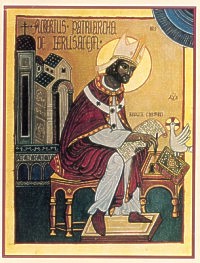

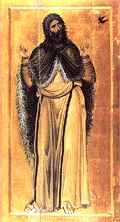
Saint Albert of Jerusalem, Bishop, and Lawgiver of Carmel
St. Albert of Jerusalem
St. Albert of Jerusalem
CIN
carmelite.com > Spirituality > The Rule of St. Albert
Carmelite Sisters D.C.J. -- Rule of Carmel
The Rule of Saint Albert
Rule of St. Albert
RULE OF SAINT ALEBERT AND THE CONSTITUTIONS OF THE SECULAR ORDER ...
The Carmelite Web Site - O.Carm.
THE CARMELITE WAY OF LIFE: COMMEMORATING THE RULE OF ST ALBERT
Saint Albert of Jerusalem, Bishop, and Lawgiver of Carmel
St. Albert of Jerusalem
St. Albert of Jerusalem
CIN
Thursday, September 06, 2007
Gregory of Nyssa on Perfection
Gregory of Nyssa on Perfection
"God Continually Expands the Possibilities of the Soul"
VATICAN CITY, SEPT. 5, 2007 (Zenit.org).- Here is a translation of the address Benedict XVI delivered today at the general audience in St. Peter's Square. The Holy Father continued his reflection focused on St. Gregory of Nyssa.
* * *
Dear Brothers and Sisters!
I offer you some aspects of St. Gregory of Nyssa's teaching, which we already talked about last Wednesday.
First of all, Gregory of Nyssa shows a highly elevated sense of man's dignity. Man's aim, says the bishop-saint, is to make himself like God, and he reaches this end above all through love, knowledge and the practice of the virtues, "luminous rays that come down from the divine nature" ("De beatitudinibus" 6: PG 44,1272C), in a perpetual and dynamic adherence to good, like a runner stretching forward.
Gregory uses, to this end, an effective image, already present in the Letter of Paul to the Philippians: "épekteinómenos" (3:13), which means "stretching oneself out" toward that which is greater, toward the truth and love.
This representative expression indicates a profound reality: The perfection we seek is not something that is conquered once and for all; perfection is a permanent journey, a constant commitment to progress, because complete likeness to God can never be achieved; we are always on the path (cf. "Homilia in Canticum" 12: PG 44,1025d).
The story of each soul is that of a love which is totally fulfilled, and at the same time open to new horizons, because God continually expands the possibilities of the soul, so as to make it capable of ever greater good. God himself, who placed the seeds of good within us, and from whom comes every initiative of holiness, "forms the block of clay … polishing and cleaning our spirit, forming Christ in us" ("In Psalmos" 2:11: PG 44,544B).
Gregory is careful to clarify: "It is not the result of our efforts, neither is it the result of human strength to become like the Deity, but rather it is the result of God's generosity, who even from his origin offered to our nature the grace of likeness with him" ("De virginitate" 12:2: SC 119,408-410).
For the soul, therefore, "it is not a matter of knowing something about God, but in having God within us" ("De beatitudinibus" 6: PG 44, 1269c). As Gregory notes, "divinity is purity, it is freedom from the passions and removal from all evil: If all these things are in you, God is truly in you" ("De beatitudinibus" 6: PG 44,1272C).
When we have God within us, when man loves God, through that reciprocity that is part of the law of love, he wants what God himself wants (cf. "Homilia in Canticum" 9: PG 44,956ac), and therefore cooperates in forming the divine image within himself, so that "our spiritual birth is the result of a free choice, and we are parents of ourselves in some way, creating ourselves as we want to be, and forming ourselves through our will according to the model we choose" ("Vita Moysis" 2:3: SC 1bis,108).
To ascend to God, man must be purified: "The path, that leads human nature to heaven, is nothing more than separation from the evils of this world. … Becoming like God means becoming just, holy and good. … If therefore, according to Ecclesiastes (5:1), 'God is in heaven' and if, according to the prophet (Psalm 72:28) you 'belong to God,' it necessarily follows that you must be there where God is, from the moment that you are united to him. Because he has commanded that, when you pray, you call God Father, he tells you to become like your heavenly Father, with a life worthy of God, as the Lord commands us more explicitly in other passages, saying: 'Be perfect as your heavenly Father is perfect!' (Matthew 5:48)" ("De oratione dominica" 2: PG 44,1145ac).
In this journey of spiritual ascent, Christ is the model and the master, who shows us the beautiful image of God (cf. "De perfectione Christiana": PG 46,272a). Looking at him, each one of us discovers ourselves to be "the painter of our own life," in which our will undertakes the work and our virtues are the colors at our disposal (ibid.: PG 46,272b).
Therefore, if man is considered worthy of Christ's name, how must he act?
Gregory responds in this way: "[He must] always examine his inner thoughts, his words and actions, to see if they are focused on Christ or if they are far from him" (ibid.: PG 46,284c).
Gregory, as we mentioned earlier, speaks of ascent: ascent to God in prayer through purity of heart; but ascent to God also through love of neighbor. Love is the ladder that leads us to God. Therefore, he heartily encourages each one his listeners: "Be generous with these brothers, victims of the plight. Give to the hungry that which you deny your own stomach" (ibid.: PG 46,457c).
With great clarity Gregory reminds us that we are all dependent on God, and therefore he exclaims: "Do not think that everything is yours! There must also be something for the poor, the friends of God. The truth, in fact, is that everything comes from God, the universal Father, and that we are brothers, and we belong to the same progeny" (ibid PG 46,465b).
And so the Christian must examine himself, Gregory insists: "What does it profit you to fast and abstain from meat, if with your wickedness you bite your brother? What do you gain from it, in God's eyes, from not eating what is yours, if you unjustly strip from the hands of a poor man what is his?" (ibid.: PG 46,456a).
We conclude our catecheses on the three great Cappadocian Fathers by recalling the important aspect of the spiritual doctrine of Gregory of Nyssa, which is prayer.
To make progress on the journey toward perfection and to welcome God within ourselves, to carry within us the Spirit of God, the love of God, man must turn to him in prayer with faith: "Through prayer we are able to be with God. He who is with God is far from the enemy. Prayer is the support and defense of chastity, the restraint of anger, the quieting and control of pride. Prayer is the guardian of virginity, protection of fidelity in marriage, hope for those who keep vigil, abundance of fruit for farmers, security for the traveler" ("De oratione dominica" 1: PG 44,1124A-B).
The Christian prays, inspired by the Lord's prayer: "If we want to pray for God's Kingdom to descend upon us, we ask this with the power of the Word: That I be removed from corruption, freed from death, released from the chains of error; that death will never reign over me, that the tyranny of evil will never have power over us, that the enemy never rule over me or make me a prisoner through sin, but may your kingdom come, so that the passions that rule me may be removed from me or, better yet, be obliterated" (ibid., 3: PG 44,1156d-1157a).
At the end of his earthly life, the Christian can approach God in serenity. In speaking about this, St. Gregory refers to the death of his sister Macrina and writes that at the moment of her death she prayed: "You who have the power on earth to remit sins forgive me, so that I can have the Risen One" (Psalm 38:14), and that I can be found spotless in your eyes, in the moment in which I am stripped of my body (cf. Collosians 2:11), so that my spirit, holy and immaculate (cf. Ephesians 5:27) will be welcomed into your hands, "like incense before you" (Psalm 140:2)" ("Vita Macrinae" 24: SC 178,224).
This teaching of Gregory's remains valid: not only speaking about God, but bringing God within us. We do this through prayer and by living in the spirit of love for all of our brothers.
[Translation by ZENIT]
[After the audience, the Holy Father addressed the audience in various languages. In English, he said:]
Dear Brothers and Sisters,
In our catechesis on the teachers of the early Church, we once again consider Saint Gregory of Nyssa, one of the great Cappadocian Fathers of the fourth century. At the heart of Saint Gregory's teaching is the innate dignity of every man and woman, made in the image of God and called to grow more fully into his likeness. Human fulfillment is found in a dynamic process of growth towards that perfection which has its fullness in God; daily we "press forward" (cf. Phil 3:13) towards union with God through love, knowledge and the cultivation of the virtues. This ascent to God calls for a process of purification which, by his grace, perfects our human nature and produces fruits of justice, holiness and goodness. In all of this, Jesus Christ, the perfect image of the Father, is our model and teacher. Gregory insists on Christ's presence in the poor, who challenge us to acknowledge our own dependence on God and to imitate his mercy. Finally, Gregory points to the importance of prayer modeled on the Lord's own prayer for the triumph of God's Kingdom. May his teaching inspire us to seek that holiness and purity of heart which will one day enable us to see God face to face!
* * *
I extend a warm welcome to all the English-speaking pilgrims and visitors here today, including the groups from England, Scotland, Ireland, Sweden, Japan, Korea and the United States. I thank you for the affection with which you have greeted me. Upon you all, I invoke God's blessings of joy and peace.
© Copyright 2007 -- Libreria Editrice Vaticana
Sunday, September 02, 2007
Interview with Mother Dolores Heart
Work and Prayer
Interview With the Prioress of Regina Laudis Abbey
BETHLEHEM, Connecticut, AUG. 30, 2007 (Zenit.org).- Adherence to the Benedictine tradition of work and prayer is the key to the success of the Abbey of Regina Laudis, according to its prioress, Mother Dolores Hart.
The Abbey of Regina Laudis is the topic of the recently released book "Mother Benedict," written by Antoinette Bosco and published by Ignatius Press.
Mother Benedict Duss founded the Benedictine monastery 60 years ago, after the Second World War. She died in 2005.
In this interview with ZENIT, Mother Dolores discusses the history of the monastery, her own personal journey from Hollywood film star to Benedictine nun, and the personality of the abbey's founder.
Q: Mother Benedict, the founder of the first contemplative Benedictine Abbey for women, is described in the book as strong and determined, but also a gardener, both of flowers and of souls. What was she able to accomplish through this unique set of personality traits?
Mother Dolores: Mother Benedict loved to garden. She said her ideal monastic life was gardening and studying.
God had other ideas, however, and she was driven to establish a foundation because she could see that is was what God wanted.
Mother Benedict was also a very creative, intelligent woman who cultivated many friendships and who always had time for a crisis.
Q: Can you explain the connections between General George Patton and the Abbey of Regina Laudis at the end of World War II?
Mother Dolores: General George Patton, Sr., liberated France as the commanding general of the Third Army. His was the army that liberated Jouarre, the abbey where Mother Benedict was in hiding.
Years later his granddaughter, the daughter of General George Patton, Jr., Mother Margaret Georgina Patton, found her way to the Abbey of Regina Laudis, and that began the conscious connection between the liberator and Mother Benedict.
This connection continues through the whole Patton family to this day.
Q: Many convents, during the turbulent time after the Second Vatican Council, were forced to close for one reason or another. What do you think kept Regina Laudis not only stable, but flourishing during that time?
Mother Dolores: Regina Laudis suffered its own turmoil during those years. What kept Mother Benedict going was her adherence to Benedictine tradition in work and prayer and a dedicated program of renewal, engaged in by the whole community.
For Mother Benedict this did not mean throwing everything out, but taking on perennial values with a new dedication.
Q: Your own life could be a story, going from a movie star, in roles opposite Elvis Presley and George Hamilton, to a cloistered Benedictine nun. In what way were you drawn from your Hollywood lifestyle, to the quiet, contemplative life at Regina Laudis?
Mother Dolores: My life will soon become a story by the good grace of my long time friend and collaborator, Dick DeNeut, who headed Globe photos in Hollywood for many years.
My good fortune was to have him as a professional contact who made certain that my reputation in the press never went the way of becoming a "starlet." I learned very early in my career that good complements held your life intact, and I was indeed graced.
Hal Wallis signed me to a seven-year contract when I was only 17. In those seven years to follow, I was the leading lady for Elvis Presley, Montgomery Clift and Stephen Boyd, and I learned my trade from such greats as Karl Malden, Anthony Quinn and Cyril Richard.
To experience the fullness of my profession through the gifts of these artists and many more who came my way in the short years of my time in Hollywood was a gift from God that I never had dreamed possible. Yet it was one I had prayed for since I was a small girl, watching the films on Saturday afternoons in my grandfather's movie projection booth.
I was watching for my Daddy who was an actor and had been whisked off to Hollywood by a talent scout because he looked like Clark Gable. I vowed that I would do this too.
But God had other plans for me. I had to acknowledge the vocation I had been trying to run from for years. I knew this the first time I came to Regina Laudis. I was finally home.
Q: In the preface of the book, you discuss Mother Benedict's wisdom on living out one's sexuality even under the vow of virginity. Can you describe her thoughts on this?
Mother Dolores: There is no contradiction between virginity and sexuality. To be truly virginal is to be fully oneself. To be fully a woman, one's sexuality must be integrated and expressed in all that one does.
This integration should lead to the ability to collaborate with men or women, lay or religious, in creative movements within the community or with laity, according to one's mission.
Sexuality is not limited to genital expression but pervades all we do. In a life dedicated to virginity the genital expression is sacrificed, but not the total giving of oneself to the mission.
Q: The book ends shortly after the death of Mother Benedict. Now, after nearly 60 years since the abbey's founding, how do things look today at the Abbey of Regina Laudis?
Mother Dolores: Today, the Abbey of Regina Laudis is blessed in a number of ways.
On July 11, the feast of St. Benedict, we were privileged to receive the archbishop of Hartford, His Excellency Henry Mansell, for an unprecedented ceremony of monastic consecration in which the archbishop consecrated five members of our community who had been married before they entered religious life. This was an enormous blessing for all of us.
We are also planning for the November release of our new CD, "The Announcement of Christmas," that celebrates our work in chant covering the season of Christmas from the beginning of Advent through the close of the season at Epiphany.
This will allow listeners to enjoy the musical treasures of the church's liturgy that are often hidden from the ears of everyday churchgoers. These time-honored chant melodies for centuries have so beautifully expressed the glory of Christ's continual coming through the ages in the Flesh of Humanity.
There is also our own birth, in August, as the community celebrates the ceremony of "clothing," which welcomes the entrance of a postulant into the novitiate, reminding us that Our Lady's gift of fecundity is ever-present in the growth of our own community.
And Regina Laudis remains hopeful for continuity as a new postulant has arrived to fill the new novice's place in the ranks.
We are reminded in Romans 5 that it is through faith that we are in grace and so we pray for this gift continually, that we may be worthy of him to whom we have pledged our lives.
Subscribe to:
Posts (Atom)