First Instruction
To those about to be illuminated; and for what reason the laver is said to be of regeneration and not of remission of sins; and that it is a dangerous thing not only to forswear oneself, but also to take an oath, even though we swear truly.
1. How delightful and lovable is our band of young brethren! For brethren I call you, even now before you have been brought forth, and before your birth I welcome this relationship with you: For I know, I know clearly, to how great an honour you are about to be led, and to how great a dignity; and those who are about to receive dignity, all are wont to honor, even before the dignity is conferred, laying up for themselves beforehand by their attention good will for the future. And this also I myself now do. For you are not about to be led to an empty dignity, but to an actual kingdom: and not simply to a kingdom, but to the kingdom of the Heavens itself. Wherefore I beseech and entreat you that you remember me when you come into that kingdom, and as Joseph said to the chief butler"Remember me when it shall be well with you," Genesis 40:14 this also I say now to you, do ye remember me when it is well with you. I do not ask this in return for interpreting your dreams, as he; for I have not come to interpret dreams for you, but to discourse of matters celestial, and to convey to you glad tidings of such good things as "eye has not seen, and ear has not heard and which have entered not into the heart of man, such are the things which God has prepared for them that love him." 1 Corinthians 2:9-10 Now Joseph indeed said to that chief butler, "yet three days and Pharaoh will restore you to your chief butlership." But I do not say, yet three days and you shall be set to pour out the wine of a tyrant, but yet thirty days, and not Pharaoh but the king of Heaven shall restore you to the country which is on high, Jerusalem, which is free—to the city which is in the heavens; and he said indeed, "You shall give the cup into the hands of Pharaoh." But I say not that you shall give the cup into the hands of the king, but that the king shall give the cup into your hand—that dread cup, full of much power, and more precious than any created thing. The initiated know the virtue of this cup, and you yourselves shall know it a little while hence. Remember me, therefore, when you come into that kingdom, when you receive the royal robe, when you are girt with the purple dipped in the master's blood, when you will be crowned with the diadem, which has lustre leaping forth from it on all sides, more brilliant than the rays of the sun. Such are the gifts of the Bridegroom, greater indeed than your worth, but worthy of his lovingkindness.
Wherefore, I count you blessed already before those sacred nuptials, and I do not only count you blessed, but I praise your prudence in that you have not come to your illumination as the most slothful among men, at your last breath, but already, like prudent servants, prepared with much goodwill to obey your master, have brought the neck of your soul with much meekness and readiness beneath the bands of Christ, and have received His easy yoke, and have taken His light burden. For if the grace bestowed be the same both for you and for those who are initiated at their last hour, yet the matter of the intention is not the same, nor yet the matter of the preparation for the rite. For they indeed receive it on their bed, but you in the bosom of the Church, which is the common mother of us all; they indeed with lamentation and weeping, but you rejoicing, and exceeding glad: they sighing, you giving thanks; they indeed lethargic with much fever, you filled with much spiritual pleasure; wherefore in your case all things are in harmony with the gift, but in theirs all are adverse to it. For there is wailing and much lamentation on the part of the initiated, and children stand around crying, wife tearing her cheeks, and dejected friends and tearful servants; the whole aspect of the house resembles some wintry and gloomy day. And if you shall open the heart of him who is lying there, you will find it more downcast than are these. For as winds meeting one another with many a contrary blast, break up the sea into many parts, so too the thought of the terrors preying upon him assail the soul of the sick man, and distract his mind with many anxieties. Whenever he sees his children, he thinks of their fatherless condition; whenever he looks from them to his wife, he considers her widowhood; when he sees the servants, he beholds the desolation of the whole house; when he comes back to himself, he calls to mind his own present life, and being about to be torn from it, experiences a great cloud of despondency. Of such a kind is the soul of him who is about to be initiated. Then in the midst of its tumult and confusion, the Priest enters, more formidable than the fever itself, and more distressing than death to the relatives of the sick man. For the entrance of the Presbyter is thought to be a greater reason for despair than the voice of the physician despairing of his life, and that which suggests eternal life seems to be a symbol of death. But I have not yet put the finishing stroke to these ills. For in the midst of relatives raising a tumult and making preparations, the soul has often taken its flight, leaving the body desolate; and in many cases, while it was present it was useless, for when it neither recognizes those who are present, nor hears their voice, nor is able to answer those words by which it will make that blessed covenant with the common master of us all, but is as a useless log, or a stone, and he who is about to be illuminated lies there differing nothing from a corpse, what is the profit of initiation in a case of such insensibility?
2. For he who is about to approach these holy and dread mysteries must be awake and alert, must be clean from all cares of this life, full of much self-restraint, much readiness; he must banish from his mind every thought foreign to the mysteries, and on all sides cleanse and prepare his home, as if about to receive the king himself. Such is the preparation of your mind: such are your thoughts; such the purpose of your soul. Await therefore a return worthy of this most excellent decision from God, who overpowers with His recompense those who show forth obedience to Him. But since it is necessary for his fellow servants to contribute of their own, then we will contribute of our own; yea rather not even are these things our own, but these too are our Master's."For what have you," says He, "that thou did not receive? but if you received it, why do you glory, as if you had not received it?" 1 Corinthians 4:7 I wished to say this first of all, why in the world our fathers, passing by the whole year, settled that the children of the Church should be initiated at this season; and for what reason, after the instruction from us, removing your shoes and raiment, unclad and unshod, with but one garment on, they conduct you to hear the words of the exorcisers. For it is not thoughtlessly and rashly that they have planned this dress and this season for us. But both these things have a certain mystic and secret reason. And I wish to say this to you. But I see that our discourse now constrains us to something more necessary to say what baptism is, and for what reason it enters into our life, and what good things it conveys to us.
But, if you will, let us discourse about the name which this mystic cleansing bears: for its name is not one, but very many and various. For this purification is called the laver of regeneration."He saved us," he says, "through the laver of regeneration, and renewing of the Holy Ghost." Titus 3:5 It is called also illumination, and this St. Paul again has called it, "For call to remembrance the former days in which after ye were illuminated ye endured a great conflict of sufferings;" Hebrews 10:32 and again, "For it is impossible for those who were once illuminated, and have tasted of the heavenly gift, and then fell away, to renew them again unto repentance." Hebrews 6:4-6 It is called also, baptism: "For as many of you as were baptized into Christ did put on Christ." Galatians 3:27 It is called also burial: "For we were buried" says he, "with him, through baptism, into death." Romans 6:4 It is called circumcision: "In whom you were also circumcised, with a circumcision not made with hands, in the putting off of the body of the sins of the flesh." Galatians 2:11 It is called a cross: "Our old man was crucified with him that the body of sin might be done away." Romans 6:6 It is also possible to speak of other names besides these, but in order that we should not spend our whole time over the names of this free gift, come, return to the first name, and let us finish our discourse by declaring its meaning; but in the meantime, let us extend our teaching a little further. There is that laver by means of the baths, common to all men, which is wont to wipe off bodily uncleanness; and there is the Jewish laver, more honorable than the other, but far inferior to that of grace; and it too wipes off bodily uncleanness but not simply uncleanness of body, since it even reaches to the weak conscience. For there are many matters, which by nature indeed are not unclean, but which become unclean from the weakness of the conscience. And as in the case of little children, masks, and other bugbears are not in themselves alarming, but seem to little children to be alarming, by reason of the weakness of their nature, so it is in the case of those things of which I was speaking; just as to touch dead bodies is not naturally unclean, but when this comes into contact with a weak conscience, it makes him who touches them unclean. For that the thing in question is not unclean naturally, Moses himself who ordained this law showed, when he bore off the entire corpse of Joseph, and yet remained clean. On this account Paul also, discoursing to us about this uncleanness which does not come naturally but by reason of the weakness of the conscience, speaks somewhat in this way, "Nothing is common of itself save to him who accounts anything to be common." Romans 14:14 Do you not see that uncleanness does not arise from the nature of the thing, but from the weakness of the reasoning about it? And again: "All things indeed are clean, howbeit it is evil to that man who eats with offense." Romans 14:20 Do you see that it is not to eat, but to eat with offense, that is the cause of uncleanness?
3. Such is the defilement from which the laver of the Jews cleansed. But the laver of grace, not such, but the real uncleanness which has introduced defilement into the soul as well as into the body. For it does not make those who have touched dead bodies clean, but those who have set their hand to dead works: and if any man be effeminate, or a fornicator, or an idolator, or a doer of whatever ill you please, or if he be full of all the wickedness there is among men: should he fall into this pool of waters, he comes up again from the divine fountain purer than the sun's rays. And in order that you may not think that what is said is mere vain boasting, hear Paul speaking of the power of the laver,"Be not deceived: neither idolators, nor fornicators, nor adulterers, nor effeminate, nor abusers of themselves with men, nor covetous, not drunkards, not revilers, not extortioners shall inherit the kingdom of God." 1 Corinthians 6:9-10 And what has this to do with what has been spoken? says one, "for prove the question whether the power of the laver thoroughly cleanses all these things." Hear therefore what follows: "And such were some of you, but ye were washed, but ye were sanctified, but ye were justified in the name of the Lord Jesus Christ, and in the spirit of our God." We promise to show you that they who approach the laver become clean from all fornication: but the word has shown more, that they have become not only clean, but both holy and just, for it does not say only "ye were washed," but also "ye were sanctified and were justified." What could be more strange than this, when without toil, and exertion, and good works, righteousness is produced? For such is the lovingkindness of the Divine gift that it makes men just without this exertion. For if a letter of the Emperor, a few words being added, sets free those who are liable to countless accusations, and brings others to the highest honors; much rather will the Holy Spirit of God, who is able to do all things, free us from all evil and grant us much righteousness, and fill us with much assurance, and as a spark falling into the wide sea would straightway be quenched, or would become invisible, being overwhelmed by the multitude of the waters, so also all human wickedness, when it falls into the pool of the divine fountain, is more swiftly and easily overwhelmed, and made invisible, than that spark. And for what reason, says one, if the laver take away all our sins, is it called, not a laver of remission of sins, nor a laver of cleansing, but a laver of regeneration? Because it does not simply take away our sins, nor simply cleanse us from our faults, but so as if we were born again. For it creates and fashions us anew not forming us again out of earth, but creating us out of another element, namely, of the nature of water. For it does not simply wipe the vessel clean, but entirely remoulds it again. For that which is wiped clean, even if it be cleaned with care, has traces of its former condition, and bears the remains of its defilement, but that which falls into the new mould, and is renewed by means of the flames, laying aside all uncleanness, comes forth from the furnace, and sends forth the same brilliancy with things newly formed. As therefore any one who takes and recasts a golden statue which has been tarnished by time, smoke, dust, rust, restores it to us thoroughly cleansed and glistening: so too this nature of ours, rusted with the rust of sin, and having gathered much smoke from our faults, and having lost its beauty, which He had from the beginning bestowed upon it from himself, God has taken and cast anew, and throwing it into the waters as into a mould, and instead of fire sending forth the grace of the Spirit, then brings us forth with much brightness, renewed, and made afresh, to rival the beams of the sun, having crushed the old man, and having fashioned a new man, more brilliant than the former.
4. And speaking darkly of this crushing, and this mystic cleansing, the prophet of old said, "You shall dash them in pieces like a potter's vessel." For that the word is in reference to the faithful, what goes before sufficiently shows us, "For you are my Son," he says, "today have I begotten you, ask of me and I will give the heathen for three inheritance, the utmost parts of the earth for your possession." Do you see how he has made mention of the church of the Gentiles, and has spoken of the kingdom of Christ extended on all sides? Then he says again, "You shall rule them with a rod of iron;" not grievous, but strong: "you shall break them in pieces like a potter's vessel." Behold then, the laver is more mystically brought forward. For he does not say earthen vessels: but vessels of the potter. But, give heed: For earthen vessels when crushed would not admit of refashioning, on account of the hardness which was gained by them from the fire. But the fact is that the vessels of the potter are not earthen, but of clay; wherefore, also, when they have been distorted, they can easily, by the skill of the artificer, be brought again to a second shape. When, therefore, God speaks of an irremediable calamity, he does not say vessels of the potter, but an earthen vessel; when, for instance, he wished to teach the prophet and the Jews that he delivered up the city to an irremediable calamity, he bade him take an earthen wine-vessel, and crush it before all the people, and say,"Thus shall this city be destroyed, be broken in pieces." But when he wishes to hold out good hopes to them, he brings the prophet to a pottery, and does not show him an earthen vessel, but shows him a vessel of clay, which was in the hands of the potter, falling to the ground: and brings him to it saying," If this potter has taken up and remodelled his vessel which has fallen, shall I not much rather be able to restore you when you have fallen?" It is possible therefore for God not only to restore those who are made of clay, through the laver of regeneration, but to bring back again to their original state, on their careful repentance, those who have received the power of the Spirit, and have lapsed. But this is not the time for you to hear words about repentance, rather may the time never come for you to fall into the need of these remedies, but may you always remain in preservation of the beauty and the brightness which you are now about to receive, unsullied. In order, then, that you may ever remain thus, come and let us discourse to you a little about your manner of life. For in the wrestling schools falls of the athletes are devoid of danger. For the wrestling is with friends, and they practice all their exercises on the persons of their teachers. But when the time of the contest has come, when the lists are open, when the spectators are seated above, when the president has arrived, it necessarily follows that the combatants, if they become careless, fall and retire in great disgrace, or if they are in earnest, win the crowns and the prizes. So then, in your case these thirty days are like some wrestling school, both for exercise and practice: let us learn from thence already to get the better of that evil demon. For it is to contend with him that we have to strip ourselves, with him after baptism are we to box and fight. Let us learn from thence already his grip, on what side he is aggressive, on what side he can easily threaten us, in order that, when the contest comes on, we may not feel strange, nor become confused, as seeing new forms of wrestling; but having already practiced them amongst ourselves, and having learned all his methods, may engage in these forms of wrestling against him with courage. In all ways, therefore, is he accustomed to threaten us, but especially by means of the tongue, and the mouth. For there is no organ so convenient for him for our deception and our destruction as an unchastened tongue and an unchecked utterance. Hence come many slips on our part: hence many serious accusations against us. And the ease of these falls through the tongue a certain one showed, when he said,"Many fell by the sword, but not so many as by the tongue." Sirach 28:22 Now the gravity of the fall the same person shows us again when he says: "To slip upon a pavement is better than to slip with the tongue." Sirach 20:18 And what he speaks of is of this kind. Better it is, says he, that the body should fall and be crushed, than that such a word should go forth as destroys the soul; and he does not speak of falls merely; he also admonishes us that much forethought should be exercised, so that we should not be tripped up, thus saying"Make a door and bars for your mouth," Sirach 20:25 not that we should prepare doors and bars, but that with much security, we should shut the tongue off from outrageous words; and again in another place, after showing that we need influence from above, both as accompanying and preceding our own effort so as to keep this wild beast within: stretching forth his hands to God, the prophet said, "Let the lifting up of my hands be an evening sacrifice, set a watch, O Lord, before my mouth, keep the door of my lips;" and he who before admonished, himself too says again "Who shall set a watch before my mouth, and a seal of wisdom upon my lips?" Sirach 22:27 Do you not see, each one fearing these falls and bewailing them, both giving advice, and praying that the tongue may have the benefit of much watchfulness? and for what reason, says one, if this organ brings us such ruin, did God originally place it within us? Because indeed, it is of great use, and if we are careful, it is of use only, and brings no ruin. Hear, for example, what he says who spoke the former words,"Death and life are in the power of the tongue." Proverbs 18:21 And Christ points to the same thing when he says, "By your words you shall be condemned, and by your words you shall be justified." Mark 12:27 For the tongue stands in the midst ready for use on either hand. You are its master. Thus indeed a sword lies in the midst, and if thou use it against your enemies, this organ becomes a means of safety for you. But if thou thrust its stroke against yourself, not the nature of the iron, but your own transgression becomes the cause of your slaughter. Let us then take this view of the tongue. It is a sword lying in the midst; sharpen it for the purpose of accusing your own sins. Thrust not the stroke against your brother. For this reason God surrounded it with a double fortification; with the fence of the teeth and the barrier of the lips, that it may not rashly and without circumspection utter words which are not convenient. Well, do you say it will not endure this? Bridle it therefore within. Restrain it by means of the teeth, as though giving over its body to these executioners and making them bite it. For it is better that when it sins now it should be bitten by the teeth, than one day when it seeks a drop of water and is parched with heat, to be unable to obtain this consolation. In many other ways indeed it is wont to sin, by raillery and blasphemy, by uttering foul words, by slander, swearing, and perjury.
5. But in order that we may not by saying everything at once today, confuse your minds, we put before you one custom, namely, about the avoidance of oaths, saying this much by way of preface, and speaking plainly—that if you do not avoid oaths, I say not perjury merely, but those too which happen in the cause of justice, we shall not further discourse upon any other subject. For it is monstrous that teachers of letters should not give a second lesson to their children until they see the former one fixed well in their memory, but that we, without being able to express our first lessons clearly, should inculcate others before the first are completed. For this is nothing else than to pour into a perforated jar. Give great care, then, that you silence not our mouth. For this error is grave, and it is exceedingly grave because it does not seem to be grave, and on this account I fear it, because no one fears it. On this account the disease is incurable, because it does not seem to be a disease; but just as simple speech is not a crime, so neither does this seem to be a crime, but with much boldness this transgression is committed: and if any one call it in question, straightway laughter follows, and much ridicule, not of those who are called in question for their oaths, but of those who wish to rectify the disease. On this account I largely extend my discourse about these matters. For I wish to pull up a deep root, and to wipe out a long-standing evil: I speak not of perjury alone, but even of oaths in good faith. But so and so, says one, a forbearing man, consecrated to the priesthood, living in much self-control and piety, takes an oath. Do not speak to me of this forbearing person, this self-controlled, pious man who is consecrated to the priesthood; but if you will, add that this man is Peter, or Paul, or even an angel descended out of heaven. For not even in such a case do I regard the dignity of their persons. For the law which I read upon oaths, is not that of the servant, but of the King: and when the edicts of a king are read, let every claim of the servants be silent. But if you are able to say that Christ bade us use oaths, or that Christ did not punish the doing of this, show me, and I am persuaded. But if he forbids it with so much care, and takes so much thought about the matter as to class him who takes an oath with the evil one (for whatsoever is more than these, namely, than yea and nay, says he, is of the devil), Matthew 5:35 why do you bring this person and that person forward? For not because of the carelessness of your fellow servants, but from the injunctions of his own laws, will God record his vote against you. I have commanded, he says, you ought to obey, not to shelter yourself behind such and such a person and concern yourself with other persons' evil. Since the great David sinned a grievous sin, is it then safe for us to sin? Tell me: on this account then we ought to make sure of this point, and only to emulate the good works of the saints; and if there is carelessness, and transgression of the law anywhere, we ought to flee from it with great care. For our reckoning is not with our fellow-servants, but with our Master, and to him we shall give account for all done in our life. Let us prepare ourselves therefore for this tribunal. For even if he who transgresses this law be beyond everything revered and great, he shall certainly pay the penalty attaching to the transgression. For God is no respecter of persons. How then and in what way is it possible to flee from this sin? For one ought to show not only that the crime is grievous, but to give counsel how we may escape from it. Have you a wife, have you a servant, children, friends, acquaintance, neighbors? To all these enjoin caution on these matters. Custom is a grievous thing, terrible to supplant, and hard to guard against, and it often attacks us unwilling and unknowing; therefore in so far as you know the power of custom, to such an extent study to be freed from any evil custom, and transfer yourself to any other most useful one. For as that custom is often able to trip you up, though you are careful, and guardest yourself, and takest thought, and consideration, so if you transfer yourself to the good custom of abstaining from oaths, you will not be able, either involuntarily or carelessly, to fall into the fault of oaths. For custom is really great and has the power of nature. In order then that we do not continually distress ourselves let us transfer ourselves to another custom, and ask thou each one of your kindred and acquaintance this favor, that he advise you and exhort you to flee from oaths, and reprove you, when detected in them. For the watch over you which takes place on their part, is to them too counsel and a suggestion to what is right. For he who reproves another for oaths, will not himself easily fall into this pit. For much swearing is no ordinary pit, not only when it is about little matters but about the greatest. And we, whether buying vegetables, or quarrelling over two farthings, or in a rage with our servants and threatening them, always call upon God as our witness. But a freeman, possessed of some barren dignity, you would not dare to call upon as witness in the market to such things; but even if you attempted it, you will pay the penalty of thine insolence. But the King of Heaven, the Lord of Angels, when disputing both about purchases and money, and what not, you drag in for a testimony. And how can these things be borne? whence then should we escape from this evil custom? After setting those guards of which I spoke round us, let us fix on a specified time to ourselves for amendment, and adding thereto condemnation if, when the time has passed, we have not amended this. How long time will suffice for the purpose? I do not think that they who are very wary, and on the alert, and watchful about their own salvation, should need more than ten days, so as to be altogether free from the evil custom of oaths. But if after ten days we be detected swearing, let us add a penalty due to ourselves, and let us fix upon the greatest punishment and condemnation of the transgression; what then is this condemnation? This I do not fix upon, but will suffer you yourselves to determine the sentence. So we arrange matters in our own case, not only in respect of oaths but in respect of other defects, and fixing a time for ourselves, with most grievous punishments, if at any time we have fallen into them, shall come clean to our Master, and shall escape the fire of hell, and shall stand before the judgment seat of Christ with boldness, to which may we all attain, by the grace and lovingkindness of our Lord Jesus Christ, with whom be glory to the Father together with the Holy Spirit for ever and ever: Amen.
Second Instruction
To those about to be illuminated; and concerning women who adorn themselves with plaiting of hair, and gold, and concerning those who have used omens, and amulets, and incantations, all which are foreign to Christianity.
1. I have come to ask first of all for some fruit in return for the words lately said out of brotherly love to you. For we do not speak in order that you should hear simply, but in order that you should remember what has been said, and may afford us evidence of this, by your works. Yea, rather, not us, but, God, who knows the secrets of the heart. On this account indeed instruction is so called, in order that even when we are absent, our discourse may instruct your hearts. And be not surprised if, after an interval of ten days only, we have come asking for fruit from the seed sown. For in one day it is possible at once to let the seed fall, and to accomplish the harvest. For strengthened not by our own power alone, but by the influence which comes from God, we are summoned to the conflict. Let as many therefore as have received what has been spoken, and have fulfilled it by their works, remain reaching forth to the things which are before. But let as many as have not yet arrived at this good achievement, arrive at it straightway, that they may dispel the condemnation which arises out of their sloth by their diligence for the future. For it is possible, it is indeed possible for him who has been very slothful, by using diligence for the future to recover the whole loss of the time that is past. Wherefore, He says,"Today if you will hear his voice, harden not your hearts, as in the day of provocation." And this, He says, exhorting and counselling us; that we should never despair, but so long as we are here, should have good hopes, and should lay hold on what is before us, and hasten towards the prize of our high calling of God. This then let us do, and let us inquire into the names of this great gift. For as ignorance of the greatness of this dignity makes those who are honored with it more slothful, so when it is known it renders them thankful, and makes them more earnest; and anyhow it would be disgraceful and ridiculous that they who enjoy such glory and honors from God, should not even know what the names of it are intended to show forth. And why do I speak about this gift, for if you will consider the common name of our race, you will receive the greatest instruction and incentive to virtue. For this name"Man," we do not define according as they who are without define it, but as the Divine Scripture has bidden us. For a man is not merely whosoever has hands and feet of a man, nor whosoever is rational only, but whosoever practices piety and virtue with boldness. Hear, at least, what he says concerning Job. For in saying that"there was a man in the land of Ausis," he does not describe him in those terms in which they who are without describe him, nor does he say this because he had two feet and broad nails, but he added the evidences of his piety and said,"just, true, fearing God, eschewing every evil deed," Job 1:1 showing that this is a man; even as therefore another says, "Fear God, and keep his commandments, because this is the whole man." Ecclesiastes 12:13 But if the name man affords such a great incentive to virtue, much rather the term faithful. For you are called faithful on this account, because you have faith in God, and yourself art entrusted from Him with righteousness, sanctification, cleansing of soul, adoption, the kingdom of heaven. He entrusted you with these, and handed them over to you. Thou in turn hast entrusted, and handed over other things to him, almsgiving, prayers, self-control and every other virtue. And why do I say almsgiving? If you give him even a cup of cold water, you shall not indeed lose this, but even this he keeps with care against that day, and will restore it with overflowing abundance. For this truly is wonderful, that he does not keep only that which has been entrusted to him, but in recompensing it increases it.
This too he has bidden you do according to your power, with what has been entrusted to you, to extend the holiness which you have received, and to make the righteousness which comes from the laver brighter, and the gift of grace more radiant; even as therefore Paul did, increasing all the good things which he received by his subsequent labors, and his zeal, and his diligence. And look at the carefulness of God; neither did he give the whole to you then, nor withhold the whole, but gave part, and promised part. And for what reason did he not give the whole then? In order that you might show your faith about Him, believing, on his promise alone, in what was not yet given. And for what reason again did he not there dispense the whole, but did give the grace of the Spirit, and righteousness and sanctification? In order that he might lighten your labors for you, and by what has been already given may also put you in good hope for that which is to come. On this account, too, you are about to be called newly-enlightened, because your light is ever new, if you will, and is never quenched. For this light of day, whether we will or no, the night succeeds, but darkness knows not that light's ray. "For the light shines in the darkness, and the darkness apprehended it not." Not so bright at least is the world, when the sunbeams come forth, as the soul shines and becomes brighter when it has received grace from the Spirit and learns more exactly the nature of the case. For when night prevails, and there is darkness, often a man has seen a coil of rope and has thought it was a serpent, and has fled from an approaching friend as from an enemy, and being aware of some noise, has become very much alarmed; but when the day has come, nothing of this sort could happen, but all appears just as it really is; which thing also occurs in the case of our soul. For when grace has come, and driven away the darkness of the understanding, we learn the exact nature of things, and what was before dreadful to us becomes contemptible. For we no longer fear death, after learning exactly, from this sacred initiation, that death is not death, but a sleep and a seasonable slumber; nor poverty nor disease, nor any other such thing, knowing that we are on our way to a better life, undefiled and incorruptible, and free from all such vicissitudes.
2. Let us not therefore remain craving after the things of this life, neither after the luxury of the table, or costliness of raiment. For you have the most excellent of raiment, you have a spiritual table you have the glory from on high, and Christ is become to you all things, your table, your raiment, your home, your head, your stem. "For as many of you as were baptized into Christ, did put on Christ." Galatians 3:27 See how he has become raiment for you. Do you wish to learn how he becomes a table for you? "He who eats me," says He, "as I live because of the Father, he also shall live because of me;" and that he becomes a home for you, "he that eats my flesh abides in me, and I in him;" John 6:56 and that He is stem He says again, "I am the vine, you the branches," John 15:5 and that he is brother, and friend, and bride-groom, "I no longer call you servants: for you are my friends;" John 15:15 and Paul again, "I espoused you to one husband, that I might present you as a pure virgin to Christ;" 2 Corinthians 11:2 and again, "That he might be the first-born among many brethren;" Romans 8:29 and we become not his brethren only, but also his children, "For behold," he says, "I and the children which God has given me" Isaiah 8:18 and not this only, but His members, and His body. For as if what has been said were not enough to show forth the love and the good will which He has shown forth towards us, He has added another thing greater and nearer still, calling himself besides, our head. Knowing all these matters, beloved, requite your benefactor by the best conversation, and considering the greatness of the sacrifice, adorn the members of your body; consider what you receive in your hand, and never suffer it to strike any one, nor shame what has been honored with so great a gift by the sin of a blow. Consider what you receive in your hand, and keep it clean from all covetousness and extortion; think that thou dost not receive this in your hand, but also puttest it to your mouth, and guard your tongue in purity from base and insolent words, blasphemy, perjury, and all other such things. For it is disastrous that what is ministered to by such most dread mysteries, and has been dyed red with such blood, and has become a golden sword, should be perverted to purposes of raillery, and insult, and buffoonery. Reverence the honor with which God has honoured it, and bring it not down to the vileness of sin, but having reflected again that after the hand and the tongue, the heart receives this dread mystery, do not ever weave a plot against your neighbor, but keep your thoughts pure from all evil. Thus you shall be able to keep your eyes too, and your hearing safe. For is it not monstrous, after this mystic voice is borne from heaven—I mean the voice of the Cherubim—to defile your hearing with lewd songs, and dissolute melodies? and does it not deserve the utmost punishment if, with the same eyes with which you look upon the unspeakable and dread mysteries, you look upon harlots, and dost commit adultery in your heart. You are called to a marriage, beloved: enter not in clad in sordid raiment, but take a robe suitable to the marriage. For if when men are called to a material marriage, though they be poorer than all others, they often possess themselves of or buy clean raiment, and so go to meet those who called them. Do thou too who hast been called to a spiritual marriage, and to a royal banquet, consider what kind of raiment it would be right for you to buy, but rather there is not even need to purchase, yea he himself who calls you gives it you gratis, in order that you may not be able to plead poverty in excuse. Keep, therefore, the raiment which you received. For if you lose it, you will not be able to use it henceforth, or to buy it. For this kind of raiment is nowhere sold. Have you heard how those who were initiated, in old time, groaned, and beat their breasts, their conscience thereupon exciting them? Beware then, beloved, that you do not at any time suffer like this. But how will you not suffer, if thou dost not cast off the wicked habit of evil men? For this reason I said before, and speak now and will not cease speaking, if any has not rectified the defects in his morals, nor furnished himself with easily acquired virtue, let him not be baptized. For the laver is able to remit former sins, but there is no little fear, and no ordinary danger lest we return to them, and our remedy become a wound. For by how much greater the grace is, by so much is the punishment more for those who sin after these things.
3. In order, therefore, that we return not to our former vomit, let us henceforward discipline ourselves. For that we must repent beforehand, and desist from our former evil, and so come forward for grace, hear what John says, and what the leader of the apostles says to those who are about to be baptized. For the one says, "Bring forth fruit worthy of repentance, and begin not to say within yourselves, we have Abraham to our Father;" Luke 3:8 and the other says again to those who question him, "Repent ye and be baptized every one of you in the name of the Lord Jesus Christ." Acts 2:38 Now he who repents, no longer touches the same matters of which he repented. On this account, also, we are bidden to say, "I renounce you, Satan," in order that we may never more return to him. As therefore happens in the case of painters from life, so let it happen in your case. For they, arranging their boards, and tracing white lines upon them, and sketching the royal likeness in outline, before they apply the actual colors, rub out some lines, and change some for others, rectifying mistakes, and altering what is amiss with all freedom. But when they put on the coloring for good, it is no longer in their power to rub out again, and to change one thing for another, since they injure the beauty of the portrait, and the result becomes an eyesore. Consider that your soul is the portrait; before therefore the true coloring of the spirit comes, wipe out habits which have wrongly been implanted in you, whether swearing, or falsehood, or insolence, or base talking, or jesting, or whatever else you have a habit of doing of things unlawful. Away with the habit, in order that you may not return to it, after baptism. The laver causes the sins to disappear. Correct your habits, so that when the colors are applied, and the royal likeness is brought out, you may no more wipe them out in the future; and add damage and scars to the beauty which has been given you by God. Restrain therefore anger, extinguish passion. Be not thou vexed, be sympathizing, be not exasperated, nor say, "I have been injured in regard to my soul." No one is injured in regard to the soul if we do not injure ourselves in regard to the soul; and how this is, I now say. Has any one taken away your substance? He has not injured you in regard to your soul, but your money. But if thou cherish ill-will against him, you have injured yourself in regard to your soul. For the money taken away has wrought you no damage, nay has even been profitable, but thou by not dismissing thine anger wilt give account in the other world for this cherishing of ill-will. Has any one reviled you and insulted you. He has in no way injured your soul, and not even your body. Have you reviled in return and insulted? You have injured yourself in regard to your soul, for for the words which you have said you are about to render account there; and this I wish you to know chiefly of all, that the Christian, and faithful man, no one is able to injure in regard to the soul, not even the devil himself; and not only is this wonderful, that God has made us inaccessible to all his designs, but that he has constituted us fit for the practice of virtue, and there is no hinderance, if we will, even though we be poor, weak in body, outcast, nameless, bondservants. For neither poverty, nor infirmity, nor deformity of body, nor servitude, nor any other of such things could ever become a hinderance to virtue; and why do I say, poor, and a bondservant, and nameless? Even if you are a prisoner, not even this would be ever any hinderance to you as regards virtue. And how this is I proceed to say. Has any of your household grieved you and provoked you? dismiss your wrath against him. Have bonds, and poverty, and obscurity been any hinderance to you in this respect? and why do I say hinderance? They have both helped and contributed to restrain pride. Have you seen another prospering? do not envy him. For not even in this case is poverty a bar. Again, whenever you need to pray, do so with a sober and watchful mind, and nothing shall be a bar even in that case. Show all meekness, forbearance, self-restraint, gravity. For these things need no external helps. And this especially is the chief point about virtue, that it has no necessity for wealth, power, glory, nor anything of that kind, but of a sanctified soul alone, and it seeks for nothing more. And behold, also, the same thing happening in respect of grace. For if any one be lame, if he has had his eyes put out, if he be maimed in body, if he has fallen into the last extremity of weakness, grace is not hindered from coming by any of these things. For it only seeks a soul receiving it with readiness, and all these external things it passes over. For in the case of worldly soldiers, those who are about to enlist them for the army seek for stature of body and healthy condition, and it is not only necessary that he who is about to become a soldier should have these alone, but he must also be free. For if anybody be a slave, he is rejected. But the King of Heaven seeks for nothing of this kind, but receives slaves into his army, and aged people, and the languid in limb, and is not ashamed. What is more merciful than this? What could be more kind? For he seeks for what is in our own power, but they seek for what is not in our power. For to be a slave or free is not our doing. To be tall, again, or short is not in our own power, or to be aged, or well grown, and such like. But to be forbearing and kind, and so forth, are matters of our own choice; and God demands of us only those things of which we have control. And quite reasonably. For He does not call us to grace because of his own need, but because of doing us kindness; but kings, because of services required by them; and they carry men off to an outward and material warfare, but He to a spiritual combat; and it is not only in the case of heathen wars, but in the case of the games also that one may see the same analogy. For they who are about to be brought into the theatre, do not descend to the contest until the herald himself takes them beneath the gaze of all, and leads them round, shouting out and saying,"Has any one a charge against this person?" although in that case the struggle is not concerned with the soul, but with the body. Wherefore then do you demand proofs of nobleness? But in this case there is nothing of the kind, but all is different, our contest not consisting of hand locked in hand, but in philosophy of soul, and excellence of mind. The president of our conflicts does the opposite. For he does not take us, and lead us round and say, "Has any one a charge against this man?" but cries out, "Though all men, though demons, stand up with the devil and accuse him of extreme and unspeakable crimes, I reject him not, nor abhor him, but removing him from his accusers, and freeing him from his wickedness, thus I bring him to the contest. And this is very reasonable. For there indeed the president contributes nothing towards the victory, in the case of the combatants, but stands still in the midst. But here, the President of the contests for holiness becomes a fellow-combatant, and helper, sharing with them the conflict against the devil.
4. And not only is this the wonderful thing that he remits our sins, but that he not even reveals them nor makes them manifest and patent, nor compels us to come forward into the midst, and to tell out our errors, but bids us make our defense to him alone, and to confess ourselves to him. And yet among secular judges, if any tell any of the robbers or grave-riflers, when they are arrested, to tell their errors and be quit of their punishment, they would accede to this with all readiness, despising the shame through desire of safety. But in this case there is nothing of this kind, but he both remits the sins, nor compels us to marshal them in array before any spectators. But one thing alone he seeks, that he who enjoys this remission should learn the greatness of the gift. How is it not, therefore, absurd that in case where he does us service, he should be content with our testimony only, but in those where we serve him we seek for others as witnesses, and do a thing for ostentation's sake? While we wonder then at his kindliness, let us show forth our doings, and before all others let us curb the vehemence of our tongue, and not always be giving utterance."For in the multitude of words there wants not transgression." Proverbs 10:19 If indeed then you have anything useful to say, open your lips. But if there be nothing necessary for you to say, be silent, for it is better. Are you a handicraftsman? as you sit at work, sing psalms. Do you not wish to sing with your mouth? do this in your heart; a psalm is a great companion. In this case you shall undergo nothing serious, but shall be able to sit in your workshop as in a monastery. For not suitableness of place, but strictness of morals will afford us quiet. Paul, at least, pursuing his trade in a workshop suffered no injury to his own virtue. Acts 18:3 Do not thou therefore say, How can I, being a handicraftsman and a poor man, be a philosopher? This is indeed the very reason why you may be a philosopher. For poverty is far more conducive to piety for us than wealth, and work than idleness; since wealth is even a hinderance to those who do not take heed. For when it is needful to dismiss anger, to extinguish envy, to curb passion, to offer prayer, to exhibit forbearance and meekness, kindliness and charity, when would poverty be a bar? For it is not possible by spending money to accomplish these things, but by exhibiting a right disposition; almsgiving especially needs money, but even it shines forth in greater degree through poverty. For she who spent the two mites was poorer than all men, and yet surpassed all. Luke 21:2-4 Let us not then consider wealth to be anything great, nor gold to be better than clay. For the value of material things is not owing to their nature, but to our estimate of them. For if any one would inquire carefully, iron is much more necessary than gold. For the one contributes to no need of our life, but the other has furnished us with the greater part of our needs, ministering to countless arts; and why do I speak of a comparison between gold and iron? For these stones are more necessary than precious stones. For of those nothing serviceable could be made, but out of these, houses and walls and cities are erected. But do thou show me what gain could be derived from these pearls, rather what harm would not happen? For in order that you may wear one pearl drop, countless poor people are pinched with hunger. What excuse will you hit upon? what pardon?
Do you wish to adorn your face? Do so not with pearls, but with modesty, and dignity. So your countenance will be more full of grace in the eyes of your husband. For the other kind of adorning is wont to plunge him into a suspicion of jealousy, and into enmity, quarrelsomeness and strife, for nothing is more annoying than a face which is suspected. But the ornament of compassion and modesty casts out all evil suspicion, and will draw your partner to you more strongly than any bond. For natural beauty does not impart such comeliness to the face as does the disposition of him who beholds it, and nothing is so wont to produce that disposition as modesty and dignity; so that if any woman be comely, and her husband be ill affected towards her, she appears to him the most worthless of all women; and if she do not happen to be fair of face, but her husband be well affected towards her, she appears more comely than all. For sentence is given not according to the nature of what is beheld, but according to the disposition of the beholders. Adorn your face then with modesty, dignity, pity, lovingkindness, charity, affection for your husband, forbearance, meekness, endurance of ill. These are the tints of virtue. By means of these you will attract angels not human beings to be your lovers. By means of these you have God to commend you, and when God receives you, he will certainly win over your husband for you. For if the wisdom of a man illuminates his countenance, Ecclesiastes 8:1 much more does the virtue of a woman illuminate her face; and if you consider this to be a great ornament, tell me what will be the advantage of the pearls in that day? But why is it necessary to speak of that day, since it is possible to show all this from what happens now. When, then, they who thought fit to revile the emperor were dragged to the judgment hall, and were in danger of extreme measures being taken, then the mothers, and the wives, laying aside their necklaces, and their golden ornaments, and pearls, and all adornment, and golden raiment, wearing a simple and mean dress, and besprinkled with ashes, prostrated themselves before the doors of the judgment hall and thus won over the judges; and if in the case of these earthly courts of justice, the golden ornaments, and the pearls, and the variegated dress would have been a snare and a betrayal, but forbearance, and meekness, and ashes, and tears, and mean garments persuaded the judge, much more would this take place in the case of that impartial and dread tribunal. For what reason will you be able to state, what defense, when the Master lays these pearls to your charge, and brings the poor who have perished with hunger into the midst? On this account Paul said,"not with braided hair, or gold, or pearls, or costly raiment." 1 Timothy 2:9 For therein would be a snare. And if we were to enjoy them continually, yet we shall lay them aside with death. But arising out of virtue there is all security, and no vicissitude and changeableness, but here it makes us more secure, and also accompanies us there. Do you wish to possess pearls, and never to lay aside this wealth? Take off all ornament and place it in the hands of Christ through the poor. He will keep all your wealth for you, when He shall raise up your body with much radiancy. Then He shall invest you with better wealth and greater ornament, since this present is mean and absurd. Consider then whom you wish to please, and for whose sake you put on this ornament, not in order that the ropemaker and the coppersmith and the huckster may admire. Then are you not ashamed, nor do you blush when you show yourself to them? doing all on their account whom you do not consider worthy of accosting.
How then will you laugh this fancy to scorn? If you will remember that word, which you sent forth when thou were initiated, I renounce you, Satan, and your pomp, and your service. For the frenzy about pearls is a pomp of Satan. For you received gold not in order that you might bind it on to your body, but in order that you might release and nourish the poor. Say therefore constantly, I renounce you, Satan. Nothing is more safe than this word if we shall prove it by our deeds.
5. This I think it right that you who are about to be initiated should learn. For this word is a covenant with the Master. And just as we, when we buy slaves, first ask those who are being sold if they are willing to be our servants: So also does Christ. When He is about to receive you into service, He first asks if you wish to leave that cruel and relentless tyrant, and He receives covenants from you. For his service is not forced upon you. And see the lovingkindness of God. For we, before we put down the price, ask those who are being sold, and when we have learned that they are willing, then we put down the price. But Christ not so, but He even put down the price for us all; his precious blood. For, He says, you were bought with a price. 1 Corinthians 7:25 Notwithstanding, not even then does He compel those who are unwilling, to serve him; but except you have grace, He says, and of your own accord and will determinest to enroll yourself under my rule, I do not compel, nor force you. And we should not have chosen to buy wicked slaves. But if we should at any time have so chosen, we buy them with a perverted choice, and put down a corresponding price for them. But Christ, buying ungrateful and lawless slaves, put down the price of a servant of first quality, nay rather much more, and so much greater that neither speech nor thought can set forth its greatness. For neither giving heaven, nor earth, nor sea, but giving up that which is more valuable than all these, his own blood, thus He bought us. And after all these things, he does not require of us witnesses, or registration, but is content with the single word, if you say it from your heart."I renounce you, Satan, and your pomp," has included all. Let us then say this, "I renounce you, Satan," as men who are about in that world at that day to have that word demanded of them, and let us keep it in order that we may then return this deposit safe. But Satan's pomps are theatres, and the circus, and all sin, and observance of days, and incantations and omens.
"And what are omens?" says one. Often when going forth from his own house he has seen a one-eyed or lame man, and has shunned him as an omen. This is a pomp of Satan. For meeting the man does not make the day turn out ill, but to live in sin. When you go forth, then, beware of one thing—that sin does not meet you. For this it is which trips us up. And without this the devil will be able to do us no harm. What do you say? You see a man, and shunnest him as an omen, and dost not see the snare of the devil, how he sets you at war with him who has done you no wrong, how he makes you the enemy of your brother on no just pretext; but God has bidden us love our enemies; but you are turned away from him who did you no wrong, having nothing to charge him with, and do you not consider how great is the absurdity, how great the shame, rather how great is the danger? Can I speak of anything more absurd? I am ashamed, indeed, and I blush: But for your salvation's sake, I am, I am compelled to speak of it. If a virgin meet him he says the day becomes unsuccessful; but if a harlot meet him, it is propitious, and profitable, and full of much business; are you ashamed? and do you smite your foreheads, and bend to the ground? But do not this on account of the words which I have spoken, but of the deeds which have been done. See then, in this case, how the devil hid his snare, in order that we might turn away from the modest, but salute and be friendly to the unchaste. For since he has heard Christ saying that"He who looks on a woman to desire her, has already committed adultery with her," Matthew 5:28 and has seen many get the better of unchastity, wishing by another wrong to cast them again into sin, by this superstitious observance he gladly persuades them to pay attention to whorish women.
And what is one to say about them who use charms and amulets, and encircle their heads and feet with golden coins of Alexander of Macedon. Are these our hopes, tell me, that after the cross and death of our Master, we should place our hopes of salvation on an image of a Greek king? Do you not know what great result the cross has achieved? It has abolished death, has extinguished sin, has made Hades useless, has undone the power of the devil, and is it not worth trusting for the health of the body? It has raised up the whole world, and do you not take courage in it? And what would you be worthy to suffer, tell me? Thou dost not only have amulets always with you, but incantations bringing drunken and half-witted old women into your house, and are you not ashamed, and do you not blush, after so great philosophy, to be terrified at such things? and there is a graver thing than this error. For when we deliver these exhortations, and lead them away, thinking that they defend themselves, they say, that the woman is a Christian who makes these incantations, and utters nothing else than the name of God. On this account I especially hate and turn away from her, because she makes use of the name of God, with a view to ribaldry. For even the demons uttered the name of God, but still they were demons, and thus they used to say to Christ, "We know you who you are, the Holy One of God," Mark 1:24 and notwithstanding, he rebuked them, and drove them away. On this account, then, I beseech you to cleanse yourselves from this error, and to keep hold of this word as a staff; and just as without sandals, and cloak, no one of you would choose to go down to the market-place, so without this word never enter the market-place, but when you are about to pass over the threshold of the gateway, say this word first: I leave your ranks, Satan, and your pomp, and your service, and I join the ranks of Christ. And never go forth without this word. This shall be a staff to you, this thine armor, this an impregnable fortress, and accompany this word with the sign of the cross on your forehead. For thus not only a man who meets you, but even the devil himself, will be unable to hurt you at all, when he sees you everywhere appearing with these weapons; and discipline yourself by these means henceforth, in order that when you receive the seal you may be a well-equipped soldier, and planting your trophy against the devil, may receive the crown of righteousness, which may it be the lot of us all to obtain, through the grace and lovingkindness of our Lord Jesus Christ, with whom be glory to the Father and to the Holy Spirit for ever and ever—Amen.
Friday, April 13, 2007
Instruction to Catechumens
source

Monday, April 09, 2007
Easter Homily, by St. John Chrysostom
Easter Homily
by St. John Chrysostom
Let all pious men and all lovers of God rejoice in the splendor of this feast; let the wise servants blissfully enter into the joy of their Lord; let those who have borne the burden of Lent now receive their pay, and those who have toiled since the first hour, let them now receive their due reward; let any who came after the third hour be grateful to join in the feast, and those who may have come after the sixth, let them not be afraid of being too late; for the Lord is gracious and He receives the last even as the first. He gives rest to him who comes on the eleventh hour as well as to him who has toiled since the first: yes, He has pity on the last and He serves the first; He rewards the one and praises the effort.
Come you all: enter into the joy of your Lord. You the first and you the last, receive alike your reward; you rich and you poor, dance together; you sober and you weaklings, celebrate the day; you who have kept the fast and you who have not, rejoice today. The table is richly loaded: enjoy its royal banquet. The calf is a fatted one: let no one go away hungry. All of you enjoy the banquet of faith; all of you receive the riches of his goodness. Let no one grieve over his poverty, for the universal kingdom has been revealed; let no one weep over his sins, for pardon has shone from the grave; let no one fear death, for the death of our Saviour has set us free: He has destroyed it by enduring it, He has despoiled Hades by going down into its kingdom, He has angered it by allowing it to taste of his flesh.
When Isaias foresaw all this, he cried out: "O Hades, you have been angered by encountering Him in the nether world." Hades is angered because frustrated, it is angered because it has been mocked, it is angered because it has been destroyed, it is angered because it has been reduced to naught, it is angered because it is now captive. It seized a body, and, lo! it encountered heaven; it seized the visible, and was overcome by the invisible.
O death, where is your sting? O Hades, where is your victory? Christ is risen and you are abolished. Christ is risen and the demons are cast down. Christ is risen and the angels rejoice. Christ is risen and life is freed. Christ is risen and the tomb is emptied of the dead: for Christ, being risen from the dead, has become the Leader and Reviver of those who had fallen asleep. To Him be glory and power for ever and ever. Amen.
Wednesday, April 04, 2007
Interview with Carl J. Sommers
The Everyday Lives of the Early Christians An interview with Carl J. Sommers, author of We Look For the Kingdom: The Everyday Lives of the Early Christians Carl E. Olson
Carl J. Sommer's newly published book, We Look For a Kingdom, is a fascinating study of the faith, life, and world of the early Christians living in the era between the Apostles and the Emperor Constantine (A.D. 100-313). Using documentary evidence and archaeological records, Sommer reconstructs the lives of the early Christians in order to "introduce the treasures of early Christianity to a large number of modern readers". IgnatiusInsight.com editor Carl E. Olson recently interviewed Sommer about the book, the lessons to be learned from the first Christians, and how American culture compares to ancient Roman culture.
IgnatiusInsight.com: What is your educational background and what sort of studies prepared you to write this book?
Carl J. Sommer: Years ago, I spent a couple of years in a Catholic Seminary, Conception Abbey (Benedictine) in northwest Missouri. After two years, I decided not to become a priest, but, after years in the business world, I decided to pursue a Masters Degree in theology, with plans to go on for my doctorate. I got the Masters, from Aquinas Institute of Theology in St. Louis, but did not pursue the doctorate, because my wife and I started a family, and I needed to go to work. I have spent time as a parish DRE, and currently do Baptism preparation and RCIA for a parish here in St. Louis. In writing this book, I actually had to unlearn much that I "learned" at Aquinas. The faculty at Aquinas thought, and taught, that the early Church was egalitarian, with women in sacramental ministries, etc. In my research I found that, with the exception of some odd heretical sects (the kind that believed in twelve, or thirty, or a thousand gods), the early Christians were not egalitarian, and though they had substantial roles for women, they did not allow them to fulfill the priestly ministry.
I learned a great deal about the early Christians on my own, trying to answer parishioners' questions, and in my own personal apologetics. After a while, I had files developed on the Mass, the Saints, infant baptism, and so forth, and I thought it would be easy to put it all together into book form. But when I actually began writing I found that I had to do much more research to nail things down. I wanted airtight cases, or at least cases that any reasonable person would find hard to refute. On most of the topics covered in We Look for a Kingdom, I think I have shown that the early Christians were a lot like Catholics of every generation.
IgnatiusInsight.com: Did you write We Look For a Kingdom with various common questions or misunderstandings in mind? Is it to some degree both a popular history and a work of apologetics?
Sommer: Yes, I had a large number of common misconceptions I wished to refute. Some I mentioned above. Others would be the idea that apostolic succession was a later invention, and the notion that the Liturgy must have had a lengthy period of evolution before it reached its present form. I have argued, and provided evidence, that both the idea of apostolic succession and the basic shape of the Liturgy were present in the Church from the very beginning. In that sense, yes, apologetics and history meet in We Look for a Kingdom.
IgnatiusInsight.com: Judging by the critical success of the HBO series, "Rome," ancient Rome apparently maintains a certain mystique within the popular imagination. Why do you think that might be? What sort of false notions or misunderstandings about ancient Rome do you encounter on a regular basis?
Sommer: I think two things are at work. First of all, we are fascinated by the glamour of power and excess that we associate with the Romans. Secondly, I think we do, in a very real sense, see our own culture mirrored in that of ancient Rome. The image in the mirror is distorted and misshapen in many ways, but you can detect the outlines, if you look closely. I will have more to say on this subject later in the interview.
The single biggest misunderstanding about the Roman Empire is that people assume that it was a totalitarian regime along the lines of twentieth century dictatorships, that the Romans sought to control every aspectof the thoughts and behaviors of their subjects, as, say, Hitler and Stalin did. Certainly, some of the emperors (Domitian and Decius come to mind) would have liked to have had control of every aspect of their subjects' lives, but the technologies necessary for such control simply didn't exist. Other emperors, including Hadrian, Trajan, Marcus Aurelius, and even Augustus himself, were genuinely interested in justice and good government. Generally speaking, local communities were allowed to order their own affairs without interference, so long as they paid their taxes, maintained order,and refrained from armed revolt. It is true that taxes were high, and unjustly collected,but they were actually lower than those collected by previous empires.
IgnatiusInsight.com: In what ways did the existence of the Roman Empire help the early Christians? Hinder?
Sommer: The Romans aided the spread of Christianity unintentionally, in some very general ways. First of all, the Romans made travel throughout the Mediterranean world relatively safe and easy. They cleared the seas of pirates, suppressed banditry in the countryside, and built an excellent system of roads. This made the general spread of ideas possible, and since Christ's message, the Gospel, is the best idea the world has ever encountered, Christianity spread as well. Secondly, the Romans kept the Mediterranean world at peace throughout most of this period. Granted, it was a rough peace, enforced by the sword sometimes quite brutally, but the absence of open military conflict made it possible for Christianity to spread. Thirdly, in a strange way, the persecutions helped spread Christianity, since people who were not familiar with the Christian message were exposed to the Gospel and got to see the fortitude of the martyrs. The Romans--particularly Roman soldiers--were very impressed with physical bravery, and they were exposed to many examples of Christian fortitude as a result of the persecutions.
On the other hand, the Romans deliberately did some quite specificthings to hinder the spread of Christianity. The persecutions undoubtedly deterred many people from becoming Christians, and not everyone behaved with fortitude under the threat of persecution. We hear about large numbers of lapsi, people who abandoned the faith under the threat of torture, during the persecution of Decius in 251. Many of these lapsi were later readmitted into the Church, but some were lost forever. Beyond the persecutions, the fact that Christianity was illegal presented the Church with other obstacles. The Christians could not have public worship spaces as other religions could, but had to worship in private houses. This meant that passers by could not just walk in to see what was going on. Also, the process of admission into the Church was complicated by the necessity of protecting the bishops, who were the primary targets of the persecutions, from government infiltrators.
IgnatiusInsight.com: You mention that the fall of Rome has fascinated historians for centuries, but you also say that "the more interesting question, and one closer to the heart of this book, has to do with why the Roman Empire came into existence." How do the answers to that question help us understand the early Christians better?
Sommer: Early Christianity is sometimes described as a fortuitous melding of Jewish and Greek culture, but there is a third element in the mix. Roman culture itself has played an immense role in the development of western Christianity. The genius of early Christianitywas that it was able to take the positive elements of Greek and Roman culture and incorporate them into the life of the Church. It was just those positive elements, filial piety, devotion to duty, and love of justice, that brought about the rise of Rome in the first place. Some of the early Christians themselves thought that the rise of the Roman Empire had been brought about as a result of God's design.
IgnatiusInsight.com: In examining how the early Christians lived, what do you think would surprise modern-day Catholics the most? What aspects of early Christian worship and liturgy might be most strange or foreign to 21st-century Catholics?
Sommer: In my experience, modern Catholics are most surprised by how much the structure, beliefs, and worship of the early Christians resembles our own. This is particularly true in the case of the Liturgy. We have been led to believe, primarily by a flawed interpretation of New Testament evidence, that the worship of the early Church was charismatic and unstructured. But when people see Justin Martyr's description of the Liturgy as it was practiced in 150, they realize that very early on the Christians were worshipping almost exactly the way we do today. Of course, there was a certain amount of development between the New Testament period and 150, but the basic structure of the Liturgy appeared quite soon, and did not change very much.
There are two aspects of early Christian worship that would appear strange to us today: the agape meals and the refrigerium. The agape meals were typically eaten on Sunday evenings, and combined elements of a potluck dinner, where everyone would bring something for the table, and a prayer service. The agape meals had their own prescribed prayers, and typically a bishop or presbyter was the presider. The refrigerium was even stranger, for the early Christians appear to have had the practice of eating meals at the gravesites of prominent Christians. We don't know much about this practice, but archaeologists have found, scattered throughout the empire, martyria, or gravesites of martyrs (there is a beautiful example of this in Hierapolis, the martyrium of Phillip). Some of these martyria are complete with recognizable dining areas. We certainly don't have either one of these practices today, though I think that in some ways the Church could benefit from a revival in the practice of agape.
IgnatiusInsight.com: There has been a decent amount of scholarly debate over how much or intensely the early Christians were persecuted. How bad, in fact, was the Roman treatment of Christians, and what would have been the general attitude of the average Roman toward the Christian religion?
Sommer: Both sides of the debate over persecution have valid points. In the three hundred year period of the early Church, there are approximately a thousand known martyrs. Periods of persecution tended to be intense, savage, and local. Notable examples in my book would be the persecutions in Rome from 64-67, the persecution in Lyons in 178, the persecution in North Africa around 205, and the final great persecution that began in 303 and was not really ended until Constantine won his great victory at Milvian Bridge. On the other hand, there were long periods of time (including two thirty-year periods in the third century), when the Church was relatively free from persecution. But those who favor the notion that the persecutions were overblown have to realize that until Contantine the threat of martyrdom was constantly present. Some of the most famous martyrs of the early Church--Ignatius of Antioch, Polycarp of Smyrna, and Justin Martyr--were martyred under emperors who were disposed to show some lenience to the Christians. Other factors have to be considered as well. There were also some spontaneous persecutions that were brought about by local circumstances. For instance, Tarsicius of Rome was murdered by a mob while he was trying to take the Eucharist to the sick. We will never know exactly how many Christians died in these spontaneous persecutions.
The average Roman tended to see the Christians as dangerously impious. The Romans thought that the Christians' failure to honor the gods of Rome was likely to lead to famines, floods, earthquakes, military disasters, diseases, and a host of other ills. Consequently, every time one of these events occurred (and they occurred often), the Christians were blamed.
IgnatiusInsight.com: A common charge from various secularists is that the early Christians not only failed to eliminate slavery, they seemed to have supported it. How would you respond to that accusation?
Sommer: The charge only has substance if one thinks it reasonable to hold people of vastly different cultural and historical circumstances accountable to the moral standards of the current era. Consider: after two thousand years of Christianity, the Enlightenment (the best impulses of which were Christian in origin), and sundry other moral crusades, we are now thoroughly convinced that slavery is a great moral evil. But the early Christians lived in a world that had always known slavery. Under such circumstances, it is not surprising that no one thought to call for the end of slavery. It is certainly true that neither Jesus, nor any of the apostles, nor any of the Church Fathers called for the end of slavery. It is not clear that any of these, with the exception of Jesus, could even imagine a world without slavery.
But what they did do about slavery clearly led to the ultimate abolition of slavery in the Western world. They taught that masters had to treat their slaves like brothers. In a world where masters could have their slaves crucified, where if a master were murdered all his slaves would be executed, and where female slaves had no recourse against the sexual advances of their masters, this was radical enough. If taken seriously, the internal logic of Christian teaching insured that eventually slavery would die out, because you can't beat your brother for trivial offenses, or work him to death in a copper mine, and you can't rape your sister, if you truly believe thatshe is your sister.
We do know of instances where the early Christians used community funds to purchase the freedom of slaves, but there were no widespread efforts to end slavery as an institution. Nevertheless, slavery gradually diminished in the Christian West, to be replaced by a system marginally better for the poor. Furthermore, under the influence of Christianity, the lot of the poorest citizens of Western Europe has steadily improved ever since. The critics of the slowness of the Christian response to social problems like slavery fail to realize that, with the exception of Christians, very few people even cared about the fate of slaves, or the poor, or the sick. As I wrote in We Look for a Kingdom, "Christianity began in an empire in which a third of the people were enslaved, yet it brought into being a world in which almost everyone knows slavery is wrong."
IgnatiusInsight.com: Historical epochs are difficult to compare, but there is often comparisons made between the situation in the modern Western world and the ancient Roman world, particularly in terms of morality (or immorality), fragmenting culture, and political turmoil. In your estimation, how worthy of comparison is that? What lessons might we learn from the decline and fall of Rome?
Sommer: There are definite similarities and clear differences between ancient Roman and modern American culture. There are eerie parallels between the types of entertainment some Americans are drifting towards and those favored by the Romans. Also, our societal sexual mores are quite similar to that of the Romans,even to the widespread resort to divorce, contraception, abortion, and occasionally even infanticide. The frightening difference, though, is that while the Romans got better in these regards, we seem to be getting worse.
On the other hand, our political and economic systems are vastly superior to anything the Romans produced. The Romans were never capable of creating a system that would ensure the orderly transfer of power from one administration to the next, nor were they able to provide political freedom to their citizens, despite the fact that their own heritagewas republican. Our economic system of regulated capitalism is also vastly superior to anything the Romans produced. The Romans veered from unregulated capitalism in the early empire (the phrase 'caveat emptor' accurately reflects the Roman attitude toward commerce) to over-regulation in the late empire, including wage and price freezes that were designed to prevent inflation, but only succeeded in destroying entrepreneurship.
Frequently one hears the comparison between Roman imperial policies and the foreign policy of the United States. No comparison could be more fatuous, when one compares actual events. When the Romans finally defeated Carthage, they leveled the city, sowed the soil with salt so nothing could grow there, and sold thousands into slavery. Similarly, when the Jews revolted against Roman rule in A.D. 66, the Romans sent four legions to besiege Jerusalem, and when they finally conquered the city, they leveled it (with the exception of the western wall of the Temple), slaughtered all the defendants, andcondemned thousands of women and children to slavery. To say that modern America has used its power differently would be an understatement. We have been, and continue to be, the most benevolent, well-intentioned superpower the world has ever known. If we behaved as the Romans routinely did to nations that defied them, we would have left smoking piles of rubble from Casablanca to Kabul after 9/11. The response we actually made, while undoubtedly flawed in some respects, was mild compared to what the Romans would have done.
We can, however, learn some lessons from the decline and fall of the Roman Empire. Some day, our preeminence in the world will end. We may pray, with Tertullian, that that dayis far distant, but nothing on this planet lasts forever, and eventually America will be surpassed militarily, politically, and economically. We can only hope to use our time for good, not ill. We should also realize that we can lengthen the duration of our civilization only by the inculcation of virtues in the citizenry, not by any quick technological fixes. In the short term, the biggest, meanest dog gets the most food, but in the long run virtue is rewarded and vice is punished, in this world as in the next. I should add that this holds true only in the life of nations, not in the life of individuals. Virtuous individuals sometimes suffer in this world, while the wicked sometimes prosper. But in the life of nations, in the end, virtue is rewarded and vice is punished. We need to heed this warning.
Tuesday, April 03, 2007
Origin and Use of the Paschal Candle
Origin and Use of the Paschal Candle
And More on the Passion
ROME, APRIL 3, 2007 (Zenit.org).- Answered by Father Edward McNamara, professor of liturgy at the Regina Apostolorum university.
Q: Can you explain the origin of the paschal candle and how long after Easter is it to be lit during Mass? Is it to be brought out into the sanctuary and lit also during weddings and funerals throughout the year, as is done in one parish I visited? -- E.L., Fresno, California
A: The origin of the paschal candle is uncertain. The most likely origin is that it derived from the Lucernarium, the evening office with which early Christians began the vigil for every Sunday and especially that of Easter.
In turn, this rite is probably inspired by the Jewish custom of lighting a lamp at the conclusion of the Sabbath. The rite therefore has its roots in the very beginning of Christianity.
In the Lucernarium rite the light destined to dispel the darkness of night was offered to Christ as the splendor of the Father and indefectible light. This Sunday rite was logically carried out with greater solemnity during the Easter Vigil.
There is clear evidence that this solemn rite began no later than the second half of the fourth century. For example, the use of singing a hymn in praise of the candle and the Easter mystery is mentioned as an established custom in a letter of St. Jerome, written in 384 to Presidio, a deacon from Piacenza, Italy.
Sts. Ambrose and Augustine are also known to have composed such Easter proclamations. The poetic and solemn text of the "Exultet," or Easter proclamation now in use, originated in the fifth century but its author is unknown.
The use of the candle has varied over the centuries. Initially it was broken up after the Easter Vigil and its fragments given to the faithful. This was later transferred to the following Sunday; but from the 10th century the use prevailed of keeping it in a place of honor near the Gospel until the feast of the Ascension (now until Pentecost).
From around the 12th century the custom began of inscribing the current year on the candle as well as the dates of the principal movable feasts. The candle hence grew in size so as to merit the attribution of pillar mentioned in the "Exultet." There are cases of candles weighing about 300 pounds. The procession foreseen in the present rite requires much more moderate dimensions.
The paschal candle is usually blessed at the beginning of the Easter Vigil ceremonies and is placed on a special candlestick near the altar or ambo.
During the ceremony, five grains of incense representing Christ's wounds are inserted in the form of a cross. An alpha above the cross and an omega below (the first and last letters of the Greek alphabet) indicate that Christ is the beginning and end of all. The current year is traced on the four sides of the cross.
The candle remains in the presbytery during the 50 days of Easter season and is lit for all liturgical offices. After Pentecost it is left next to the baptismal font.
During the year it is lit during all baptisms and funeral services; the candle is placed next to the casket during the funeral Mass. In this way it symbolizes baptism as a death and resurrection in Christ, and also testifies to Christian certainty in the resurrection of the dead as well as to the fact that all are alive in the risen Christ.
The paschal candle may also be lit for some devotional practices, such as the fairly common custom of the faithful renewing their baptismal promises on concluding retreats and spiritual exercises.
Finally, while venerable legitimate customs might exist in some places, I am unaware of any official liturgical role for the paschal candle during the celebration of matrimony.
* * *
Follow-up: When Reading the Passion
After our remarks on different methods of reading the Passion (see March 20) a reader from Rochester, Minnesota, made some interesting observations, to wit:
"1. In the United States, Catholics observe the practices of other traditions. No matter how careful the books of these traditions are, strange practices creep into the ceremonies.
"2. These get taken home and are sometimes further distorted. So, the practice of the Episcopal Church of allowing multiple readers (for each of the individuals named) and having the 'crowd' read by the entire congregation have been adopted by Roman Catholic parishes. Since such things are usually poorly prepared the noise and confusion can be terrible.
"The same goes for sitting. In the provisions of the Book of Common Prayer 1979 the people may sit for the early portion of the Passion. They are instructed to rise at the point in the narrative when Jesus takes up his cross. A period of silence is required at the moment of Jesus' death. A genuflection or kneeling is not mentioned, although the practice is widespread. In circumstances where there are multiple services with small groups of worshippers, the Passion may begin where the people are directed to stand.
"The custom of interpolating hymns is, naturally, Lutheran. I guess it works well in Germany. I have seen it done in an Episcopal Church. The Lutheran organist did it with great sensitivity to the text and did not get in the way of the moment of silence. Even with the good work it was always on the edge of falling apart."
Our reader also recommends singing the Passion as the best means of dividing the parts. I would agree that it should be done whenever possible but recognize that it is a formidable task for a nonprofessional singer, especially the poor narrator of St. John's Gospel on Good Friday.
Several readers asked if it was permitted to incorporate mimes and dramas during the reading of the Passion. While such elements may be incorporated into extra-liturgical events such as a Way of the Cross or catechesis, they are never permitted within the liturgy. God's Word must be heard in the silence of the soul with as little interference as possible from visual or audible distractions.
Wednesday, March 28, 2007
On St. Irenaeus of Lyons
On St. Irenaeus of Lyons
"The First Great Theologian of the Church"
VATICAN CITY, MARCH 28, 2007 (Zenit.org).- Here is a translation of the address Benedict XVI gave at the general audience today in St. Peter's Square. The reflection focused on St. Irenaeus of Lyons.
* * *
Dear Brothers and Sisters!
In the catechesis on the great figures of the Church during the first centuries, today we reach the figure of an eminent personality, Irenaeus of Lyons. His biographical information comes from his own testimony, sent down to us by Eusebius in the fifth book of the "Storia Ecclesiastica."
Irenaeus was most probably born in Smyrna (today Izmir, in Turkey) between the years 135 and 140. There, while still a youth, he attended the school of Bishop Polycarp, for his part, a disciple of the apostle John. We do not know when he moved from Asia Minor to Gaul, but the move must have coincided with the first developments of the Christian community in Lyons: There, in 177, we find Irenaeus mentioned among the college of presbyters.
That year he was sent to Rome, bearer of a letter from the community of Lyons to Pope Eleutherius. The Roman mission took Irenaeus away from the persecution by Marcus Aurelius, in which at least 48 martyrs died, among them the bishop of Lyons himself, the 90-year-old Pothinus, who died of mistreatment in jail. Thus, on his return, Irenaeus was elected bishop of the city. The new pastor dedicated himself entirely to his episcopal ministry, which ended around 202-203, perhaps by martyrdom.
Irenaeus is above all a man of faith and a pastor. Like the Good Shepherd, he has prudence, a richness of doctrine, and missionary zeal. As a writer, he aims for a twofold objective: to defend true doctrine from the attacks of the heretics, and to clearly expound the truth of the faith. His two works still in existence correspond exactly to the fulfillment of these two objectives: the five books "Against Heresies," and the "Demonstration of Apostolic Preaching" (which could be called the oldest "catechism of Christian doctrine"). Without a doubt, Irenaeus is the champion in the fight against heresies.
The Church of the second century was threatened by so-called gnosticism, a doctrine which claimed that the faith taught by the Church was nothing more than symbolism for the simpleminded, those unable to grasp more difficult things. Instead, the initiated, the intellectuals -- they called themselves gnostics -- could understand what was behind the symbolism, and thus would form an elite, intellectual Christianity.
Obviously, this intellectual Christianity became more and more fragmented with different currents of thought, often strange and extravagant, yet attractive to many. A common element within these various currents was dualism, that is, a denial of faith in the only God, Father of all, creator and savior of humanity and of the world. To explain the evil in the world, they asserted the existence of a negative principle, next to the good God. This negative principle had created matter, material things.
Firmly rooted in the biblical doctrine of Creation, Irenaeus refuted dualism and the gnostic pessimism that devalued corporal realities. He decisively affirmed the original holiness of matter, of the body, of the flesh, as well as of the spirit. But his work goes far beyond the refutation of heresies: In fact, one can say that he presents himself as the first great theologian of the Church, who established systematic theology. He himself speaks about the system of theology, that is, the internal coherence of the faith.
The question of the "rule of faith" and its transmission lies at the heart of his doctrine. For Irenaeus, the "rule of faith" coincides in practice with the Apostles' Creed, and gives us the key to interpret the Gospel, to interpret the creed in light of the Gospel. The apostolic symbol, a sort of synthesis of the Gospel, helps us understand what the Gospel means, how we must read the Gospel itself.
In fact, the Gospel preached by St. Irenaeus is the one he received from Polycarp, bishop of Smyrna, and the Gospel of Polycarp goes back to the apostle John, Polycarp having been John's disciple. Thus, the true teaching is not that invented by the intellectuals, rising above the simple faith of the Church. The true Gospel is preached by the bishops who have received it thanks to an uninterrupted chain from the apostles.
These men have taught nothing but the simple faith, which is also the true depth of the revelation of God. Thus, says Irenaeus, there is no secret doctrine behind the common creed of the Church. There is no superior Christianity for intellectuals. The faith publicly professed by the Church is the faith common to all. Only this faith is apostolic, coming from the apostles, that is, from Jesus and from God.
To adhere to this faith publicly taught by the apostles to their successors, Christians must observe what the bishops say. They must specifically consider the teaching of the Church of Rome, pre-eminent and ancient. This Church, because of its age, has the greatest apostolicity; in fact its origins come from the columns of the apostolic college, Peter and Paul. All the Churches must be in harmony with the Church of Rome, recognizing in it the measure of the true apostolic tradition and the only faith common to the Church.
With these arguments, very briefly summarized here, Irenaeus refutes the very foundation of the aims of the gnostics, of these intellectuals: First of all, they do not possess a truth that would be superior to the common faith, given that what they say is not of apostolic origin, but invented by them. Second, truth and salvation are not a privilege monopolized by a few, but something that everyone can reach through the preaching of the apostles' successors, and, above all, that of the Bishop of Rome.
By taking issue with the "secret" character of the gnostic tradition and by contesting its multiple intrinsic contradictions, Irenaeus concerns himself with illustrating the genuine concept of Apostolic Tradition, that we could summarize in three points.
a) The Apostolic Tradition is "public," not private or secret. For Irenaeus, there is no doubt that the content of the faith transmitted by the Church is that received from the apostles and from Jesus, the Son of God. There is no teaching aside from this. Therefore, for one who wishes to know the true doctrine, it is enough to know "the Tradition that comes from the Apostles and the faith announced to men": tradition and faith that "have reached us through the succession of bishops" ("Adv. Haer." 3,3,3-4). Thus, the succession of bishops, personal principle, Apostolic Tradition, and doctrinal principle all coincide.
b) The Apostolic Tradition is "one." While gnosticism is divided into many sects, the Church's Tradition is one in its fundamental contents, which -- as we have seen -- Irenaeus calls "regula fidei" or "veritatis." And given that it is one, it creates unity among peoples, different cultures and different communities. It has a common content like that of truth, despite different languages and cultures.
There is a beautiful expression that Irenaeus uses in the book "Against Heresies": "The Church, having received this preaching and this faith, although scattered throughout the whole world, yet, as if occupying but one house, carefully preserves it. She also believes these points (of doctrine) just as if she had but one soul, and one and the same heart, and she proclaims them, and teaches them, and hands them down, with perfect harmony, as if she possessed only one mouth. For, although the languages of the world are dissimilar, yet the import of the tradition is one and the same. For the Churches which have been planted in Germany do not believe or hand down anything different, nor do those in Spain, nor those in Gaul, nor those in the East, nor those in Egypt, nor those in Libya, nor those which have been established in the central regions of the world."
We can already see at this time -- we are in the year 200 -- the universality of the Church, its catholicity and the unifying force of truth, which unites these so-very-different realities, from Germany, to Spain, to Italy, to Egypt, to Libya, in the common truth revealed to us by Christ.
c) Finally, the Apostolic Tradition is, as he says in Greek, the language in which he wrote his book, "pneumatic," that is, spiritual, led by the Holy Spirit. In Greek, spirit is "pneuma." It is not a transmission entrusted to the abilities of more or less educated men, but the Spirit of God who guarantees faithfulness in the transmission of the faith.
This is the "life" of the Church, that which makes the Church always young, that is, fruitful with many charisms. Church and Spirit are inseparable for Irenaeus. This faith, we read in the third book of "Against Heresies," "which, having been received from the Church, we do preserve, and which always, by the Spirit of God, renewing its youth, as if it were some precious deposit in an excellent vessel, causes the vessel itself containing it to renew its youth also. … For where the Church is, there is the Spirit of God; and where the Spirit of God is, there is the Church, and every kind of grace" (3,24,1).
As we can see, Irenaeus does not stop at defining the concept of Tradition. His tradition, uninterrupted Tradition, is not traditionalism, because this Tradition is always internally vivified by the Holy Spirit, which makes it alive again, allows it to be interpreted and understood in the vitality of the Church.
According to his teaching, the Church's faith must be preached in such a way that it appears as it must appear, that is "public," "one," "pneumatic," "spiritual." From each of these characteristics, one can glean a fruitful discernment of the authentic transmission of the faith in the Church of today.
More generally, in the doctrine of Irenaeus, human dignity, body and soul, is firmly rooted in Divine Creation, in the image of Christ and in the permanent work of sanctification of the Spirit. This doctrine is like the "main road" to clarify to all people of good will, the object and the limits of dialogue on values, and to give an ever new impulse to the missionary activities of the Church, to the strength of truth which is the source of all the true values in the world.
[Translation by ZENIT]
[After the audience, Benedict XVI greeted visitors in various languages. In English, he said:]
Dear Brothers and Sisters,
Continuing our catechesis on the Church Fathers, we turn now to Saint Irenaeus of Lyons, a great theologian and bishop at the end of the second century. In his writings, Irenaeus clearly sets forth the contents of the apostolic faith and appeals to the Church's living tradition in order to defend that faith from false teachings. He thus emphasizes the regula fidei: the "rule of faith" contained in the Apostles' Creed and in the Gospel proclaimed by the Church's Bishops. The Gospel Irenaeus preached was the Gospel preached by his teacher Polycarp, who in turn received it from the Apostle John in an unbroken line of succession going back to Christ himself. Irenaeus also writes of the unique authority of the Church of Rome as founded on the Apostles. This zealous pastor illustrates for us three important characteristics of the Apostolic Tradition: it is "public", because it is available to all through the teaching of the Bishops; it is "one", because its content remains the same despite the variety of languages and cultures; and it is "pneumatic", because, through it, the Holy Spirit continues to enliven and renew the Church even today.
I am pleased to welcome the many English-speaking pilgrims present. In a special way, I offer cordial greetings to the priests from the Institute for Continuing Theological Education and to the students of the NATO Defense College. Upon all of you I invoke God's blessings of peace and joy.
© Copyright 2007 -- Libreria Editrice Vaticana
Wednesday, March 21, 2007
On St. Justin Martyr
He Considered Christianity the "True Philosophy"
VATICAN CITY, MARCH 21, 2007 (Zenit.org).- Here is a translation of the address Benedict XVI gave at the general audience today in St. Peter's Square. The reflection focused on St. Justin Martyr.
* * *
Dear Brothers and Sisters,
With these catecheses we are reflecting on the great figures of the early Church. Today, we will talk about St. Justin, philosopher and martyr, the most important among the apologist fathers of the second century.
The term "apologist" refers to those ancient Christian writers who wanted to defend the new religion from the weighty accusations of the pagans and the Jews, and to spread Christian doctrine in terms understandable for the times.
Thus, the apologists have a twofold objective: the properly apologetic one, that is, to defend newborn Christianity (in fact, the Greek word "apologhía" means defend); and the "missionary" objective, which seeks to explain the faith using language and ideas which were understandable to their contemporaries.
Justin was born around the year 100, near the ancient city of Sichem, in Samaria, in the Holy Land. For a long time he searched for truth, passing through the various schools of traditional Greek philosophy.
Finally -- as he himself tells in the first chapters of his "Dialogue with Trypho" -- a mysterious person, an old man he met on the beach, initially unsettles Justin by showing him that it is impossible for the human person to satisfy the desire for the divine with human strengths alone.
Then, this man pointed to the ancient prophets as the ones who could show Justin the path to God and "true philosophy." Before leaving, the old man exhorts him to pray so that the doors of light would be opened to him.
The story symbolizes a crucial moment in Justin's life: At the end of a long philosophical journey in search of truth, he comes to find Christianity. He then founded a school in Rome, where, for free, he initiated his students into the new religion, which he considered the true philosophy.
In this religion, in fact, he had found the truth and, therefore, the way to live uprightly. Because of this he was denounced and decapitated around the year 165, under the reign of Marcus Aurelius, the emperor-philosopher to whom Justin had dedicated an "Apologia."
His two "Apologies" and the "Dialogue with Trypho" are the only works of his still in existence. In them, Justin aims above all to show the divine projects of creation and of salvation brought about by Christ, the "Logos," that is, the eternal Word, eternal Reason, creative Reason.
Every person, as a rational creature, participates in the "Logos," carrying within himself a "seed," and can perceive glimmers of truth. In this way, the same "Logos," who had revealed himself as a prophetic image to the Jews in the Old Covenant, had also partially revealed himself, as with "seeds of truth," in Greek philosophy.
Thus, Justin concludes, given that Christianity is a historical and personal manifestation of the "Logos" in its entirety, "all that is beautiful which has been expressed by anyone, belongs to us Christians" (II Apologia 13,4). In this way, Justin, even while contesting Greek philosophy for its contradictions, decidedly directs any philosophical truth toward the "Logos," justifying from a rational viewpoint the unusual "pretension" of truth and the universality of the Christian religion.
If the Old Testament tends toward Christ in the same way that a figure tends toward the reality which it represents, Greek philosophy also tends toward Christ and the Gospel, just as a part tends toward union with the whole.
And he says that these two realities, the Old Testament and Greek philosophy, are like two roads leading to Christ, to the "Logos." This is why Greek philosophy cannot be opposed to evangelical truth, and Christians may confidently draw from it, as if it was their own possession. This is why my venerable predecessor, Pope John Paul II, defined Justin as a "pioneer of a positive engagement with philosophical thinking -- albeit with cautious discernment. Although he continued to hold Greek philosophy in high esteem after his conversion, Justin claimed with power and clarity that he had found in Christianity 'the only sure and profitable philosophy,' ("Dialogue with Trypho" 8,1)" ("Fides et Ratio," No. 38).
On the whole, the person and the work of Justin mark the ancient Church's decisive option for philosophy, because of reason, instead of pagan religions. In fact, the first Christians refused any compromise with the pagan religion. They considered it idolatry, even at the cost of being accused as "impious" and "atheists." In particular and especially in his first "Apology," Justin harshly criticized the pagan religion and its myths, which he considered diabolical "disorientations" on the path to truth.
Instead, philosophy represented the privileged meeting place for paganism, Judaism and Christianity, precisely at the level of critiquing the pagan religion and its false myths.
Another apologist, Justin's contemporary, Bishop Melito of Sardis, defined the new religion as "our philosophy …" ("Hist. Eccl." 4,26,7).
In fact, the pagan religion did not walk along the path of the "Logos," but insisted on following its myths even if recognized by Greek philosophy as inconsistent with the truth. Therefore, the fall of the pagan religion was inevitable: It was the logical consequence of detaching religion from the truth of things, reducing it to a fake collection of ceremonies, traditions and customs.
Justin, and with him other apologists, took the position of the Christian faith as the God of the philosophers instead of the false gods of the pagan religion. It was a choice for the truth of being versus the myth of traditions. Some decades after Justin, Tertullian defined the same option of the Christians with a perennially valid phrase: "Dominus noster Christus veritatem se, non consuetudinem, cognominavit -- Christ said he was the truth, not the tradition" ("De virgin. vel." 1,1).
Note that the term "consuetudo," used here by Tertullian with reference to the pagan religion, may be translated in modern languages with expressions like "cultural fashions" or "fads."
In an era such as ours, marked by relativism in the debate on values and on religion -- as well as in interreligious dialogue -- this is a lesson that should not be forgotten. With this objective, and here I'll conclude, I again present to you the words of the mysterious old man that Justin found by the sea: "You, above all, pray that the doors of light will be opened for you. For, no one can see nor understand if God and his Christ do not give him understanding" ("Dial." 7,3).
[Translation by ZENIT]
[After the audience, Benedict XVI greeted visitors in various languages. In English, he said:]
Dear Brothers and Sisters,
Continuing our catechesis on the Fathers of the Early Church, we consider today St. Justin, Philosopher and Martyr. St. Justin was born in Samaria, Palestine, around the year 100 (one hundred). During his youth he ardently sought the truth. After a meeting with an old man, who directed him to prayer and the study of the prophets, the St. converted to Christianity. He eventually established a school in Rome where he taught the new religion; he was denounced as a Christian and decapitated in the year 165 (one sixty five). Of his written works only his two Apologies and his Dialogue with Trypho remain. These emphasize God's project of Creation and Salvation which find fulfillment in Jesus Christ, who is the Logos or Word of God. Before the birth of Christ the Logos allowed men and women to come to know part of the truth about God and man. The full truth, however, has been given to Christians with the Incarnation of the Word of God. Our dialogue with philosophy and other religions, inspired by St. Justin, must remain firmly rooted in Truth, while always avoiding that which is merely fashionable.
I offer a warm welcome to all the English-speaking visitors present at today's audience. I extend particular greetings to the students from the American Taipei School, to the members of the Shinto religious delegation from Japan and to the pilgrims from St. Vincent Archabbey in Latrobe. May this Lenten season purify your hearts and fill you with joy, and may God bless you all!
© Copyright 2007 -- Libreria Editrice Vaticana
Thursday, March 15, 2007
On St. Ignatius of Antioch
"Truly a Doctor of Unity"
VATICAN CITY, MARCH 14, 2007 (ZENIT.org).- Here is a translation of the address Benedict XVI gave at the general audience today on St. Ignatius of Antioch.
* * *
Dear Brothers and Sisters,
Like last Wednesday, today we are talking about the protagonists in the young Church. Last week, we spoke about Pope Clement I, third successor to St. Peter. Today, we will talk about St. Ignatius, who was "the third bishop of Antioch in Syria, from the year 70 to 107," the year of his martyrdom.
At that time, Rome, Alexandria and Antioch were the three great cities of the Roman Empire. The Council of Nicaea mentions the three "primacies": that of Rome, and Alexandria and Antioch participate, in a certain sense, in a "primacy."
St. Ignatius was the bishop of Antioch, which is now located in Turkey. Here, in Antioch, as we know from the Acts of the Apostles, a blossoming Christian community was emerging: Its first bishop was the apostle Peter as is stated in tradition, and "there for the first time the disciples were called Christians" (Act 11:26).
Eusebius of Caesarea, a fourth-century historian, dedicates an entire chapter of his Storia Ecclesiastica to the life and works of Ignatius (3,36).
"From Syria," he writes, "Ignatius was sent to Rome to be thrown to the animals, because of his testimony to Christ. Traveling through Asia, under the severe care of the guards" (which he calls "ten leopards" in his Letter to the Romans, 5:1), "in each city where he stopped, with preaching and admonitions, he reinforced the Churches; above all, he would exhort heatedly to watch out for heresy, which were beginning to come about and recommended not straying from the apostolic tradition."
The first stop on Ignatius' trip toward martyrdom was the city of Smyrna, whose bishop was St. Polycarp, a disciple of St. John. Here, Ignatius wrote four letters, respectively to the Church of Ephesus, Magnesia, Tralles and Rome.
Eusebius continues: "Having left Smyrna, Ignatius came to Troas, and from there sent new letters": two to the Churches of Philadelphia and Smyrna, and one to Bishop Polycarp.
Eusebius completes the list of letters, which have come to us from the first-century Church like a precious treasure. Reading these texts, one can feel the freshness of the faith of the generation that had still known the apostles. We can also feel in these letters the ardent love of a saint. Finally from Troas, the martyr reached Rome, where, in the Flavian Amphitheater, he was thrown to the lions.
No other Church Father expressed as intensely as Ignatius the wish for union with Christ and life in him. This is why we have read the Gospel of the vine, which according to the Gospel of St. John is Jesus.
Two spiritual currents can be found in St. Ignatius: St. Paul's tending toward union with Christ and St. John's concentrating on life in him. In turn, these two currents merge into "imitation of Christ" many times proclaimed by Ignatius as my or our God.
Therefore Ignatius begs the Roman Christians to not postpone his martyrdom, because he was "impatient to join Jesus Christ." And explains: "It is beautiful for me to die going toward ('eis') Jesus Christ, rather than reigning to the ends of the earth. I look for him, who died for me, I want him, who was resurrected for us. … Let me imitate the Passion of my God!" (Romans 5-6).
In these expressions of burning love we can see the specific Christological realism typical of the Church of Antioch, evermore attentive to the incarnation of the Son of God and his true and concrete humanity. Ignatius writes to the Smyrnaeans, "He is truly of the line of David … truly born of a virgin … truly was he nailed for us" (1,1).
Ignatius' irresistible tension toward union with Christ founds a real "mystique of unity." He defines himself as "a man who has been given the duty of unity" (Philadelphians 8,1).
For Ignatius, union is "above all a prerogative of God who being three," is one in absolute union. He often repeats that God is union and only in God can this be found in the pure and original state. The union to be reached in this world by Christians is but an imitation, the closest possible to the divine archetype. In this way, Ignatius elaborates a vision of the Church, closely recalling certain expression of the Letter to the Corinthians by Clement of Rome.
For example, he writes to the Christians of Ephesus: "Wherefore it is fitting that you should run in accordance with the will of your bishop, a thing you also do. For your justly renowned presbytery, worthy of God, is fitted as exactly to the bishop as the strings are to the harp. Therefore in your concord and harmonious love, Jesus Christ is sung. And do ye, man by man, become a choir, that being harmonious in love, and taking up the song of God in unison you may with one voice sing" (4,1-2).
And after having advised the Smyrnaeans to not "undertake anything regarding the Church without the bishop" (8,1), he confides to Polycarp: "I offer my life for those obeying the bishop, the presbyters and the deacons. May I, with them, have a part with God. Work together one with the other, fight together, run together, suffer together, sleep and wake together as administrators of God, his assessors and servants. Please him under whom you fight and from whom you receive grace. May none of you be found deserting. May your baptism remain a shield, faith as a helmet, charity as a lance, patience as armor" (6,1-2).
In general, in Ignatius' letters, we can see a sort of constant and fruitful dialectic between the two aspects characteristic of Christian life: on one hand the hierarchical structure of the ecclesial community, and on the other hand, the fundamental union that links all the faithful in Christ. Therefore the roles cannot be opposed. On the contrary, the insistence on communion of the faithful among themselves and with their pastors is continually formulated through eloquent images and analogies: the harp, the chords, the tone, the concert, the symphony. The specific responsibility of the bishops, the presbyters and the deacons in the building of the community is evident. To them above all, the invitation to love and union is valid.
Ignatius writes to the Magnesians, taking up Jesus' prayer during the Last Supper: "Be as one. One supplication, one mind one hope in love. … Come all to Jesus Christ as the only temple of God, as the one altar; he is one, and proceeding from the one Father, he remained in union with him, and returned to him in union" (7,1-2).
Ignatius was the first one in Christian literature to give the Church the adjective "Catholic," that is, "universal." He states: "Where Jesus Christ is, so is the Catholic Church" (Smyrnaeans 8,2).
It is in the service of union to the Catholic Church that the Christian community of Rome exercises a sort of primacy in love: "In Rome, it presides worthy of God, venerable worthy of being called blessed. … Presiding over charity, who bears the law of Christ and the name of Father" (Romans, prologue).
As we can see, Ignatius is "truly a doctor of unity": unity of God and unity of Christ (despite the various heresies that had begun to spread and divided humanity and divinity in Christ), unity of the Church, unity of the faithful "in faith and charity, of which there is nothing more excellent" (Smyrnaeans 6,1).
In conclusion, the realism of Ignatius invites the faithful of yesterday and today, invites us all, to a progressive synthesis between configuration to Christ (union with him, life in him) and dedication to his Church (union with the bishop, generous service to the community and the world).
In other words, one must achieve a synthesis between communion of the Church within itself and the mission of proclamation of the Gospel to others, until one dimension speaks through the other, and believers are evermore "in possession of that indivisible spirit that is Jesus Christ himself" (Magnesians 15).
Imploring this "grace of union" of the Lord, and with the conviction of presiding charity throughout the Church (cf. Romans, prologue), I wish you the same desire that ends the Letter by Ignatius to the Trallians: "Love one another with an undivided heart. My spirit is offered in sacrifice for you not only now, but also when you have reached God. … In Christ may you be found without sin" (13). And we pray that the Lord may help us in achieving this unity and to be found without sin, because love purifies the spirit.
[Translation by ZENIT]
[After the audience, the Pope greeted visitors in various languages. In English he said:]
I welcome all the English speaking visitors present today, including the Cardinals and Bishops of the Vox Clara committee, gathered in Rome to advise the Congregation for Divine Worship on the new English translation of the Roman Missal. I thank them and their assistants for their important work. Upon all of you I invoke God's abundant blessings of joy and peace.
© Copyright 2007 -- Libreria Editrice Vaticana
Tuesday, March 13, 2007
Pope's Letter to the Camaldolese Order
Pope's Letter to the Camaldolese Order
On the Life of St. Peter Damian
VATICAN CITY, MARCH 13, 2007 (Zenit.org).- Here is the Vatican translation of the Feb. 20 letter Benedict XVI sent to the Camaldolese Order.
* * *
LETTER OF HIS HOLINESS BENEDICT XVI
TO THE CAMALDOLESE ORDER
FOR THE FEAST OF SAINT PETER DAMIAN
To Rev. Fr Guido Innocenzo Gargano, Superior of the Monastery of San Gregorio al Celio
Today's Feast of St Peter Damian offers me the pleasant opportunity to address a cordial greeting to all the members of the worthy Camaldolese Order, as well as to those who admire and are inspired by the figure and work of this great Gospel witness. He was one of the protagonists of Medieval Church history and undoubtedly the most prolific writer of the 11th century.
The 1,000th anniversary of his birth is an especially appropriate occasion to examine closely the aspects characterizing his multifacetted personality as scholar, hermit and man of the Church, but especially as a person in love with Christ.
In his life, St Peter Damian was proof of a successful synthesis of hermitic and pastoral activity. As a hermit, he embodied that Gospel radicalism and unreserved love for Christ, so well expressed in the Rule of St Benedict: "Prefer nothing, absolutely nothing, to the love of Christ".
As a man of the Church, he worked with farsighted wisdom and when necessary also made hard and courageous decisions. The whole of his human and spiritual life was played out in the tension between his life as a hermit and his ecclesiastical duty.
St Peter Damian was above all a hermit, indeed, the last theoretician of the hermitic life in the Latin Church exactly at the time of the East-West schism. In his interesting work entitled The Life of Blessed Romuald, he left us one of the most significant fruits of the monastic experience of the undivided Church. For him, the hermitic life was a strong call to rally all Christians to the primacy of Christ and his lordship.
It is an invitation to discover Christ's love for the Church, starting from his relationship with the Father; a love that the hermit must in turn nourish with, for and in Christ, in regard to the entire People of God. St Peter Damian felt the presence of the universal Church in the hermitic life so strongly that he wrote in his ecclesiological treatise entitled Dominus Vobiscum that the Church is at the same time one in all and all in each one of her members.
This great holy hermit was also an eminent man of the Church who made himself available to move from the hermitage to go wherever his presence might be required in order to mediate between contending parties, were they Churchmen, monks or simple faithful.
Although he was radically focused on the unum necessarium, he did not shirk the practical demands that love for the Church imposed upon him. He was impelled by his desire that the Ecclesial Community always show itself as a holy and immaculate Bride ready for her heavenly Bridegroom, and expressed with a lively ars oratoria his sincere and disinterested zeal for the Church's holiness.
Yet, after each ecclesial mission he would return to the peace of the hermitage at Fonte Avellana and, free from all ambition, he even reached the point of definitively renouncing the dignity of Cardinal so as not to distance himself from his hermitic solitude, the cell of his hidden existence in Christ.
Lastly, St Peter Damien was the soul of the "Riforma gregoriana", which marked the passage from the first to the second millennium and whose heart and driving force was St Gregory VII. It was, in fact, a matter of the application of institutional decisions of a theological,disciplinary and spiritual character which permitted a greater libertas Ecclesiae in the second millennium. They restored the breath of great theology with reference to the Fathers of the Church and in particular, to St Augustine, St Jerome and St Gregory the Great. With his pen and his words he addressed all: he asked his brother hermits for the courage of a radical self-giving to the Lord which would as closely as possible resemble martyrdom; he demanded of the Pope, Bishops and ecclesiastics a high level of evangelical detachment from honours and privileges in carrying out their ecclesial functions; he reminded priests of the highest ideal of their mission that they were to exercise by cultivating purity of morals and true personal poverty.
In an age marked by forms of particularism and uncertainties because it was bereft of a unifying principle, Peter Damien, aware of his own limitations -- he liked to define himself as peccator monachus -- passed on to his contemporaries the knowledge that only through a constant harmonious tension between the two fundamental poles of life -- solitude and communion -- can an effective Christian witness develop. Does not this teaching also apply to our times? I gladly express the hope that the celebration of the Millennium of his birth may not only contribute to rediscovering the timeliness and depth of his thought and action, but may also be an appropriate opportunity for a personal and communitarian spiritual renewal, starting constantly from Jesus Christ, "the same yesterday and today and for ever" (Heb 13:8).
I assure a remembrance in prayer for you and for all the Camaldolese Monk Hermits to whom I send a special Apostolic Blessing, gladly extending it to all those who share their spirituality.
From the Vatican, 20 February 2007
BENEDICTUS PP. XVI
Catholic Encyclopedia:
Camaldolese
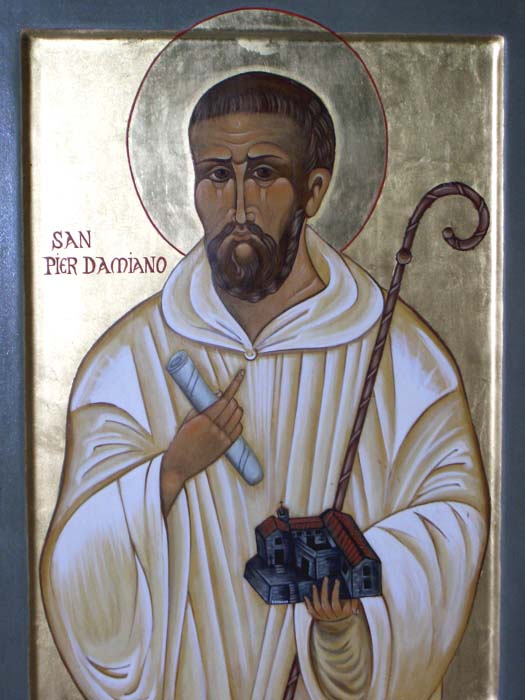
St. Peter Damian (SEP, Doctors of the Catholic Church)
Monastic community of Camaldoli
New Camaldoli Hermitage (Big Sur, CA)
Camaldolese Oblates
Wednesday, March 07, 2007
On St. Clement of Rome
"The Church Has a Sacramental, Not Political Structure"
VATICAN CITY, MARCH 7, 2007 (ZENIT.org).- Here is a translation of Benedict XVI's address at today's general audience. The Pope is beginning a new cycle of catecheses on the Apostolic Fathers, starting with St. Clement of Rome.
* * *
Dear Brothers and Sisters,
During the past few months we have meditated upon the figures of each individual apostle and the first witnesses of the Christian faith, those mentioned in the New Testament writings. Now, we will turn our attention to the Apostolic Fathers, that is, to the first and second generation of the Church after the apostles. This way we can see how the Church's path started in history.
St. Clement, Bishop of Rome during the last years of the first century, is the third successor of Peter, after Linus and Anacletus. The most important testimonial of his life is that written by St. Irenaeus, bishop of Lyon until 202. He asserts that Clement "had seen the apostles … had met with them," and "still had their preaching in his ears, and their tradition before his eyes" (Adv. Haer. 3,3,3). Later testimonials, between the fourth and sixth centuries, give Clement the title of martyr.
This Bishop of Rome's authority and prestige were such that various writings were attributed to him, but the only certain one is the Letter to the Corinthians.
Eusebius of Caesarea, the great "archivist" of Christian origins, presents it with these words: "One letter by Clement has been sent down to us recognized as authentic, great and admirable. It was written by him on behalf of the Church of Rome to the Church of Corinth. … We know that for a long time, and still today, this letter is read publicly during the reunions of the faithful" (Hist. Eccl. 3,16).
An almost canonical characteristic was attributed to this letter. At the beginning of the text, written in Greek, Clement is sorry if "the multiple and calamitous events" (1,1), made for a tardy intervention. These "events" can be identified with the persecution of Domitian; therefore, the date this letter was written goes back to a time directly after the death of the emperor and toward the end of the persecution, that is to say just after 96.
Clement's intervention -- we are still in the first century -- was called upon because of the serious problems the Church of Corinth was undergoing; the priests of the community, in fact, had been deposed by some young upstarts. The painful event is remembered, once again by St. Irenaeus who writes, "Under Clement, having given rise to a rather serious contrast between the Corinthian brothers, the Church of Rome sent the Corinthians a very important letter to reconcile them in peace to renew their faith and to announce the tradition, a tradition they had so newly received from the apostles" (Adv. Haer. 3,3,3).
Therefore, we could say that this letter is a first exercise of a Primate of Rome after the death of St. Peter. Clement's letter touches upon topics dear to St. Paul who had written two great letters to the Corinthians, in particular the theological dialectic, always pertinent, between the indicative of salvation and the imperative of moral commitment.
First, there is the proclamation of saving grace. The Lord foresees us and gives us forgiveness, gives us his love, the grace of being Christians, his brothers and sisters. This is an announcement that fills our life with joy and gives certitude to our actions. The Lord always foresees our acts with his goodness and the goodness of the Lord is always greater than all of our sins.
We must, however, commit ourselves in a coherent way to this gift that we have received and answer the proclamation of salvation with a generous and courageous path toward conversion. Looking at the Pauline model, the novelty is that Clement follows the doctrinal part and the practical part with a "great prayer," which practically concludes the letter.
The immediate occasion of the letter opened to the Bishop of Rome the possibility for vast intervention on the identity of the Church and its mission. If there were abuses in Corinth, Clement notes, the reason should be looked for in the weakening of charity and the necessary Christian virtues. This is why he calls all the faithful to humility and brotherly love, two virtues, truly the basis for being part of the Church. "We are the portion of the Holy One," he says, "let us do all those things which pertain to holiness" (30,1).
In particular, the Bishop of Rome recalls that the Lord himself, "where and by whom he desires these things to be done, he himself has fixed by his own supreme will, in order that all things, being piously done according to his good pleasure, may be acceptable unto him. … For his own peculiar services are assigned to the high priest, and their own proper place is prescribed to the priests and their own special ministrations devolve on the Levites. The layman is bound by the laws that pertain to the laymen" (40,1-5: note that here, in this letter from the end of the first century, for the first time in Christian literature the Greek term "laikós" appears which means "member of the laos," that is "the people of God").
This way, referring to the liturgy of ancient Israel, Clement reveals his ideal of the Church. This is gathered by his "one spirit of grace poured down upon us," which shows through the different members of the Body of Christ, in which all, joined without division are "members one of the other" (46,6-7).
The clear distinction between the "laymen" and the hierarchy does not mean, in any way, a contraposition but only the organic connection of a body, of an organism with different functions. In fact, the Church is not a place for confusion and anarchy, where someone can do whatever he wants at any time; each one in this organism with an articulated structure practices his ministry according to the vocation received.
As pertains to the heads of the communities, Clement specifies clearly the doctrine of apostolic succession. The laws that regulate this derive from God himself in an ultimate analysis. The Father sent Jesus Christ, who in turn sent the apostles. These then sent out the first heads of the communities, and established that they would be followed by worthy men. Therefore, all proceeds in "an orderly way, according to the will of the word of God" (42).
With these words, with these phrases, St. Clement underlines that the Church has a sacramental structure, not a political structure. God's actions that come to us in the liturgy precede our decisions and our ideas. The Church is above all a gift of God and not a creature of ours and therefore this sacramental structure not only guarantees the common order but also the precedence of the gift of God that we all need.
Finally, the "great prayer" confers a cosmic breath to the preceding discussion. Clement praises and thanks God for his great providence of love, who created the world and continued to save it and bless it. Particular relevance is given to the invocation for the governing body. After the New Testament texts, this represents the oldest prayer for political institutions. Thus, on the morrow of the persecution, Christians, well aware that the persecutions would continue, did not cease to pray for those very authorities that had condemned them unjustly.
The motive is above all Christological: One must pray for persecutors, as Jesus did on the cross. But this prayer also contains a teaching that guides, in the course of the centuries, the attitude of Christians in the face of politics and the state.
In praying for the authorities, Clement recognizes the legitimacy of the political institutions in the order established by God. At the same time, he manifests his concern that the authorities be docile to God and "exercise the power that God has given them in peace and gentleness with compassion" (61,2).
Caesar is not all. Another sovereignty emerges, whose origin and essence are not of this world, but "from above": It is that of Truth, which merits the right to be heard also in confrontations with the state."
Thus Clement's letter faces numerous themes of continuous actuality. This is more significant inasmuch as it represents, since the first century, solicitude of the Church of Rome, which presides in charity over all other churches.
With the same spirit we make our invocations as the "great prayer," where the Bishop of Rome becomes the voice for the entire world, "Yea, Lord, make your face to shine upon us for good in peace, that we may be shielded by your mighty hand ... we praise you through the high priest and guardian of our souls, Jesus Christ, through whom be glory and majesty to you both now and from generation to generation and for evermore. Amen" (60-61).
[Translation by ZENIT]
[At the end of the audience, the Pope greeted pilgrims in several languages. In English, he said:]
Dear Brothers and Sisters,
In our catechesis on the early Church, we now turn to the Apostolic Fathers. Saint Clement, Bishop of Rome and third successor of Peter, lived in the last years of the first century. He had met the apostles personally. Clement wrote an important letter to the Church in Corinth at a time when the Christian community was deeply divided. He encourages them to renew their faith in the message received from the apostles and to be reconciled with one another. In this way, he shows the essential connection between the content of the Gospel and the way we live. This connection is essential to Clement's ideal for the Church, in which the hierarchical structure is intrinsically ordered to the service of charity. Laity and hierarchy are not opposed, but organically connected in the mystery of the one body. According to Clement, not only the Church, but also the entire cosmos reflects God's providential love and mercy. Clement concludes his letter by praising God for this marvelous order. Let us join him as we beg the Lord to "make his face shine upon us in goodness and peace. Amen."
I offer a warm welcome to all the English-speaking visitors and pilgrims present at today's audience, especially the groups from Scotland, Denmark, Japan, Canada and the United States of America. May your pilgrimage renew your love for the Lord and his Church, and may God bless you all!
Monday, February 19, 2007
Pope John Paul II's Angelus Message, August 11, 1996
Pope John Paul II's Angelus Message, August 11, 1996.
Eastern Theology Has Enriched the Whole Church
Dear Brothers and Sisters,
1. Continuing my reflection on Eastern Christianity, today I would like to focus attention on the development of Eastern theology, which, even in the centuries that followed the age of the Fathers and the sad division with the Apostolic See, led to profound and stimulating perspectives at which the whole Church looks with interest. Although there is still disagreement on this point or that, we must not forget that what unites us is greater than what divides us.
An important doctrinal development occurred between the eighth and ninth centuries after the "iconoclast" crisis unleashed by several Byzantine emperors, who decided radically to suppress the veneration of sacred images. Many were forced to suffer for resisting this absurd imposition. St John Damascene and St Theodore the Studite come to mind in particular. The victorious outcome of their resistance proved decisive not only for devotion and sacred art, but also for a deeper understanding of the mystery of the Incarnation. Indeed, in the final analysis the defense of images was based on the fact that God truly became man in Jesus of Nazareth. It is therefore legitimate for the artist to endeavour to portray his face, not only with the aid of his talent, but especially by interior docility to God's Spirit. The images refer to the Mystery that surpasses them, and they help us feel its presence in our life.
2. The hesychast controversy marked another distinctive moment in Eastern theology. In the East, hesychasm means a method of prayer characterized by a deep tranquillity of the spirit, which is engaged in constant contemplation of God by invoking the name of Jesus. There was no lack of tension with the Catholic viewpoint on certain aspects of this practice. However, we should acknowledge the good intentions which guided the defense of this spiritual method, that is, to emphasize the concrete possibility that man is given to unite himself with the Triune God in the intimacy of his heart, in that deep union of grace which Eastern theology likes to describe with the particularly powerful term of "theosis", "divinization".
Precisely in this regard Eastern spirituality has amassed a very rich experience which was vigorously presented in the famous collection of texts significantly entitled Philokalia (love of beauty") and gathered by Nicodemus the Hagiorite at the end of the 18th century. Down the centuries until our day, Eastern theological reflection has undergone interesting developments, not only in the classical areas of the Byzantine and Russian tradition, but also in the Orthodox communities scattered throughout the world. One need only recall, among the many studies worthy of mention, the Theology of Beauty elaborated by Pavel Nikolaievich Evdokimov, which is based on the Eastern art of the icon, and the study of the doctrine of "divinization" by the Orthodox scholar, Loth Borovine.
How many things we have in common! It is time for Catholics and Orthodox to make an extra effort to understand each other better and to recognize with the renewed wonder of brotherhood what the Spirit is accomplishing in their respective traditions towards a new Christian springtime.
3. Let us ask Mary, Mother of Wisdom, to teach us to recognize promptly the infinite expressions of God's presence in the history of mankind. May she help us to concentrate on the positive rather than the negative, and to use all the creativity of mutual understanding for engaging in fruitful dialogue, even on points where differences remain. For this reason, may the Holy Spirit grant us the wisdom of heart so dear to Eastern spirituality and essential to any genuinely Christian experience.
I am pleased to welcome all the English-speaking visitors who have joined us for this Angelus prayer. May these summer holidays be a time of relaxation and spiritual renewal for you and your families.
Today, as we remember St Clare of Assisi, my thoughts turn to the Poor Clares and to all cloistered nuns. I express to them the loftiest esteem which the Christian community has for this kind of life, "a sign of the exclusive union of the Church as Bride with her Lord, whom she loves above all things" (Apostolic Exhortation Vita consecrata, n. 59). By offering themselves to Jesus for the world's salvation, they represent "a joyful proclamation and prophetic anticipation of the possibility offered to every person and to the whole of humanity to live solely for God in Christ Jesus" (ibid.). They therefore deserve my gratitude and that of the whole Church, and an encouragement to persevere faithfully in the cloistered life according to their specific charism.
Wednesday, February 14, 2007
Women of the Early Church
Women of the Early Church
"The Feminine Presence Was in No Way Secondary"
VATICAN CITY, FEB. 14, 2007 (Zenit.org).- Here is a translation of the address Benedict XVI delivered at today's general audience. The Pope dedicated his talk to women who spread the Gospel in the early Church.
* * *
Dear Brothers and Sisters:
We come today to the end of the journey among the witnesses of early Christianity, mentioned in the writings of the New Testament. And we take advantage of the last stage of this first journey to focus our attention on the many feminine figures who played an effective and precious role in spreading the Gospel.
Their testimony cannot be forgotten, in keeping with what Jesus himself said about the woman who anointed his head shortly before his passion: "Truly I say to you, wherever this Gospel is preached in the whole world, what she has done will be told in memory of her" (Matthew 26:13; Mark 14:9).
The Lord wants these witnesses of the Gospel, these figures who have made their contribution so that faith in him would grow, to be known and their memory to remain alive in the Church. Historically we can distinguish the role of women in primitive Christianity, during Jesus' earthly life and during the vicissitudes of the first Christian generation.
Of course, as we know, Jesus chose 12 men among his disciples as fathers of the new Israel "to be with him, and to be sent out to preach" (Mark 3:14-15). This fact is obvious but, in addition to the Twelve, pillars of the Church, fathers of the new People of God, many women were also chosen and numbered among the disciples.
I can only mention briefly those who found themselves on the path of Jesus himself, beginning with the prophetess Anna (cf. Luke 2:36-38), coming then to the Samaritan woman (cf. John 4:1-39), the Syrophoenician woman (cf. Mark 7:24-30), the woman with the hemorrhage (cf. Matthew 9:20-22) and the forgiven woman sinner (cf. Luke 7:36-50).
Nor will I consider the protagonists of some of his effective parables, for example, the woman who makes the bread (Matthew 13:33), the woman who loses the silver coin (Luke 15:8-10), or the vexing widow before the judge (Luke 18:1-8).
More significant for our discussion are the women who played an active role in the context of Jesus' mission. Above all, our thoughts go naturally to the Virgin Mary, who with her faith and maternal endeavor collaborated in a unique way in our redemption, to the point that Elizabeth was able to call her "blessed among women" (Luke 1:42), adding: "Blessed is she who believed" (Luke 1:45).
Becoming a disciple of Christ, Mary manifested at Cana her complete trust in him (cf. John 2:5) and followed him to the foot of the cross, where she received a maternal mission from him for all his disciples of all times, represented by John (cf. John 19:25-27).
There are, moreover, several women who in different ways gravitated around the figure of Jesus with functions of responsibility. The women who followed Jesus to serve him with their properties are an eloquent example of this. Luke gives us some names: Mary of Magdala, Joanna, Susanna "and many others" (cf. Luke 8:2-3). Later, the Gospels tell us that the women, unlike the Twelve, did not abandon Jesus in the hour of his passion (cf. Matthew 27:56.61; Mark 15:40).
Outstanding among these women, in particular, is the Magdalene, who not only was present at the Passion, but also became the first witness and herald of the Risen One (cf. John 20:1,11-18). To Mary of Magdala, in fact, St. Thomas Aquinas dedicates the singular description "apostle of the apostles" ("apostolorum apostola"), dedicating a beautiful commentary to her: "Just as a woman had announced to the first man the words of death, so also a woman was the first to announce to the apostles the words of life" ("Super Ioannem," CAI publishers, Paragraph 2519).
Moreover, in the ambit of the early Church the feminine presence was in no way secondary. This is the case of the four daughters of "deacon" Philip, whose names are not mentioned, residents in Caesarea, all of them gifted, as St. Luke says, with the "gift of prophecy," that is, of the faculty to speak publicly under the action of the Holy Spirit (cf. Acts 21:9). The brevity of the news does not allow for more precise deductions.
We owe to St. Paul a more ample documentation on woman's dignity and ecclesial role. He begins with the fundamental principle, according to which, for the baptized "there is neither Jew nor Greek, there is neither slave nor free, there is neither male nor female; for you are all one in Christ Jesus" (Galatians 3:28), that is, all united in the same nature, though each one with specific functions (cf. 1 Corinthians 12:27-30).
The Apostle admits as something normal that woman can "prophesy" in the Christian community (1 Corinthians 11:5), that is, pronounce herself openly under the influence of the Holy Spirit, on the condition that it is for the edification of the community and in a dignified manner. Therefore, the famous exhortation "the women should keep silence in the churches" must be relativized (1 Corinthians 14:34).
The much-discussed problem on the relationship between the first phrase -- women can prophesy in church -- and the other -- they cannot speak -- that is, the relationship between these two indications which are seemingly contradictory, we leave for the exegetes.
It is not something that must be discussed here. Last Wednesday we already met with Prisca, or Priscilla, wife of Aquila, who in two cases is mentioned surprisingly before her husband (cf. Acts 18:18; Romans 16:3): Both are described explicitly by Paul as his "sun-ergous," or collaborators (Romans 16:3).
There are other observations that must not be neglected. It is necessary to state, for example, that the brief Letter to Philemon is addressed by Paul also to a woman called "Apphia" (cf. Philemon 2). Latin and Syrian translations of the Greek text add to the name "Apphia" the description "soror carissima" (ibid.), and it must be said that in the community of Colossae they must have had an important role. In any case, she is the only woman mentioned by Paul among the recipients of one of his letters.
In other passages, the Apostle mentions a certain Phoebe whom he calls "diakonos" of the church of Cenchreae, the small port city east of Corinth (cf. Romans 16:1-2). Although at that time the title still did not have a specific ministerial value of a hierarchical character, it expresses a genuine exercise of responsibility on the part of this woman in favor of that Christian community.
Paul requests that she be received cordially and "help her in whatever she may require," and then adds: "For she has been a benefactor to many and to me as well." In the same epistolary context, the Apostle, with delicate lines recalls other names of women: a certain Mary, and then Tryphaena, Tryphosa and Persis, "beloved," as well as Julia, of whom he writes openly that they "have worked hard for you" or "have worked hard in the Lord" (Romans 16:6,12a,12b,15), thus underlining their intense ecclesial commitment.
Moreover, two women, called Euodia and Syntyche, are distinguished in the church of Philippi (Philippians 4:2): Paul's appeal to mutual agreement suggests that the two women carried out an important function within that community.
In sum, the history of Christianity would have developed very differently if the generous contribution of many women had not taken place. For this reason, as my venerated and beloved predecessor, John Paul II, wrote in the apostolic letter "Mulieris Dignitatem": "Therefore, the Church gives thanks for each and every woman. ... The Church gives thanks for all the manifestations of the feminine 'genius' which have appeared in the course of history, in the midst of all peoples and nations; she gives thanks for all the charisms which the Holy Spirit distributes to women in the history of the People of God, for all the victories which she owes to their faith, hope and charity: She gives thanks for all the fruits of feminine holiness" (No. 31).
As we see, the praise refers to women in the course of the history of the Church and is expressed in the name of the whole ecclesial community. We also join ourselves to this appreciation, giving thanks to the Lord because he leads his Church, from generation to generation, making use indistinctly of men and women, who are able to make their faith and baptism fruitful for the good of the whole ecclesial Body for the greater glory of God.
[Translation by ZENIT]
[At the end of the audience, the Pope greeted pilgrims in several languages. In English, he said:]
Dear Brothers and Sisters,
Today, as we near the end of our reflections on the earliest Christian witnesses in the New Testament, we turn our attention to the women who played an important role in spreading the Good News. Above all, we remember the Virgin Mary, who cooperated in a unique way in our Redemption. As a faithful disciple of her Son, Mary manifested her complete trust in him at Cana. She received a special mission from him at the foot of the Cross to be the mother of all disciples. Others who assisted our Lord were Mary Magdalene -- the first to announce his Resurrection -- as well as Joanna, Susanna, and the sisters Mary and Martha. Saint Paul writes that in the early Church, it was normal for a woman to prophesy under the influence of the Holy Spirit (cf. 1 Corinthians 11:5). In his Letter to the Romans, Paul refers to Phoebe as diakonos, showing that she had a unique responsibility in the early Christian community. Indeed, the history of Christianity would have developed much differently if it were not for the generous contribution made by so many women. Today, let us give thanks to God who, through Baptism, continues to use the gifts of both men and women for the good of the entire Church.
I am pleased to welcome the many English-speaking pilgrims present, especially those from England, Bosnia-Herzegovina, Japan, and the United States of America. My special greetings go to the members of the National Catholic Committee on Scouting from the United States, to the representatives of the John Carroll Society from Washington, D.C., and to the students and faculty of the Ecumenical Institute of Bossey, Switzerland. Upon all of you I invoke God's blessings of peace and joy.
© Copyright 2007 -- Libreria Editrice Vaticana
Subscribe to:
Posts (Atom)