Easter Homily
by St. John Chrysostom
Let all pious men and all lovers of God rejoice in the splendor of this feast; let the wise servants blissfully enter into the joy of their Lord; let those who have borne the burden of Lent now receive their pay, and those who have toiled since the first hour, let them now receive their due reward; let any who came after the third hour be grateful to join in the feast, and those who may have come after the sixth, let them not be afraid of being too late; for the Lord is gracious and He receives the last even as the first. He gives rest to him who comes on the eleventh hour as well as to him who has toiled since the first: yes, He has pity on the last and He serves the first; He rewards the one and praises the effort.
Come you all: enter into the joy of your Lord. You the first and you the last, receive alike your reward; you rich and you poor, dance together; you sober and you weaklings, celebrate the day; you who have kept the fast and you who have not, rejoice today. The table is richly loaded: enjoy its royal banquet. The calf is a fatted one: let no one go away hungry. All of you enjoy the banquet of faith; all of you receive the riches of his goodness. Let no one grieve over his poverty, for the universal kingdom has been revealed; let no one weep over his sins, for pardon has shone from the grave; let no one fear death, for the death of our Saviour has set us free: He has destroyed it by enduring it, He has despoiled Hades by going down into its kingdom, He has angered it by allowing it to taste of his flesh.
When Isaias foresaw all this, he cried out: "O Hades, you have been angered by encountering Him in the nether world." Hades is angered because frustrated, it is angered because it has been mocked, it is angered because it has been destroyed, it is angered because it has been reduced to naught, it is angered because it is now captive. It seized a body, and, lo! it encountered heaven; it seized the visible, and was overcome by the invisible.
O death, where is your sting? O Hades, where is your victory? Christ is risen and you are abolished. Christ is risen and the demons are cast down. Christ is risen and the angels rejoice. Christ is risen and life is freed. Christ is risen and the tomb is emptied of the dead: for Christ, being risen from the dead, has become the Leader and Reviver of those who had fallen asleep. To Him be glory and power for ever and ever. Amen.
Monday, April 09, 2007
Easter Homily, by St. John Chrysostom

Wednesday, April 04, 2007
Interview with Carl J. Sommers
The Everyday Lives of the Early Christians An interview with Carl J. Sommers, author of We Look For the Kingdom: The Everyday Lives of the Early Christians Carl E. Olson
Carl J. Sommer's newly published book, We Look For a Kingdom, is a fascinating study of the faith, life, and world of the early Christians living in the era between the Apostles and the Emperor Constantine (A.D. 100-313). Using documentary evidence and archaeological records, Sommer reconstructs the lives of the early Christians in order to "introduce the treasures of early Christianity to a large number of modern readers". IgnatiusInsight.com editor Carl E. Olson recently interviewed Sommer about the book, the lessons to be learned from the first Christians, and how American culture compares to ancient Roman culture.
IgnatiusInsight.com: What is your educational background and what sort of studies prepared you to write this book?
Carl J. Sommer: Years ago, I spent a couple of years in a Catholic Seminary, Conception Abbey (Benedictine) in northwest Missouri. After two years, I decided not to become a priest, but, after years in the business world, I decided to pursue a Masters Degree in theology, with plans to go on for my doctorate. I got the Masters, from Aquinas Institute of Theology in St. Louis, but did not pursue the doctorate, because my wife and I started a family, and I needed to go to work. I have spent time as a parish DRE, and currently do Baptism preparation and RCIA for a parish here in St. Louis. In writing this book, I actually had to unlearn much that I "learned" at Aquinas. The faculty at Aquinas thought, and taught, that the early Church was egalitarian, with women in sacramental ministries, etc. In my research I found that, with the exception of some odd heretical sects (the kind that believed in twelve, or thirty, or a thousand gods), the early Christians were not egalitarian, and though they had substantial roles for women, they did not allow them to fulfill the priestly ministry.
I learned a great deal about the early Christians on my own, trying to answer parishioners' questions, and in my own personal apologetics. After a while, I had files developed on the Mass, the Saints, infant baptism, and so forth, and I thought it would be easy to put it all together into book form. But when I actually began writing I found that I had to do much more research to nail things down. I wanted airtight cases, or at least cases that any reasonable person would find hard to refute. On most of the topics covered in We Look for a Kingdom, I think I have shown that the early Christians were a lot like Catholics of every generation.
IgnatiusInsight.com: Did you write We Look For a Kingdom with various common questions or misunderstandings in mind? Is it to some degree both a popular history and a work of apologetics?
Sommer: Yes, I had a large number of common misconceptions I wished to refute. Some I mentioned above. Others would be the idea that apostolic succession was a later invention, and the notion that the Liturgy must have had a lengthy period of evolution before it reached its present form. I have argued, and provided evidence, that both the idea of apostolic succession and the basic shape of the Liturgy were present in the Church from the very beginning. In that sense, yes, apologetics and history meet in We Look for a Kingdom.
IgnatiusInsight.com: Judging by the critical success of the HBO series, "Rome," ancient Rome apparently maintains a certain mystique within the popular imagination. Why do you think that might be? What sort of false notions or misunderstandings about ancient Rome do you encounter on a regular basis?
Sommer: I think two things are at work. First of all, we are fascinated by the glamour of power and excess that we associate with the Romans. Secondly, I think we do, in a very real sense, see our own culture mirrored in that of ancient Rome. The image in the mirror is distorted and misshapen in many ways, but you can detect the outlines, if you look closely. I will have more to say on this subject later in the interview.
The single biggest misunderstanding about the Roman Empire is that people assume that it was a totalitarian regime along the lines of twentieth century dictatorships, that the Romans sought to control every aspectof the thoughts and behaviors of their subjects, as, say, Hitler and Stalin did. Certainly, some of the emperors (Domitian and Decius come to mind) would have liked to have had control of every aspect of their subjects' lives, but the technologies necessary for such control simply didn't exist. Other emperors, including Hadrian, Trajan, Marcus Aurelius, and even Augustus himself, were genuinely interested in justice and good government. Generally speaking, local communities were allowed to order their own affairs without interference, so long as they paid their taxes, maintained order,and refrained from armed revolt. It is true that taxes were high, and unjustly collected,but they were actually lower than those collected by previous empires.
IgnatiusInsight.com: In what ways did the existence of the Roman Empire help the early Christians? Hinder?
Sommer: The Romans aided the spread of Christianity unintentionally, in some very general ways. First of all, the Romans made travel throughout the Mediterranean world relatively safe and easy. They cleared the seas of pirates, suppressed banditry in the countryside, and built an excellent system of roads. This made the general spread of ideas possible, and since Christ's message, the Gospel, is the best idea the world has ever encountered, Christianity spread as well. Secondly, the Romans kept the Mediterranean world at peace throughout most of this period. Granted, it was a rough peace, enforced by the sword sometimes quite brutally, but the absence of open military conflict made it possible for Christianity to spread. Thirdly, in a strange way, the persecutions helped spread Christianity, since people who were not familiar with the Christian message were exposed to the Gospel and got to see the fortitude of the martyrs. The Romans--particularly Roman soldiers--were very impressed with physical bravery, and they were exposed to many examples of Christian fortitude as a result of the persecutions.
On the other hand, the Romans deliberately did some quite specificthings to hinder the spread of Christianity. The persecutions undoubtedly deterred many people from becoming Christians, and not everyone behaved with fortitude under the threat of persecution. We hear about large numbers of lapsi, people who abandoned the faith under the threat of torture, during the persecution of Decius in 251. Many of these lapsi were later readmitted into the Church, but some were lost forever. Beyond the persecutions, the fact that Christianity was illegal presented the Church with other obstacles. The Christians could not have public worship spaces as other religions could, but had to worship in private houses. This meant that passers by could not just walk in to see what was going on. Also, the process of admission into the Church was complicated by the necessity of protecting the bishops, who were the primary targets of the persecutions, from government infiltrators.
IgnatiusInsight.com: You mention that the fall of Rome has fascinated historians for centuries, but you also say that "the more interesting question, and one closer to the heart of this book, has to do with why the Roman Empire came into existence." How do the answers to that question help us understand the early Christians better?
Sommer: Early Christianity is sometimes described as a fortuitous melding of Jewish and Greek culture, but there is a third element in the mix. Roman culture itself has played an immense role in the development of western Christianity. The genius of early Christianitywas that it was able to take the positive elements of Greek and Roman culture and incorporate them into the life of the Church. It was just those positive elements, filial piety, devotion to duty, and love of justice, that brought about the rise of Rome in the first place. Some of the early Christians themselves thought that the rise of the Roman Empire had been brought about as a result of God's design.
IgnatiusInsight.com: In examining how the early Christians lived, what do you think would surprise modern-day Catholics the most? What aspects of early Christian worship and liturgy might be most strange or foreign to 21st-century Catholics?
Sommer: In my experience, modern Catholics are most surprised by how much the structure, beliefs, and worship of the early Christians resembles our own. This is particularly true in the case of the Liturgy. We have been led to believe, primarily by a flawed interpretation of New Testament evidence, that the worship of the early Church was charismatic and unstructured. But when people see Justin Martyr's description of the Liturgy as it was practiced in 150, they realize that very early on the Christians were worshipping almost exactly the way we do today. Of course, there was a certain amount of development between the New Testament period and 150, but the basic structure of the Liturgy appeared quite soon, and did not change very much.
There are two aspects of early Christian worship that would appear strange to us today: the agape meals and the refrigerium. The agape meals were typically eaten on Sunday evenings, and combined elements of a potluck dinner, where everyone would bring something for the table, and a prayer service. The agape meals had their own prescribed prayers, and typically a bishop or presbyter was the presider. The refrigerium was even stranger, for the early Christians appear to have had the practice of eating meals at the gravesites of prominent Christians. We don't know much about this practice, but archaeologists have found, scattered throughout the empire, martyria, or gravesites of martyrs (there is a beautiful example of this in Hierapolis, the martyrium of Phillip). Some of these martyria are complete with recognizable dining areas. We certainly don't have either one of these practices today, though I think that in some ways the Church could benefit from a revival in the practice of agape.
IgnatiusInsight.com: There has been a decent amount of scholarly debate over how much or intensely the early Christians were persecuted. How bad, in fact, was the Roman treatment of Christians, and what would have been the general attitude of the average Roman toward the Christian religion?
Sommer: Both sides of the debate over persecution have valid points. In the three hundred year period of the early Church, there are approximately a thousand known martyrs. Periods of persecution tended to be intense, savage, and local. Notable examples in my book would be the persecutions in Rome from 64-67, the persecution in Lyons in 178, the persecution in North Africa around 205, and the final great persecution that began in 303 and was not really ended until Constantine won his great victory at Milvian Bridge. On the other hand, there were long periods of time (including two thirty-year periods in the third century), when the Church was relatively free from persecution. But those who favor the notion that the persecutions were overblown have to realize that until Contantine the threat of martyrdom was constantly present. Some of the most famous martyrs of the early Church--Ignatius of Antioch, Polycarp of Smyrna, and Justin Martyr--were martyred under emperors who were disposed to show some lenience to the Christians. Other factors have to be considered as well. There were also some spontaneous persecutions that were brought about by local circumstances. For instance, Tarsicius of Rome was murdered by a mob while he was trying to take the Eucharist to the sick. We will never know exactly how many Christians died in these spontaneous persecutions.
The average Roman tended to see the Christians as dangerously impious. The Romans thought that the Christians' failure to honor the gods of Rome was likely to lead to famines, floods, earthquakes, military disasters, diseases, and a host of other ills. Consequently, every time one of these events occurred (and they occurred often), the Christians were blamed.
IgnatiusInsight.com: A common charge from various secularists is that the early Christians not only failed to eliminate slavery, they seemed to have supported it. How would you respond to that accusation?
Sommer: The charge only has substance if one thinks it reasonable to hold people of vastly different cultural and historical circumstances accountable to the moral standards of the current era. Consider: after two thousand years of Christianity, the Enlightenment (the best impulses of which were Christian in origin), and sundry other moral crusades, we are now thoroughly convinced that slavery is a great moral evil. But the early Christians lived in a world that had always known slavery. Under such circumstances, it is not surprising that no one thought to call for the end of slavery. It is certainly true that neither Jesus, nor any of the apostles, nor any of the Church Fathers called for the end of slavery. It is not clear that any of these, with the exception of Jesus, could even imagine a world without slavery.
But what they did do about slavery clearly led to the ultimate abolition of slavery in the Western world. They taught that masters had to treat their slaves like brothers. In a world where masters could have their slaves crucified, where if a master were murdered all his slaves would be executed, and where female slaves had no recourse against the sexual advances of their masters, this was radical enough. If taken seriously, the internal logic of Christian teaching insured that eventually slavery would die out, because you can't beat your brother for trivial offenses, or work him to death in a copper mine, and you can't rape your sister, if you truly believe thatshe is your sister.
We do know of instances where the early Christians used community funds to purchase the freedom of slaves, but there were no widespread efforts to end slavery as an institution. Nevertheless, slavery gradually diminished in the Christian West, to be replaced by a system marginally better for the poor. Furthermore, under the influence of Christianity, the lot of the poorest citizens of Western Europe has steadily improved ever since. The critics of the slowness of the Christian response to social problems like slavery fail to realize that, with the exception of Christians, very few people even cared about the fate of slaves, or the poor, or the sick. As I wrote in We Look for a Kingdom, "Christianity began in an empire in which a third of the people were enslaved, yet it brought into being a world in which almost everyone knows slavery is wrong."
IgnatiusInsight.com: Historical epochs are difficult to compare, but there is often comparisons made between the situation in the modern Western world and the ancient Roman world, particularly in terms of morality (or immorality), fragmenting culture, and political turmoil. In your estimation, how worthy of comparison is that? What lessons might we learn from the decline and fall of Rome?
Sommer: There are definite similarities and clear differences between ancient Roman and modern American culture. There are eerie parallels between the types of entertainment some Americans are drifting towards and those favored by the Romans. Also, our societal sexual mores are quite similar to that of the Romans,even to the widespread resort to divorce, contraception, abortion, and occasionally even infanticide. The frightening difference, though, is that while the Romans got better in these regards, we seem to be getting worse.
On the other hand, our political and economic systems are vastly superior to anything the Romans produced. The Romans were never capable of creating a system that would ensure the orderly transfer of power from one administration to the next, nor were they able to provide political freedom to their citizens, despite the fact that their own heritagewas republican. Our economic system of regulated capitalism is also vastly superior to anything the Romans produced. The Romans veered from unregulated capitalism in the early empire (the phrase 'caveat emptor' accurately reflects the Roman attitude toward commerce) to over-regulation in the late empire, including wage and price freezes that were designed to prevent inflation, but only succeeded in destroying entrepreneurship.
Frequently one hears the comparison between Roman imperial policies and the foreign policy of the United States. No comparison could be more fatuous, when one compares actual events. When the Romans finally defeated Carthage, they leveled the city, sowed the soil with salt so nothing could grow there, and sold thousands into slavery. Similarly, when the Jews revolted against Roman rule in A.D. 66, the Romans sent four legions to besiege Jerusalem, and when they finally conquered the city, they leveled it (with the exception of the western wall of the Temple), slaughtered all the defendants, andcondemned thousands of women and children to slavery. To say that modern America has used its power differently would be an understatement. We have been, and continue to be, the most benevolent, well-intentioned superpower the world has ever known. If we behaved as the Romans routinely did to nations that defied them, we would have left smoking piles of rubble from Casablanca to Kabul after 9/11. The response we actually made, while undoubtedly flawed in some respects, was mild compared to what the Romans would have done.
We can, however, learn some lessons from the decline and fall of the Roman Empire. Some day, our preeminence in the world will end. We may pray, with Tertullian, that that dayis far distant, but nothing on this planet lasts forever, and eventually America will be surpassed militarily, politically, and economically. We can only hope to use our time for good, not ill. We should also realize that we can lengthen the duration of our civilization only by the inculcation of virtues in the citizenry, not by any quick technological fixes. In the short term, the biggest, meanest dog gets the most food, but in the long run virtue is rewarded and vice is punished, in this world as in the next. I should add that this holds true only in the life of nations, not in the life of individuals. Virtuous individuals sometimes suffer in this world, while the wicked sometimes prosper. But in the life of nations, in the end, virtue is rewarded and vice is punished. We need to heed this warning.
Tuesday, April 03, 2007
Origin and Use of the Paschal Candle
Origin and Use of the Paschal Candle
And More on the Passion
ROME, APRIL 3, 2007 (Zenit.org).- Answered by Father Edward McNamara, professor of liturgy at the Regina Apostolorum university.
Q: Can you explain the origin of the paschal candle and how long after Easter is it to be lit during Mass? Is it to be brought out into the sanctuary and lit also during weddings and funerals throughout the year, as is done in one parish I visited? -- E.L., Fresno, California
A: The origin of the paschal candle is uncertain. The most likely origin is that it derived from the Lucernarium, the evening office with which early Christians began the vigil for every Sunday and especially that of Easter.
In turn, this rite is probably inspired by the Jewish custom of lighting a lamp at the conclusion of the Sabbath. The rite therefore has its roots in the very beginning of Christianity.
In the Lucernarium rite the light destined to dispel the darkness of night was offered to Christ as the splendor of the Father and indefectible light. This Sunday rite was logically carried out with greater solemnity during the Easter Vigil.
There is clear evidence that this solemn rite began no later than the second half of the fourth century. For example, the use of singing a hymn in praise of the candle and the Easter mystery is mentioned as an established custom in a letter of St. Jerome, written in 384 to Presidio, a deacon from Piacenza, Italy.
Sts. Ambrose and Augustine are also known to have composed such Easter proclamations. The poetic and solemn text of the "Exultet," or Easter proclamation now in use, originated in the fifth century but its author is unknown.
The use of the candle has varied over the centuries. Initially it was broken up after the Easter Vigil and its fragments given to the faithful. This was later transferred to the following Sunday; but from the 10th century the use prevailed of keeping it in a place of honor near the Gospel until the feast of the Ascension (now until Pentecost).
From around the 12th century the custom began of inscribing the current year on the candle as well as the dates of the principal movable feasts. The candle hence grew in size so as to merit the attribution of pillar mentioned in the "Exultet." There are cases of candles weighing about 300 pounds. The procession foreseen in the present rite requires much more moderate dimensions.
The paschal candle is usually blessed at the beginning of the Easter Vigil ceremonies and is placed on a special candlestick near the altar or ambo.
During the ceremony, five grains of incense representing Christ's wounds are inserted in the form of a cross. An alpha above the cross and an omega below (the first and last letters of the Greek alphabet) indicate that Christ is the beginning and end of all. The current year is traced on the four sides of the cross.
The candle remains in the presbytery during the 50 days of Easter season and is lit for all liturgical offices. After Pentecost it is left next to the baptismal font.
During the year it is lit during all baptisms and funeral services; the candle is placed next to the casket during the funeral Mass. In this way it symbolizes baptism as a death and resurrection in Christ, and also testifies to Christian certainty in the resurrection of the dead as well as to the fact that all are alive in the risen Christ.
The paschal candle may also be lit for some devotional practices, such as the fairly common custom of the faithful renewing their baptismal promises on concluding retreats and spiritual exercises.
Finally, while venerable legitimate customs might exist in some places, I am unaware of any official liturgical role for the paschal candle during the celebration of matrimony.
* * *
Follow-up: When Reading the Passion
After our remarks on different methods of reading the Passion (see March 20) a reader from Rochester, Minnesota, made some interesting observations, to wit:
"1. In the United States, Catholics observe the practices of other traditions. No matter how careful the books of these traditions are, strange practices creep into the ceremonies.
"2. These get taken home and are sometimes further distorted. So, the practice of the Episcopal Church of allowing multiple readers (for each of the individuals named) and having the 'crowd' read by the entire congregation have been adopted by Roman Catholic parishes. Since such things are usually poorly prepared the noise and confusion can be terrible.
"The same goes for sitting. In the provisions of the Book of Common Prayer 1979 the people may sit for the early portion of the Passion. They are instructed to rise at the point in the narrative when Jesus takes up his cross. A period of silence is required at the moment of Jesus' death. A genuflection or kneeling is not mentioned, although the practice is widespread. In circumstances where there are multiple services with small groups of worshippers, the Passion may begin where the people are directed to stand.
"The custom of interpolating hymns is, naturally, Lutheran. I guess it works well in Germany. I have seen it done in an Episcopal Church. The Lutheran organist did it with great sensitivity to the text and did not get in the way of the moment of silence. Even with the good work it was always on the edge of falling apart."
Our reader also recommends singing the Passion as the best means of dividing the parts. I would agree that it should be done whenever possible but recognize that it is a formidable task for a nonprofessional singer, especially the poor narrator of St. John's Gospel on Good Friday.
Several readers asked if it was permitted to incorporate mimes and dramas during the reading of the Passion. While such elements may be incorporated into extra-liturgical events such as a Way of the Cross or catechesis, they are never permitted within the liturgy. God's Word must be heard in the silence of the soul with as little interference as possible from visual or audible distractions.
Wednesday, March 28, 2007
On St. Irenaeus of Lyons
On St. Irenaeus of Lyons
"The First Great Theologian of the Church"
VATICAN CITY, MARCH 28, 2007 (Zenit.org).- Here is a translation of the address Benedict XVI gave at the general audience today in St. Peter's Square. The reflection focused on St. Irenaeus of Lyons.
* * *
Dear Brothers and Sisters!
In the catechesis on the great figures of the Church during the first centuries, today we reach the figure of an eminent personality, Irenaeus of Lyons. His biographical information comes from his own testimony, sent down to us by Eusebius in the fifth book of the "Storia Ecclesiastica."
Irenaeus was most probably born in Smyrna (today Izmir, in Turkey) between the years 135 and 140. There, while still a youth, he attended the school of Bishop Polycarp, for his part, a disciple of the apostle John. We do not know when he moved from Asia Minor to Gaul, but the move must have coincided with the first developments of the Christian community in Lyons: There, in 177, we find Irenaeus mentioned among the college of presbyters.
That year he was sent to Rome, bearer of a letter from the community of Lyons to Pope Eleutherius. The Roman mission took Irenaeus away from the persecution by Marcus Aurelius, in which at least 48 martyrs died, among them the bishop of Lyons himself, the 90-year-old Pothinus, who died of mistreatment in jail. Thus, on his return, Irenaeus was elected bishop of the city. The new pastor dedicated himself entirely to his episcopal ministry, which ended around 202-203, perhaps by martyrdom.
Irenaeus is above all a man of faith and a pastor. Like the Good Shepherd, he has prudence, a richness of doctrine, and missionary zeal. As a writer, he aims for a twofold objective: to defend true doctrine from the attacks of the heretics, and to clearly expound the truth of the faith. His two works still in existence correspond exactly to the fulfillment of these two objectives: the five books "Against Heresies," and the "Demonstration of Apostolic Preaching" (which could be called the oldest "catechism of Christian doctrine"). Without a doubt, Irenaeus is the champion in the fight against heresies.
The Church of the second century was threatened by so-called gnosticism, a doctrine which claimed that the faith taught by the Church was nothing more than symbolism for the simpleminded, those unable to grasp more difficult things. Instead, the initiated, the intellectuals -- they called themselves gnostics -- could understand what was behind the symbolism, and thus would form an elite, intellectual Christianity.
Obviously, this intellectual Christianity became more and more fragmented with different currents of thought, often strange and extravagant, yet attractive to many. A common element within these various currents was dualism, that is, a denial of faith in the only God, Father of all, creator and savior of humanity and of the world. To explain the evil in the world, they asserted the existence of a negative principle, next to the good God. This negative principle had created matter, material things.
Firmly rooted in the biblical doctrine of Creation, Irenaeus refuted dualism and the gnostic pessimism that devalued corporal realities. He decisively affirmed the original holiness of matter, of the body, of the flesh, as well as of the spirit. But his work goes far beyond the refutation of heresies: In fact, one can say that he presents himself as the first great theologian of the Church, who established systematic theology. He himself speaks about the system of theology, that is, the internal coherence of the faith.
The question of the "rule of faith" and its transmission lies at the heart of his doctrine. For Irenaeus, the "rule of faith" coincides in practice with the Apostles' Creed, and gives us the key to interpret the Gospel, to interpret the creed in light of the Gospel. The apostolic symbol, a sort of synthesis of the Gospel, helps us understand what the Gospel means, how we must read the Gospel itself.
In fact, the Gospel preached by St. Irenaeus is the one he received from Polycarp, bishop of Smyrna, and the Gospel of Polycarp goes back to the apostle John, Polycarp having been John's disciple. Thus, the true teaching is not that invented by the intellectuals, rising above the simple faith of the Church. The true Gospel is preached by the bishops who have received it thanks to an uninterrupted chain from the apostles.
These men have taught nothing but the simple faith, which is also the true depth of the revelation of God. Thus, says Irenaeus, there is no secret doctrine behind the common creed of the Church. There is no superior Christianity for intellectuals. The faith publicly professed by the Church is the faith common to all. Only this faith is apostolic, coming from the apostles, that is, from Jesus and from God.
To adhere to this faith publicly taught by the apostles to their successors, Christians must observe what the bishops say. They must specifically consider the teaching of the Church of Rome, pre-eminent and ancient. This Church, because of its age, has the greatest apostolicity; in fact its origins come from the columns of the apostolic college, Peter and Paul. All the Churches must be in harmony with the Church of Rome, recognizing in it the measure of the true apostolic tradition and the only faith common to the Church.
With these arguments, very briefly summarized here, Irenaeus refutes the very foundation of the aims of the gnostics, of these intellectuals: First of all, they do not possess a truth that would be superior to the common faith, given that what they say is not of apostolic origin, but invented by them. Second, truth and salvation are not a privilege monopolized by a few, but something that everyone can reach through the preaching of the apostles' successors, and, above all, that of the Bishop of Rome.
By taking issue with the "secret" character of the gnostic tradition and by contesting its multiple intrinsic contradictions, Irenaeus concerns himself with illustrating the genuine concept of Apostolic Tradition, that we could summarize in three points.
a) The Apostolic Tradition is "public," not private or secret. For Irenaeus, there is no doubt that the content of the faith transmitted by the Church is that received from the apostles and from Jesus, the Son of God. There is no teaching aside from this. Therefore, for one who wishes to know the true doctrine, it is enough to know "the Tradition that comes from the Apostles and the faith announced to men": tradition and faith that "have reached us through the succession of bishops" ("Adv. Haer." 3,3,3-4). Thus, the succession of bishops, personal principle, Apostolic Tradition, and doctrinal principle all coincide.
b) The Apostolic Tradition is "one." While gnosticism is divided into many sects, the Church's Tradition is one in its fundamental contents, which -- as we have seen -- Irenaeus calls "regula fidei" or "veritatis." And given that it is one, it creates unity among peoples, different cultures and different communities. It has a common content like that of truth, despite different languages and cultures.
There is a beautiful expression that Irenaeus uses in the book "Against Heresies": "The Church, having received this preaching and this faith, although scattered throughout the whole world, yet, as if occupying but one house, carefully preserves it. She also believes these points (of doctrine) just as if she had but one soul, and one and the same heart, and she proclaims them, and teaches them, and hands them down, with perfect harmony, as if she possessed only one mouth. For, although the languages of the world are dissimilar, yet the import of the tradition is one and the same. For the Churches which have been planted in Germany do not believe or hand down anything different, nor do those in Spain, nor those in Gaul, nor those in the East, nor those in Egypt, nor those in Libya, nor those which have been established in the central regions of the world."
We can already see at this time -- we are in the year 200 -- the universality of the Church, its catholicity and the unifying force of truth, which unites these so-very-different realities, from Germany, to Spain, to Italy, to Egypt, to Libya, in the common truth revealed to us by Christ.
c) Finally, the Apostolic Tradition is, as he says in Greek, the language in which he wrote his book, "pneumatic," that is, spiritual, led by the Holy Spirit. In Greek, spirit is "pneuma." It is not a transmission entrusted to the abilities of more or less educated men, but the Spirit of God who guarantees faithfulness in the transmission of the faith.
This is the "life" of the Church, that which makes the Church always young, that is, fruitful with many charisms. Church and Spirit are inseparable for Irenaeus. This faith, we read in the third book of "Against Heresies," "which, having been received from the Church, we do preserve, and which always, by the Spirit of God, renewing its youth, as if it were some precious deposit in an excellent vessel, causes the vessel itself containing it to renew its youth also. … For where the Church is, there is the Spirit of God; and where the Spirit of God is, there is the Church, and every kind of grace" (3,24,1).
As we can see, Irenaeus does not stop at defining the concept of Tradition. His tradition, uninterrupted Tradition, is not traditionalism, because this Tradition is always internally vivified by the Holy Spirit, which makes it alive again, allows it to be interpreted and understood in the vitality of the Church.
According to his teaching, the Church's faith must be preached in such a way that it appears as it must appear, that is "public," "one," "pneumatic," "spiritual." From each of these characteristics, one can glean a fruitful discernment of the authentic transmission of the faith in the Church of today.
More generally, in the doctrine of Irenaeus, human dignity, body and soul, is firmly rooted in Divine Creation, in the image of Christ and in the permanent work of sanctification of the Spirit. This doctrine is like the "main road" to clarify to all people of good will, the object and the limits of dialogue on values, and to give an ever new impulse to the missionary activities of the Church, to the strength of truth which is the source of all the true values in the world.
[Translation by ZENIT]
[After the audience, Benedict XVI greeted visitors in various languages. In English, he said:]
Dear Brothers and Sisters,
Continuing our catechesis on the Church Fathers, we turn now to Saint Irenaeus of Lyons, a great theologian and bishop at the end of the second century. In his writings, Irenaeus clearly sets forth the contents of the apostolic faith and appeals to the Church's living tradition in order to defend that faith from false teachings. He thus emphasizes the regula fidei: the "rule of faith" contained in the Apostles' Creed and in the Gospel proclaimed by the Church's Bishops. The Gospel Irenaeus preached was the Gospel preached by his teacher Polycarp, who in turn received it from the Apostle John in an unbroken line of succession going back to Christ himself. Irenaeus also writes of the unique authority of the Church of Rome as founded on the Apostles. This zealous pastor illustrates for us three important characteristics of the Apostolic Tradition: it is "public", because it is available to all through the teaching of the Bishops; it is "one", because its content remains the same despite the variety of languages and cultures; and it is "pneumatic", because, through it, the Holy Spirit continues to enliven and renew the Church even today.
I am pleased to welcome the many English-speaking pilgrims present. In a special way, I offer cordial greetings to the priests from the Institute for Continuing Theological Education and to the students of the NATO Defense College. Upon all of you I invoke God's blessings of peace and joy.
© Copyright 2007 -- Libreria Editrice Vaticana
Wednesday, March 21, 2007
On St. Justin Martyr
He Considered Christianity the "True Philosophy"
VATICAN CITY, MARCH 21, 2007 (Zenit.org).- Here is a translation of the address Benedict XVI gave at the general audience today in St. Peter's Square. The reflection focused on St. Justin Martyr.
* * *
Dear Brothers and Sisters,
With these catecheses we are reflecting on the great figures of the early Church. Today, we will talk about St. Justin, philosopher and martyr, the most important among the apologist fathers of the second century.
The term "apologist" refers to those ancient Christian writers who wanted to defend the new religion from the weighty accusations of the pagans and the Jews, and to spread Christian doctrine in terms understandable for the times.
Thus, the apologists have a twofold objective: the properly apologetic one, that is, to defend newborn Christianity (in fact, the Greek word "apologhía" means defend); and the "missionary" objective, which seeks to explain the faith using language and ideas which were understandable to their contemporaries.
Justin was born around the year 100, near the ancient city of Sichem, in Samaria, in the Holy Land. For a long time he searched for truth, passing through the various schools of traditional Greek philosophy.
Finally -- as he himself tells in the first chapters of his "Dialogue with Trypho" -- a mysterious person, an old man he met on the beach, initially unsettles Justin by showing him that it is impossible for the human person to satisfy the desire for the divine with human strengths alone.
Then, this man pointed to the ancient prophets as the ones who could show Justin the path to God and "true philosophy." Before leaving, the old man exhorts him to pray so that the doors of light would be opened to him.
The story symbolizes a crucial moment in Justin's life: At the end of a long philosophical journey in search of truth, he comes to find Christianity. He then founded a school in Rome, where, for free, he initiated his students into the new religion, which he considered the true philosophy.
In this religion, in fact, he had found the truth and, therefore, the way to live uprightly. Because of this he was denounced and decapitated around the year 165, under the reign of Marcus Aurelius, the emperor-philosopher to whom Justin had dedicated an "Apologia."
His two "Apologies" and the "Dialogue with Trypho" are the only works of his still in existence. In them, Justin aims above all to show the divine projects of creation and of salvation brought about by Christ, the "Logos," that is, the eternal Word, eternal Reason, creative Reason.
Every person, as a rational creature, participates in the "Logos," carrying within himself a "seed," and can perceive glimmers of truth. In this way, the same "Logos," who had revealed himself as a prophetic image to the Jews in the Old Covenant, had also partially revealed himself, as with "seeds of truth," in Greek philosophy.
Thus, Justin concludes, given that Christianity is a historical and personal manifestation of the "Logos" in its entirety, "all that is beautiful which has been expressed by anyone, belongs to us Christians" (II Apologia 13,4). In this way, Justin, even while contesting Greek philosophy for its contradictions, decidedly directs any philosophical truth toward the "Logos," justifying from a rational viewpoint the unusual "pretension" of truth and the universality of the Christian religion.
If the Old Testament tends toward Christ in the same way that a figure tends toward the reality which it represents, Greek philosophy also tends toward Christ and the Gospel, just as a part tends toward union with the whole.
And he says that these two realities, the Old Testament and Greek philosophy, are like two roads leading to Christ, to the "Logos." This is why Greek philosophy cannot be opposed to evangelical truth, and Christians may confidently draw from it, as if it was their own possession. This is why my venerable predecessor, Pope John Paul II, defined Justin as a "pioneer of a positive engagement with philosophical thinking -- albeit with cautious discernment. Although he continued to hold Greek philosophy in high esteem after his conversion, Justin claimed with power and clarity that he had found in Christianity 'the only sure and profitable philosophy,' ("Dialogue with Trypho" 8,1)" ("Fides et Ratio," No. 38).
On the whole, the person and the work of Justin mark the ancient Church's decisive option for philosophy, because of reason, instead of pagan religions. In fact, the first Christians refused any compromise with the pagan religion. They considered it idolatry, even at the cost of being accused as "impious" and "atheists." In particular and especially in his first "Apology," Justin harshly criticized the pagan religion and its myths, which he considered diabolical "disorientations" on the path to truth.
Instead, philosophy represented the privileged meeting place for paganism, Judaism and Christianity, precisely at the level of critiquing the pagan religion and its false myths.
Another apologist, Justin's contemporary, Bishop Melito of Sardis, defined the new religion as "our philosophy …" ("Hist. Eccl." 4,26,7).
In fact, the pagan religion did not walk along the path of the "Logos," but insisted on following its myths even if recognized by Greek philosophy as inconsistent with the truth. Therefore, the fall of the pagan religion was inevitable: It was the logical consequence of detaching religion from the truth of things, reducing it to a fake collection of ceremonies, traditions and customs.
Justin, and with him other apologists, took the position of the Christian faith as the God of the philosophers instead of the false gods of the pagan religion. It was a choice for the truth of being versus the myth of traditions. Some decades after Justin, Tertullian defined the same option of the Christians with a perennially valid phrase: "Dominus noster Christus veritatem se, non consuetudinem, cognominavit -- Christ said he was the truth, not the tradition" ("De virgin. vel." 1,1).
Note that the term "consuetudo," used here by Tertullian with reference to the pagan religion, may be translated in modern languages with expressions like "cultural fashions" or "fads."
In an era such as ours, marked by relativism in the debate on values and on religion -- as well as in interreligious dialogue -- this is a lesson that should not be forgotten. With this objective, and here I'll conclude, I again present to you the words of the mysterious old man that Justin found by the sea: "You, above all, pray that the doors of light will be opened for you. For, no one can see nor understand if God and his Christ do not give him understanding" ("Dial." 7,3).
[Translation by ZENIT]
[After the audience, Benedict XVI greeted visitors in various languages. In English, he said:]
Dear Brothers and Sisters,
Continuing our catechesis on the Fathers of the Early Church, we consider today St. Justin, Philosopher and Martyr. St. Justin was born in Samaria, Palestine, around the year 100 (one hundred). During his youth he ardently sought the truth. After a meeting with an old man, who directed him to prayer and the study of the prophets, the St. converted to Christianity. He eventually established a school in Rome where he taught the new religion; he was denounced as a Christian and decapitated in the year 165 (one sixty five). Of his written works only his two Apologies and his Dialogue with Trypho remain. These emphasize God's project of Creation and Salvation which find fulfillment in Jesus Christ, who is the Logos or Word of God. Before the birth of Christ the Logos allowed men and women to come to know part of the truth about God and man. The full truth, however, has been given to Christians with the Incarnation of the Word of God. Our dialogue with philosophy and other religions, inspired by St. Justin, must remain firmly rooted in Truth, while always avoiding that which is merely fashionable.
I offer a warm welcome to all the English-speaking visitors present at today's audience. I extend particular greetings to the students from the American Taipei School, to the members of the Shinto religious delegation from Japan and to the pilgrims from St. Vincent Archabbey in Latrobe. May this Lenten season purify your hearts and fill you with joy, and may God bless you all!
© Copyright 2007 -- Libreria Editrice Vaticana
Thursday, March 15, 2007
On St. Ignatius of Antioch
"Truly a Doctor of Unity"
VATICAN CITY, MARCH 14, 2007 (ZENIT.org).- Here is a translation of the address Benedict XVI gave at the general audience today on St. Ignatius of Antioch.
* * *
Dear Brothers and Sisters,
Like last Wednesday, today we are talking about the protagonists in the young Church. Last week, we spoke about Pope Clement I, third successor to St. Peter. Today, we will talk about St. Ignatius, who was "the third bishop of Antioch in Syria, from the year 70 to 107," the year of his martyrdom.
At that time, Rome, Alexandria and Antioch were the three great cities of the Roman Empire. The Council of Nicaea mentions the three "primacies": that of Rome, and Alexandria and Antioch participate, in a certain sense, in a "primacy."
St. Ignatius was the bishop of Antioch, which is now located in Turkey. Here, in Antioch, as we know from the Acts of the Apostles, a blossoming Christian community was emerging: Its first bishop was the apostle Peter as is stated in tradition, and "there for the first time the disciples were called Christians" (Act 11:26).
Eusebius of Caesarea, a fourth-century historian, dedicates an entire chapter of his Storia Ecclesiastica to the life and works of Ignatius (3,36).
"From Syria," he writes, "Ignatius was sent to Rome to be thrown to the animals, because of his testimony to Christ. Traveling through Asia, under the severe care of the guards" (which he calls "ten leopards" in his Letter to the Romans, 5:1), "in each city where he stopped, with preaching and admonitions, he reinforced the Churches; above all, he would exhort heatedly to watch out for heresy, which were beginning to come about and recommended not straying from the apostolic tradition."
The first stop on Ignatius' trip toward martyrdom was the city of Smyrna, whose bishop was St. Polycarp, a disciple of St. John. Here, Ignatius wrote four letters, respectively to the Church of Ephesus, Magnesia, Tralles and Rome.
Eusebius continues: "Having left Smyrna, Ignatius came to Troas, and from there sent new letters": two to the Churches of Philadelphia and Smyrna, and one to Bishop Polycarp.
Eusebius completes the list of letters, which have come to us from the first-century Church like a precious treasure. Reading these texts, one can feel the freshness of the faith of the generation that had still known the apostles. We can also feel in these letters the ardent love of a saint. Finally from Troas, the martyr reached Rome, where, in the Flavian Amphitheater, he was thrown to the lions.
No other Church Father expressed as intensely as Ignatius the wish for union with Christ and life in him. This is why we have read the Gospel of the vine, which according to the Gospel of St. John is Jesus.
Two spiritual currents can be found in St. Ignatius: St. Paul's tending toward union with Christ and St. John's concentrating on life in him. In turn, these two currents merge into "imitation of Christ" many times proclaimed by Ignatius as my or our God.
Therefore Ignatius begs the Roman Christians to not postpone his martyrdom, because he was "impatient to join Jesus Christ." And explains: "It is beautiful for me to die going toward ('eis') Jesus Christ, rather than reigning to the ends of the earth. I look for him, who died for me, I want him, who was resurrected for us. … Let me imitate the Passion of my God!" (Romans 5-6).
In these expressions of burning love we can see the specific Christological realism typical of the Church of Antioch, evermore attentive to the incarnation of the Son of God and his true and concrete humanity. Ignatius writes to the Smyrnaeans, "He is truly of the line of David … truly born of a virgin … truly was he nailed for us" (1,1).
Ignatius' irresistible tension toward union with Christ founds a real "mystique of unity." He defines himself as "a man who has been given the duty of unity" (Philadelphians 8,1).
For Ignatius, union is "above all a prerogative of God who being three," is one in absolute union. He often repeats that God is union and only in God can this be found in the pure and original state. The union to be reached in this world by Christians is but an imitation, the closest possible to the divine archetype. In this way, Ignatius elaborates a vision of the Church, closely recalling certain expression of the Letter to the Corinthians by Clement of Rome.
For example, he writes to the Christians of Ephesus: "Wherefore it is fitting that you should run in accordance with the will of your bishop, a thing you also do. For your justly renowned presbytery, worthy of God, is fitted as exactly to the bishop as the strings are to the harp. Therefore in your concord and harmonious love, Jesus Christ is sung. And do ye, man by man, become a choir, that being harmonious in love, and taking up the song of God in unison you may with one voice sing" (4,1-2).
And after having advised the Smyrnaeans to not "undertake anything regarding the Church without the bishop" (8,1), he confides to Polycarp: "I offer my life for those obeying the bishop, the presbyters and the deacons. May I, with them, have a part with God. Work together one with the other, fight together, run together, suffer together, sleep and wake together as administrators of God, his assessors and servants. Please him under whom you fight and from whom you receive grace. May none of you be found deserting. May your baptism remain a shield, faith as a helmet, charity as a lance, patience as armor" (6,1-2).
In general, in Ignatius' letters, we can see a sort of constant and fruitful dialectic between the two aspects characteristic of Christian life: on one hand the hierarchical structure of the ecclesial community, and on the other hand, the fundamental union that links all the faithful in Christ. Therefore the roles cannot be opposed. On the contrary, the insistence on communion of the faithful among themselves and with their pastors is continually formulated through eloquent images and analogies: the harp, the chords, the tone, the concert, the symphony. The specific responsibility of the bishops, the presbyters and the deacons in the building of the community is evident. To them above all, the invitation to love and union is valid.
Ignatius writes to the Magnesians, taking up Jesus' prayer during the Last Supper: "Be as one. One supplication, one mind one hope in love. … Come all to Jesus Christ as the only temple of God, as the one altar; he is one, and proceeding from the one Father, he remained in union with him, and returned to him in union" (7,1-2).
Ignatius was the first one in Christian literature to give the Church the adjective "Catholic," that is, "universal." He states: "Where Jesus Christ is, so is the Catholic Church" (Smyrnaeans 8,2).
It is in the service of union to the Catholic Church that the Christian community of Rome exercises a sort of primacy in love: "In Rome, it presides worthy of God, venerable worthy of being called blessed. … Presiding over charity, who bears the law of Christ and the name of Father" (Romans, prologue).
As we can see, Ignatius is "truly a doctor of unity": unity of God and unity of Christ (despite the various heresies that had begun to spread and divided humanity and divinity in Christ), unity of the Church, unity of the faithful "in faith and charity, of which there is nothing more excellent" (Smyrnaeans 6,1).
In conclusion, the realism of Ignatius invites the faithful of yesterday and today, invites us all, to a progressive synthesis between configuration to Christ (union with him, life in him) and dedication to his Church (union with the bishop, generous service to the community and the world).
In other words, one must achieve a synthesis between communion of the Church within itself and the mission of proclamation of the Gospel to others, until one dimension speaks through the other, and believers are evermore "in possession of that indivisible spirit that is Jesus Christ himself" (Magnesians 15).
Imploring this "grace of union" of the Lord, and with the conviction of presiding charity throughout the Church (cf. Romans, prologue), I wish you the same desire that ends the Letter by Ignatius to the Trallians: "Love one another with an undivided heart. My spirit is offered in sacrifice for you not only now, but also when you have reached God. … In Christ may you be found without sin" (13). And we pray that the Lord may help us in achieving this unity and to be found without sin, because love purifies the spirit.
[Translation by ZENIT]
[After the audience, the Pope greeted visitors in various languages. In English he said:]
I welcome all the English speaking visitors present today, including the Cardinals and Bishops of the Vox Clara committee, gathered in Rome to advise the Congregation for Divine Worship on the new English translation of the Roman Missal. I thank them and their assistants for their important work. Upon all of you I invoke God's abundant blessings of joy and peace.
© Copyright 2007 -- Libreria Editrice Vaticana
Tuesday, March 13, 2007
Pope's Letter to the Camaldolese Order
Pope's Letter to the Camaldolese Order
On the Life of St. Peter Damian
VATICAN CITY, MARCH 13, 2007 (Zenit.org).- Here is the Vatican translation of the Feb. 20 letter Benedict XVI sent to the Camaldolese Order.
* * *
LETTER OF HIS HOLINESS BENEDICT XVI
TO THE CAMALDOLESE ORDER
FOR THE FEAST OF SAINT PETER DAMIAN
To Rev. Fr Guido Innocenzo Gargano, Superior of the Monastery of San Gregorio al Celio
Today's Feast of St Peter Damian offers me the pleasant opportunity to address a cordial greeting to all the members of the worthy Camaldolese Order, as well as to those who admire and are inspired by the figure and work of this great Gospel witness. He was one of the protagonists of Medieval Church history and undoubtedly the most prolific writer of the 11th century.
The 1,000th anniversary of his birth is an especially appropriate occasion to examine closely the aspects characterizing his multifacetted personality as scholar, hermit and man of the Church, but especially as a person in love with Christ.
In his life, St Peter Damian was proof of a successful synthesis of hermitic and pastoral activity. As a hermit, he embodied that Gospel radicalism and unreserved love for Christ, so well expressed in the Rule of St Benedict: "Prefer nothing, absolutely nothing, to the love of Christ".
As a man of the Church, he worked with farsighted wisdom and when necessary also made hard and courageous decisions. The whole of his human and spiritual life was played out in the tension between his life as a hermit and his ecclesiastical duty.
St Peter Damian was above all a hermit, indeed, the last theoretician of the hermitic life in the Latin Church exactly at the time of the East-West schism. In his interesting work entitled The Life of Blessed Romuald, he left us one of the most significant fruits of the monastic experience of the undivided Church. For him, the hermitic life was a strong call to rally all Christians to the primacy of Christ and his lordship.
It is an invitation to discover Christ's love for the Church, starting from his relationship with the Father; a love that the hermit must in turn nourish with, for and in Christ, in regard to the entire People of God. St Peter Damian felt the presence of the universal Church in the hermitic life so strongly that he wrote in his ecclesiological treatise entitled Dominus Vobiscum that the Church is at the same time one in all and all in each one of her members.
This great holy hermit was also an eminent man of the Church who made himself available to move from the hermitage to go wherever his presence might be required in order to mediate between contending parties, were they Churchmen, monks or simple faithful.
Although he was radically focused on the unum necessarium, he did not shirk the practical demands that love for the Church imposed upon him. He was impelled by his desire that the Ecclesial Community always show itself as a holy and immaculate Bride ready for her heavenly Bridegroom, and expressed with a lively ars oratoria his sincere and disinterested zeal for the Church's holiness.
Yet, after each ecclesial mission he would return to the peace of the hermitage at Fonte Avellana and, free from all ambition, he even reached the point of definitively renouncing the dignity of Cardinal so as not to distance himself from his hermitic solitude, the cell of his hidden existence in Christ.
Lastly, St Peter Damien was the soul of the "Riforma gregoriana", which marked the passage from the first to the second millennium and whose heart and driving force was St Gregory VII. It was, in fact, a matter of the application of institutional decisions of a theological,disciplinary and spiritual character which permitted a greater libertas Ecclesiae in the second millennium. They restored the breath of great theology with reference to the Fathers of the Church and in particular, to St Augustine, St Jerome and St Gregory the Great. With his pen and his words he addressed all: he asked his brother hermits for the courage of a radical self-giving to the Lord which would as closely as possible resemble martyrdom; he demanded of the Pope, Bishops and ecclesiastics a high level of evangelical detachment from honours and privileges in carrying out their ecclesial functions; he reminded priests of the highest ideal of their mission that they were to exercise by cultivating purity of morals and true personal poverty.
In an age marked by forms of particularism and uncertainties because it was bereft of a unifying principle, Peter Damien, aware of his own limitations -- he liked to define himself as peccator monachus -- passed on to his contemporaries the knowledge that only through a constant harmonious tension between the two fundamental poles of life -- solitude and communion -- can an effective Christian witness develop. Does not this teaching also apply to our times? I gladly express the hope that the celebration of the Millennium of his birth may not only contribute to rediscovering the timeliness and depth of his thought and action, but may also be an appropriate opportunity for a personal and communitarian spiritual renewal, starting constantly from Jesus Christ, "the same yesterday and today and for ever" (Heb 13:8).
I assure a remembrance in prayer for you and for all the Camaldolese Monk Hermits to whom I send a special Apostolic Blessing, gladly extending it to all those who share their spirituality.
From the Vatican, 20 February 2007
BENEDICTUS PP. XVI
Catholic Encyclopedia:
Camaldolese
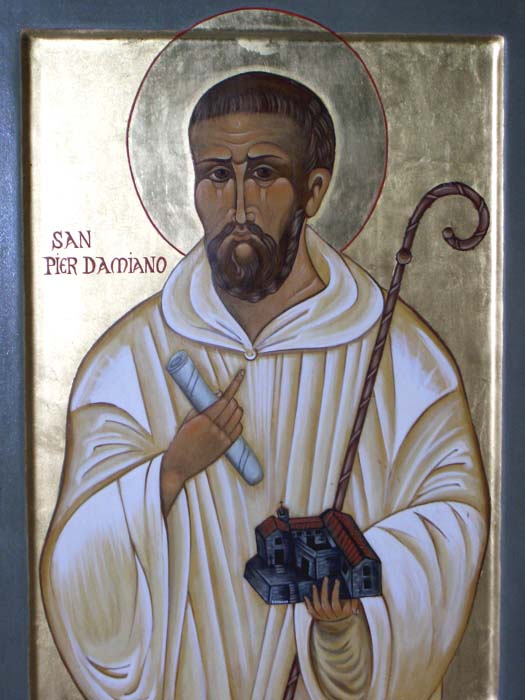
St. Peter Damian (SEP, Doctors of the Catholic Church)
Monastic community of Camaldoli
New Camaldoli Hermitage (Big Sur, CA)
Camaldolese Oblates
Wednesday, March 07, 2007
On St. Clement of Rome
"The Church Has a Sacramental, Not Political Structure"
VATICAN CITY, MARCH 7, 2007 (ZENIT.org).- Here is a translation of Benedict XVI's address at today's general audience. The Pope is beginning a new cycle of catecheses on the Apostolic Fathers, starting with St. Clement of Rome.
* * *
Dear Brothers and Sisters,
During the past few months we have meditated upon the figures of each individual apostle and the first witnesses of the Christian faith, those mentioned in the New Testament writings. Now, we will turn our attention to the Apostolic Fathers, that is, to the first and second generation of the Church after the apostles. This way we can see how the Church's path started in history.
St. Clement, Bishop of Rome during the last years of the first century, is the third successor of Peter, after Linus and Anacletus. The most important testimonial of his life is that written by St. Irenaeus, bishop of Lyon until 202. He asserts that Clement "had seen the apostles … had met with them," and "still had their preaching in his ears, and their tradition before his eyes" (Adv. Haer. 3,3,3). Later testimonials, between the fourth and sixth centuries, give Clement the title of martyr.
This Bishop of Rome's authority and prestige were such that various writings were attributed to him, but the only certain one is the Letter to the Corinthians.
Eusebius of Caesarea, the great "archivist" of Christian origins, presents it with these words: "One letter by Clement has been sent down to us recognized as authentic, great and admirable. It was written by him on behalf of the Church of Rome to the Church of Corinth. … We know that for a long time, and still today, this letter is read publicly during the reunions of the faithful" (Hist. Eccl. 3,16).
An almost canonical characteristic was attributed to this letter. At the beginning of the text, written in Greek, Clement is sorry if "the multiple and calamitous events" (1,1), made for a tardy intervention. These "events" can be identified with the persecution of Domitian; therefore, the date this letter was written goes back to a time directly after the death of the emperor and toward the end of the persecution, that is to say just after 96.
Clement's intervention -- we are still in the first century -- was called upon because of the serious problems the Church of Corinth was undergoing; the priests of the community, in fact, had been deposed by some young upstarts. The painful event is remembered, once again by St. Irenaeus who writes, "Under Clement, having given rise to a rather serious contrast between the Corinthian brothers, the Church of Rome sent the Corinthians a very important letter to reconcile them in peace to renew their faith and to announce the tradition, a tradition they had so newly received from the apostles" (Adv. Haer. 3,3,3).
Therefore, we could say that this letter is a first exercise of a Primate of Rome after the death of St. Peter. Clement's letter touches upon topics dear to St. Paul who had written two great letters to the Corinthians, in particular the theological dialectic, always pertinent, between the indicative of salvation and the imperative of moral commitment.
First, there is the proclamation of saving grace. The Lord foresees us and gives us forgiveness, gives us his love, the grace of being Christians, his brothers and sisters. This is an announcement that fills our life with joy and gives certitude to our actions. The Lord always foresees our acts with his goodness and the goodness of the Lord is always greater than all of our sins.
We must, however, commit ourselves in a coherent way to this gift that we have received and answer the proclamation of salvation with a generous and courageous path toward conversion. Looking at the Pauline model, the novelty is that Clement follows the doctrinal part and the practical part with a "great prayer," which practically concludes the letter.
The immediate occasion of the letter opened to the Bishop of Rome the possibility for vast intervention on the identity of the Church and its mission. If there were abuses in Corinth, Clement notes, the reason should be looked for in the weakening of charity and the necessary Christian virtues. This is why he calls all the faithful to humility and brotherly love, two virtues, truly the basis for being part of the Church. "We are the portion of the Holy One," he says, "let us do all those things which pertain to holiness" (30,1).
In particular, the Bishop of Rome recalls that the Lord himself, "where and by whom he desires these things to be done, he himself has fixed by his own supreme will, in order that all things, being piously done according to his good pleasure, may be acceptable unto him. … For his own peculiar services are assigned to the high priest, and their own proper place is prescribed to the priests and their own special ministrations devolve on the Levites. The layman is bound by the laws that pertain to the laymen" (40,1-5: note that here, in this letter from the end of the first century, for the first time in Christian literature the Greek term "laikós" appears which means "member of the laos," that is "the people of God").
This way, referring to the liturgy of ancient Israel, Clement reveals his ideal of the Church. This is gathered by his "one spirit of grace poured down upon us," which shows through the different members of the Body of Christ, in which all, joined without division are "members one of the other" (46,6-7).
The clear distinction between the "laymen" and the hierarchy does not mean, in any way, a contraposition but only the organic connection of a body, of an organism with different functions. In fact, the Church is not a place for confusion and anarchy, where someone can do whatever he wants at any time; each one in this organism with an articulated structure practices his ministry according to the vocation received.
As pertains to the heads of the communities, Clement specifies clearly the doctrine of apostolic succession. The laws that regulate this derive from God himself in an ultimate analysis. The Father sent Jesus Christ, who in turn sent the apostles. These then sent out the first heads of the communities, and established that they would be followed by worthy men. Therefore, all proceeds in "an orderly way, according to the will of the word of God" (42).
With these words, with these phrases, St. Clement underlines that the Church has a sacramental structure, not a political structure. God's actions that come to us in the liturgy precede our decisions and our ideas. The Church is above all a gift of God and not a creature of ours and therefore this sacramental structure not only guarantees the common order but also the precedence of the gift of God that we all need.
Finally, the "great prayer" confers a cosmic breath to the preceding discussion. Clement praises and thanks God for his great providence of love, who created the world and continued to save it and bless it. Particular relevance is given to the invocation for the governing body. After the New Testament texts, this represents the oldest prayer for political institutions. Thus, on the morrow of the persecution, Christians, well aware that the persecutions would continue, did not cease to pray for those very authorities that had condemned them unjustly.
The motive is above all Christological: One must pray for persecutors, as Jesus did on the cross. But this prayer also contains a teaching that guides, in the course of the centuries, the attitude of Christians in the face of politics and the state.
In praying for the authorities, Clement recognizes the legitimacy of the political institutions in the order established by God. At the same time, he manifests his concern that the authorities be docile to God and "exercise the power that God has given them in peace and gentleness with compassion" (61,2).
Caesar is not all. Another sovereignty emerges, whose origin and essence are not of this world, but "from above": It is that of Truth, which merits the right to be heard also in confrontations with the state."
Thus Clement's letter faces numerous themes of continuous actuality. This is more significant inasmuch as it represents, since the first century, solicitude of the Church of Rome, which presides in charity over all other churches.
With the same spirit we make our invocations as the "great prayer," where the Bishop of Rome becomes the voice for the entire world, "Yea, Lord, make your face to shine upon us for good in peace, that we may be shielded by your mighty hand ... we praise you through the high priest and guardian of our souls, Jesus Christ, through whom be glory and majesty to you both now and from generation to generation and for evermore. Amen" (60-61).
[Translation by ZENIT]
[At the end of the audience, the Pope greeted pilgrims in several languages. In English, he said:]
Dear Brothers and Sisters,
In our catechesis on the early Church, we now turn to the Apostolic Fathers. Saint Clement, Bishop of Rome and third successor of Peter, lived in the last years of the first century. He had met the apostles personally. Clement wrote an important letter to the Church in Corinth at a time when the Christian community was deeply divided. He encourages them to renew their faith in the message received from the apostles and to be reconciled with one another. In this way, he shows the essential connection between the content of the Gospel and the way we live. This connection is essential to Clement's ideal for the Church, in which the hierarchical structure is intrinsically ordered to the service of charity. Laity and hierarchy are not opposed, but organically connected in the mystery of the one body. According to Clement, not only the Church, but also the entire cosmos reflects God's providential love and mercy. Clement concludes his letter by praising God for this marvelous order. Let us join him as we beg the Lord to "make his face shine upon us in goodness and peace. Amen."
I offer a warm welcome to all the English-speaking visitors and pilgrims present at today's audience, especially the groups from Scotland, Denmark, Japan, Canada and the United States of America. May your pilgrimage renew your love for the Lord and his Church, and may God bless you all!
Monday, February 19, 2007
Pope John Paul II's Angelus Message, August 11, 1996
Pope John Paul II's Angelus Message, August 11, 1996.
Eastern Theology Has Enriched the Whole Church
Dear Brothers and Sisters,
1. Continuing my reflection on Eastern Christianity, today I would like to focus attention on the development of Eastern theology, which, even in the centuries that followed the age of the Fathers and the sad division with the Apostolic See, led to profound and stimulating perspectives at which the whole Church looks with interest. Although there is still disagreement on this point or that, we must not forget that what unites us is greater than what divides us.
An important doctrinal development occurred between the eighth and ninth centuries after the "iconoclast" crisis unleashed by several Byzantine emperors, who decided radically to suppress the veneration of sacred images. Many were forced to suffer for resisting this absurd imposition. St John Damascene and St Theodore the Studite come to mind in particular. The victorious outcome of their resistance proved decisive not only for devotion and sacred art, but also for a deeper understanding of the mystery of the Incarnation. Indeed, in the final analysis the defense of images was based on the fact that God truly became man in Jesus of Nazareth. It is therefore legitimate for the artist to endeavour to portray his face, not only with the aid of his talent, but especially by interior docility to God's Spirit. The images refer to the Mystery that surpasses them, and they help us feel its presence in our life.
2. The hesychast controversy marked another distinctive moment in Eastern theology. In the East, hesychasm means a method of prayer characterized by a deep tranquillity of the spirit, which is engaged in constant contemplation of God by invoking the name of Jesus. There was no lack of tension with the Catholic viewpoint on certain aspects of this practice. However, we should acknowledge the good intentions which guided the defense of this spiritual method, that is, to emphasize the concrete possibility that man is given to unite himself with the Triune God in the intimacy of his heart, in that deep union of grace which Eastern theology likes to describe with the particularly powerful term of "theosis", "divinization".
Precisely in this regard Eastern spirituality has amassed a very rich experience which was vigorously presented in the famous collection of texts significantly entitled Philokalia (love of beauty") and gathered by Nicodemus the Hagiorite at the end of the 18th century. Down the centuries until our day, Eastern theological reflection has undergone interesting developments, not only in the classical areas of the Byzantine and Russian tradition, but also in the Orthodox communities scattered throughout the world. One need only recall, among the many studies worthy of mention, the Theology of Beauty elaborated by Pavel Nikolaievich Evdokimov, which is based on the Eastern art of the icon, and the study of the doctrine of "divinization" by the Orthodox scholar, Loth Borovine.
How many things we have in common! It is time for Catholics and Orthodox to make an extra effort to understand each other better and to recognize with the renewed wonder of brotherhood what the Spirit is accomplishing in their respective traditions towards a new Christian springtime.
3. Let us ask Mary, Mother of Wisdom, to teach us to recognize promptly the infinite expressions of God's presence in the history of mankind. May she help us to concentrate on the positive rather than the negative, and to use all the creativity of mutual understanding for engaging in fruitful dialogue, even on points where differences remain. For this reason, may the Holy Spirit grant us the wisdom of heart so dear to Eastern spirituality and essential to any genuinely Christian experience.
I am pleased to welcome all the English-speaking visitors who have joined us for this Angelus prayer. May these summer holidays be a time of relaxation and spiritual renewal for you and your families.
Today, as we remember St Clare of Assisi, my thoughts turn to the Poor Clares and to all cloistered nuns. I express to them the loftiest esteem which the Christian community has for this kind of life, "a sign of the exclusive union of the Church as Bride with her Lord, whom she loves above all things" (Apostolic Exhortation Vita consecrata, n. 59). By offering themselves to Jesus for the world's salvation, they represent "a joyful proclamation and prophetic anticipation of the possibility offered to every person and to the whole of humanity to live solely for God in Christ Jesus" (ibid.). They therefore deserve my gratitude and that of the whole Church, and an encouragement to persevere faithfully in the cloistered life according to their specific charism.
Wednesday, February 14, 2007
Women of the Early Church
Women of the Early Church
"The Feminine Presence Was in No Way Secondary"
VATICAN CITY, FEB. 14, 2007 (Zenit.org).- Here is a translation of the address Benedict XVI delivered at today's general audience. The Pope dedicated his talk to women who spread the Gospel in the early Church.
* * *
Dear Brothers and Sisters:
We come today to the end of the journey among the witnesses of early Christianity, mentioned in the writings of the New Testament. And we take advantage of the last stage of this first journey to focus our attention on the many feminine figures who played an effective and precious role in spreading the Gospel.
Their testimony cannot be forgotten, in keeping with what Jesus himself said about the woman who anointed his head shortly before his passion: "Truly I say to you, wherever this Gospel is preached in the whole world, what she has done will be told in memory of her" (Matthew 26:13; Mark 14:9).
The Lord wants these witnesses of the Gospel, these figures who have made their contribution so that faith in him would grow, to be known and their memory to remain alive in the Church. Historically we can distinguish the role of women in primitive Christianity, during Jesus' earthly life and during the vicissitudes of the first Christian generation.
Of course, as we know, Jesus chose 12 men among his disciples as fathers of the new Israel "to be with him, and to be sent out to preach" (Mark 3:14-15). This fact is obvious but, in addition to the Twelve, pillars of the Church, fathers of the new People of God, many women were also chosen and numbered among the disciples.
I can only mention briefly those who found themselves on the path of Jesus himself, beginning with the prophetess Anna (cf. Luke 2:36-38), coming then to the Samaritan woman (cf. John 4:1-39), the Syrophoenician woman (cf. Mark 7:24-30), the woman with the hemorrhage (cf. Matthew 9:20-22) and the forgiven woman sinner (cf. Luke 7:36-50).
Nor will I consider the protagonists of some of his effective parables, for example, the woman who makes the bread (Matthew 13:33), the woman who loses the silver coin (Luke 15:8-10), or the vexing widow before the judge (Luke 18:1-8).
More significant for our discussion are the women who played an active role in the context of Jesus' mission. Above all, our thoughts go naturally to the Virgin Mary, who with her faith and maternal endeavor collaborated in a unique way in our redemption, to the point that Elizabeth was able to call her "blessed among women" (Luke 1:42), adding: "Blessed is she who believed" (Luke 1:45).
Becoming a disciple of Christ, Mary manifested at Cana her complete trust in him (cf. John 2:5) and followed him to the foot of the cross, where she received a maternal mission from him for all his disciples of all times, represented by John (cf. John 19:25-27).
There are, moreover, several women who in different ways gravitated around the figure of Jesus with functions of responsibility. The women who followed Jesus to serve him with their properties are an eloquent example of this. Luke gives us some names: Mary of Magdala, Joanna, Susanna "and many others" (cf. Luke 8:2-3). Later, the Gospels tell us that the women, unlike the Twelve, did not abandon Jesus in the hour of his passion (cf. Matthew 27:56.61; Mark 15:40).
Outstanding among these women, in particular, is the Magdalene, who not only was present at the Passion, but also became the first witness and herald of the Risen One (cf. John 20:1,11-18). To Mary of Magdala, in fact, St. Thomas Aquinas dedicates the singular description "apostle of the apostles" ("apostolorum apostola"), dedicating a beautiful commentary to her: "Just as a woman had announced to the first man the words of death, so also a woman was the first to announce to the apostles the words of life" ("Super Ioannem," CAI publishers, Paragraph 2519).
Moreover, in the ambit of the early Church the feminine presence was in no way secondary. This is the case of the four daughters of "deacon" Philip, whose names are not mentioned, residents in Caesarea, all of them gifted, as St. Luke says, with the "gift of prophecy," that is, of the faculty to speak publicly under the action of the Holy Spirit (cf. Acts 21:9). The brevity of the news does not allow for more precise deductions.
We owe to St. Paul a more ample documentation on woman's dignity and ecclesial role. He begins with the fundamental principle, according to which, for the baptized "there is neither Jew nor Greek, there is neither slave nor free, there is neither male nor female; for you are all one in Christ Jesus" (Galatians 3:28), that is, all united in the same nature, though each one with specific functions (cf. 1 Corinthians 12:27-30).
The Apostle admits as something normal that woman can "prophesy" in the Christian community (1 Corinthians 11:5), that is, pronounce herself openly under the influence of the Holy Spirit, on the condition that it is for the edification of the community and in a dignified manner. Therefore, the famous exhortation "the women should keep silence in the churches" must be relativized (1 Corinthians 14:34).
The much-discussed problem on the relationship between the first phrase -- women can prophesy in church -- and the other -- they cannot speak -- that is, the relationship between these two indications which are seemingly contradictory, we leave for the exegetes.
It is not something that must be discussed here. Last Wednesday we already met with Prisca, or Priscilla, wife of Aquila, who in two cases is mentioned surprisingly before her husband (cf. Acts 18:18; Romans 16:3): Both are described explicitly by Paul as his "sun-ergous," or collaborators (Romans 16:3).
There are other observations that must not be neglected. It is necessary to state, for example, that the brief Letter to Philemon is addressed by Paul also to a woman called "Apphia" (cf. Philemon 2). Latin and Syrian translations of the Greek text add to the name "Apphia" the description "soror carissima" (ibid.), and it must be said that in the community of Colossae they must have had an important role. In any case, she is the only woman mentioned by Paul among the recipients of one of his letters.
In other passages, the Apostle mentions a certain Phoebe whom he calls "diakonos" of the church of Cenchreae, the small port city east of Corinth (cf. Romans 16:1-2). Although at that time the title still did not have a specific ministerial value of a hierarchical character, it expresses a genuine exercise of responsibility on the part of this woman in favor of that Christian community.
Paul requests that she be received cordially and "help her in whatever she may require," and then adds: "For she has been a benefactor to many and to me as well." In the same epistolary context, the Apostle, with delicate lines recalls other names of women: a certain Mary, and then Tryphaena, Tryphosa and Persis, "beloved," as well as Julia, of whom he writes openly that they "have worked hard for you" or "have worked hard in the Lord" (Romans 16:6,12a,12b,15), thus underlining their intense ecclesial commitment.
Moreover, two women, called Euodia and Syntyche, are distinguished in the church of Philippi (Philippians 4:2): Paul's appeal to mutual agreement suggests that the two women carried out an important function within that community.
In sum, the history of Christianity would have developed very differently if the generous contribution of many women had not taken place. For this reason, as my venerated and beloved predecessor, John Paul II, wrote in the apostolic letter "Mulieris Dignitatem": "Therefore, the Church gives thanks for each and every woman. ... The Church gives thanks for all the manifestations of the feminine 'genius' which have appeared in the course of history, in the midst of all peoples and nations; she gives thanks for all the charisms which the Holy Spirit distributes to women in the history of the People of God, for all the victories which she owes to their faith, hope and charity: She gives thanks for all the fruits of feminine holiness" (No. 31).
As we see, the praise refers to women in the course of the history of the Church and is expressed in the name of the whole ecclesial community. We also join ourselves to this appreciation, giving thanks to the Lord because he leads his Church, from generation to generation, making use indistinctly of men and women, who are able to make their faith and baptism fruitful for the good of the whole ecclesial Body for the greater glory of God.
[Translation by ZENIT]
[At the end of the audience, the Pope greeted pilgrims in several languages. In English, he said:]
Dear Brothers and Sisters,
Today, as we near the end of our reflections on the earliest Christian witnesses in the New Testament, we turn our attention to the women who played an important role in spreading the Good News. Above all, we remember the Virgin Mary, who cooperated in a unique way in our Redemption. As a faithful disciple of her Son, Mary manifested her complete trust in him at Cana. She received a special mission from him at the foot of the Cross to be the mother of all disciples. Others who assisted our Lord were Mary Magdalene -- the first to announce his Resurrection -- as well as Joanna, Susanna, and the sisters Mary and Martha. Saint Paul writes that in the early Church, it was normal for a woman to prophesy under the influence of the Holy Spirit (cf. 1 Corinthians 11:5). In his Letter to the Romans, Paul refers to Phoebe as diakonos, showing that she had a unique responsibility in the early Christian community. Indeed, the history of Christianity would have developed much differently if it were not for the generous contribution made by so many women. Today, let us give thanks to God who, through Baptism, continues to use the gifts of both men and women for the good of the entire Church.
I am pleased to welcome the many English-speaking pilgrims present, especially those from England, Bosnia-Herzegovina, Japan, and the United States of America. My special greetings go to the members of the National Catholic Committee on Scouting from the United States, to the representatives of the John Carroll Society from Washington, D.C., and to the students and faculty of the Ecumenical Institute of Bossey, Switzerland. Upon all of you I invoke God's blessings of peace and joy.
© Copyright 2007 -- Libreria Editrice Vaticana
Wednesday, February 07, 2007
On Aquila and Priscilla
On Aquila and Priscilla
"Every House Can Be Transformed Into a Small Church"
VATICAN CITY, FEB. 7, 2007 (Zenit.org).- Here is a translation of Benedict XVI's address at today's general audience. The Pope spoke about Aquila and Priscilla, a married couple active in the early Church.
* * *
Dear Brothers and Sisters,
Taking a step forward in this kind of portrait gallery of the witnesses to Christian faith that we started a few weeks ago, today we consider a married couple. The couple in question are Priscilla and Aquila, who have their place among the circle of numerous collaborators drawn to the apostle Paul, and whom I already briefly mentioned last Wednesday. Based on the information we have, this married couple developed a very active role at the time of the post-paschal origins of the Church.
The names of Aquila and Priscilla are Latin, but the man and woman who bear them were of Jewish origin. However, Aquila, at least, came geographically from the Diaspora of northern Anatolia, which overlooks the Black Sea, in what is now Turkey; while Priscilla, whose name is sometimes abbreviated to Prisca, was probably a Jew originating from Rome (cf. Acts 18:2).
In any case, it is from Rome that they arrive at Corinth, where Paul met them at the beginning of the 50s; there he became associated with them, since, as Luke tells us, they also practiced Paul's trade of tentmakers for domestic use, and he was even welcomed into their home (cf. Acts 18:3).
The reason for their coming to Corinth was the decision of Emperor Claudius to expel from Rome the Jews living in the city. The Roman historian Suetonius tells us that he expelled the Jews because "they were rioting on account of someone named Chrestus" (cf. "The Lives of the Twelve Caesars, Claudius," 25).
One can see that he did not know the name well -- instead of Christ he writes "Chrestus" -- and that he only had a very confused idea about what had happened. In any case, there were disagreements within the Jewish community about the issue of whether Jesus was the Christ. And these problems were the reason the emperor simply expelled all Jews from Rome.
One can deduce from this that the couple had already embraced the Christian faith in Rome during the 40s, and had now found in Paul someone who not only shared with them this faith, that Jesus is the Christ, but who was also an apostle, personally called by the Risen Lord. Therefore, their first encounter is in Corinth, where they welcome him into their home and they work together making tents.
In a second moment, they move to Ephesus, in Asia Minor. There they played a decisive role in completing the formation of the Alexandrian Jew, Apollo, of whom we spoke last Wednesday. Since he only had a superficial knowledge of the Christian faith, "Priscilla and Aquila heard him, then took him aside and explained to him the way of God more accurately" (Acts 18:26).
When the apostle Paul writes his First Letter to the Corinthians from Ephesus, together with his characteristic greetings, he explicitly mentions "Aquila and Prisca, together with the church at their house" (1 Corinthians 16:19).
In this way we come to know the hugely important role this couple played in the sphere of the primitive Church: that of welcoming in their own home the group of local Christians when they got together to listen to the Word of God and to celebrate the Eucharist.
It is precisely that type of gathering that in Greek is called "ekklesìa" -- the Latin word is "ecclesia" -- the Italian "chiesa" -- that means assembly, gathering. So, in the house of Aquila and Priscilla, the Church gets together, the Church summoned by Christ, which celebrates here the Sacred Mysteries.
In this way we can see the very birth of the reality of the Church in the homes of the believers. Christians, in fact, until around the third century, did not have their own places of worship: At first, they gathered in Jewish synagogues, until the original symbiosis between the Old and New Testament was dissolved and the Church of the people was forced to give itself its own identity, always deeply rooted in the Old Testament.
Then, after this "split," they gather in the homes of Christians, which in this way become "Church." And finally, in the third century, authentic buildings for Christian worship were born.
But here, in the first half of the first century as in the second century, Christian houses become true and proper "church." As I have said, they read Scripture together and celebrated the Eucharist. That was what used to happen, for example, in Corinth, where Paul mentions a certain "Gaius, who is host to me and to the whole church" (Romans 16:23), or in Laodicea, where the community would get together in the house of a certain Nympha (Colossians 4:15), or in Colossae, where the gathering would take place in the house of a certain Archippus (cf. Philemon 2).
Having subsequently returned to Rome, Aquila and Priscilla continue to develop that most precious function in the capital of the empire as well. Paul, in fact, writing to the Romans, sends this precise greeting: "Greet Prisca and Aquila, my co-workers in Christ Jesus, who risked their necks for my life, to whom not only I am grateful but also all the churches of the Gentiles; greet also the church at their house" (Romans 16:3-5).
What extraordinary praise is found in these words! And it is the apostle Paul, no less, who offers it! He explicitly recognizes in them two true and important collaborators of his apostolate.
The reference to their having risked their lives for him is probably linked to an intervention in his favor during an imprisonment of his, perhaps in Ephesus itself (cf. Acts 19:23; 1 Corinthians 15:32; 2 Corinthians 1:8-9).
And that Paul should associate all the Churches of the Gentiles with his own gratitude, although the statement may seem to be hyperbole, allows us, in any case, to intuit how great their range of action and their influence for the good of the Gospel was.
Later hagiographic tradition has conferred singular importance on Priscilla, even if the problem remains of her identification with another Priscilla who was a martyr. In any case, here in Rome we have both a church dedicated to St. Prisca on the Aventine, and the Catacombs of Priscilla on Via Salaria.
In this way, the memory of a woman who has surely been an active person of great value in the history of Roman Christianity is perpetuated. One thing is certain: Together with the gratitude of those first Churches, of which Paul speaks, our own must be added, since due to the faith and apostolic commitment of faithful lay people, of families, of married couples such as Priscilla and Aquila, Christianity has reached our generation.
It was not only able to grow thanks to the apostles who announced it. In order to take root in peoples' land, in order to develop in a living way, it was necessary that there be the commitment of these families, of these couples, of these Christian communities, of faithful lay people who offered "humus" to the growth of faith.
And it is always in this way that the Church grows. In particular, this couple proves just how important the action of Christian spouses is. When these are supported by faith and a strong spirituality, their courageous commitment to and in the Church becomes natural.
Their daily community of life is prolonged and somehow sublimated in the taking on of a public responsibility for the good of the Body of Christ, even if just a small part of it. This is how it was in the first generation and this is how it will often be.
One further lesson we cannot neglect to take from their example: Every house can be transformed into a small church. Not only in the sense that, therein, Christian love, typically made of altruism and mutual care, should reign, but even more in the sense that the whole of family life, founded on faith, is called to revolve around the sole lordship of Jesus Christ.
Not by chance, in the Letter to the Ephesians, Paul compares the relationship of matrimony to the spousal communion between Christ and the Church (Ephesians 5:25-33). Even more, we can maintain that the Apostle shapes the life of the whole Church on that of the family. And the Church, in reality, is the family of God.
For this reason we honor Aquila and Priscilla as models of conjugal life, responsibly committed to the service of the entire Christian community. And we find in them the model of the Church, family of God for all times.
[Translation by ZENIT]
[At the end of the audience, the Pope greeted the pilgrims in various languages. In English, he said:]
Dear Brothers and Sisters,
In today's catechesis, we consider a married couple, Priscilla and Aquila, who played an active part in the early Church, and particularly in the ministry of Saint Paul. The Apostle first met them in exile in Corinth, and then again in Ephesus and finally in Rome. At Ephesus, they instructed Apollos in the faith and in every city they opened their home to the local Christian community for worship. Paul praises them in his Letter to the Romans as his "fellow workers in Christ Jesus, who risked their necks for my life, to whom not only I, but also all the churches of the Gentiles give thanks" (Rom 16:3-4). This remarkable tribute bespeaks their great influence in the apostolic Church and reminds us that we ourselves have received the faith through the witness of countless committed Christians like them. Priscilla and Aquila show us the important role played by married couples in the life of the Church. Every home is called to become a "domestic church" in which family life is completely centered on the lordship of Christ and the love of husband and wife mirrors the mystery of Christ's love for the Church, his Bride (cf. Eph 5:25-33).
I extend a cordial welcome to the English-speaking pilgrims present at today's Audience, especially those from England, Ireland, China, and the United States of America. May your visit to Rome inspire you to live the truth of the Gospel ever more fully. Upon all of you I invoke God's blessings of joy and peace.
© Copyright 2007 -- Libreria Editrice Vaticana
Subscribe to:
Posts (Atom)